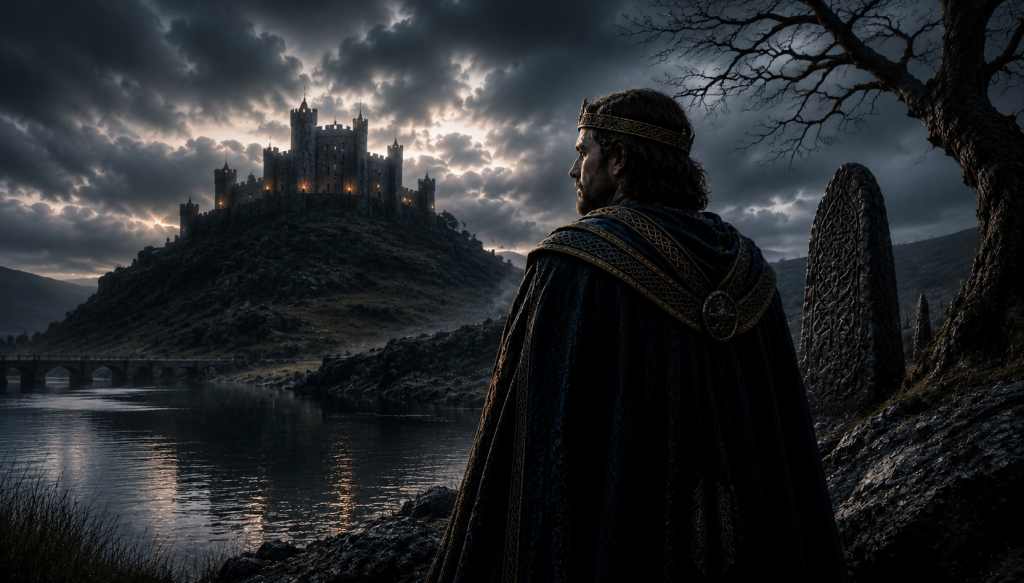
Arthur in Welsh mythology is not the Arthur most people know. He is not the courtly king presiding over a Round Table of noble knights, not the sovereign of a kingdom called Camelot, not the figure who sends Lancelot on quests and presides over the tragedy of Guinevere. That Arthur was largely invented by Geoffrey of Monmouth in 1138, elaborated by the French romanciers in the twelfth and thirteenth centuries, and fixed in the English imagination by Thomas Malory in the fifteenth. It is a magnificent invention, but it is an invention.
The Arthur of Welsh tradition is older, stranger, and considerably wilder. He is a warrior of superhuman ability who leads a band of exceptional individuals. He fights monsters and giants. He raids the Otherworld. He appears in Welsh poetry that predates Geoffrey of Monmouth by centuries, already famous, already legendary, the context of his fame assumed rather than explained. He is present in the Welsh landscape in a way that the later courtly Arthur is not: hills are named for his battles, stones bear marks attributed to his horse, caves in various parts of Wales are said to contain him and his warriors, sleeping until Britain needs them.
The Earliest References
The earliest references to Arthur in Welsh poetry are tantalizingly brief. The poem Y Gododdin, composed in the late sixth or early seventh century and preserved in a thirteenth century manuscript, contains a single line comparing a warrior’s prowess to Arthur’s, already treating him as the benchmark of military excellence. The Marvels of Britain in the Historia Brittonum, compiled around 830 CE, lists twelve battles Arthur fought across Britain as a war leader, battles that the text attributes to him without explaining who he was or where he came from, again assuming the audience already knows.
These references establish that Arthur was a figure of established legendary fame in Welsh tradition by at least the ninth century, probably considerably earlier. What they do not establish is whether that fame derived from a historical person, a mythological figure, or a conflation of both. Scholars have argued all three positions across two centuries of Arthurian scholarship without reaching consensus, and the honest position is that the question remains genuinely open.
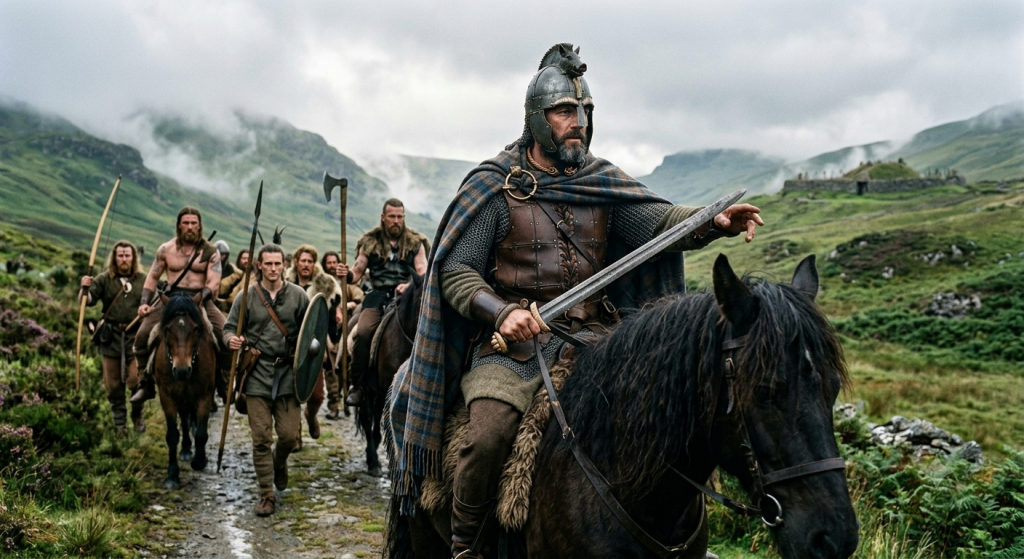
What is not open is how different the Welsh Arthur is from the Arthur of the later continental tradition. In Culhwch and Olwen, which is the fullest and earliest narrative depiction of Arthur in any language, he is a king of Britain but not a ceremonial or courtly one. He hunts. He fights directly. He makes decisions based on personal loyalty and generosity rather than abstract codes of chivalry. His warband has supernatural abilities but no heraldic identities. His court at Celliwig in Cornwall has no architectural grandeur associated with it. He is, in the most precise sense, a chief among warriors rather than a king among knights.
The Raid on Annwn
One of the most extraordinary early Welsh poems about Arthur is Preiddeu Annwfn, the Spoils of Annwn, found in the Book of Taliesin and attributed to the legendary poet Taliesin. It describes Arthur leading a raid on the Welsh Otherworld, Annwn, to seize a magical cauldron. The raid is catastrophic: of the three boatloads of warriors who set out, only seven return. The poem is deliberately obscure, cycling through different names for the Otherworld’s fortresses, each visited in turn as the raid progresses, the imagery becoming more dreamlike with each stanza.
The cauldron they seek will not boil the food of a coward. It is rimmed with pearls and kindled by the breath of nine maidens. It is clearly related to the cauldron tradition that runs through Celtic mythology generally, connecting Arthur’s raid to the broader tradition of the divine cauldron of plenty and rebirth. The raid itself connects Arthur to the tradition of Otherworld journeys that figures like Pwyll and Bran undertake in the Four Branches.
This Arthur is not going to rescue a captive queen or establish the rule of law. He is raiding the Otherworld for a magical object and losing most of his men in the process. The raid is not described as a success or a failure in any clear moral sense. It is simply what happened, recorded in a poem that assumes familiarity with a tradition now largely lost.
Arthur in the Welsh Triads
The Welsh Triads, a collection of grouped threes used as a mnemonic device for storing traditional lore, contain many references to Arthur that collectively give a picture of his importance in Welsh tradition without providing extended narratives. He appears as one of the Three Generous Men of Britain, one of the Three Frivolous Bards, the owner of one of the Three Powerful Swineherds, and in connection with events and figures that are sometimes unknown from any other source.
The Triads also preserve references to Arthurian figures and events that did not make it into the Mabinogion or the later continental tradition: characters like Gwenhwyfar, who in Welsh tradition is not one queen but possibly three, all named Gwenhwyfar and all associated with Arthur in different ways. The richness of the Triadic material suggests that the Welsh Arthurian tradition was considerably larger than what survives in extended narrative form.
The Sleeping Arthur
The tradition of Arthur sleeping in a cave or hollow hill, waiting to return when Britain faces its greatest need, is one of the most widely distributed and most persistent legends in the Welsh and broader British tradition. Caves in Wales, Scotland, and England have all been identified as his resting place at various points in local tradition. Craig y Ddinas in the Neath Valley, Alderley Edge in Cheshire, Sewingshields in Northumberland: the sleeping Arthur is everywhere and nowhere, present in the landscape as a potential rather than an absence.
This tradition transforms Arthur from a historical or mythological figure into something more like a national spirit, a presence coiled in the landscape, not dead but not yet needed. It is the most enduring thing about the Welsh Arthur, the image that has survived every transformation of the tradition from the earliest poems to the present, and it is entirely absent from the continental romances. Malory’s Arthur dies. The Welsh Arthur sleeps.
What the Welsh Arthur Tells Us
The Welsh Arthur is important not simply as an earlier version of a familiar figure but because he represents a different understanding of what heroic leadership means. The courtly Arthur of the later tradition is a judge and an administrator of chivalric values, a king whose greatness lies in the quality of the court he gathers around him rather than in his own deeds. The Welsh Arthur acts. He hunts the Twrch Trwyth personally. He raids Annwn. He makes personal judgments about who deserves his help and goes to help them.
This is a more archaic model of kingship, one where the leader’s personal excellence is the source of the community’s strength rather than the institutional framework he presides over. It is the model that appears in Beowulf, in the Iliad, in the Ulster Cycle, in every early heroic tradition: the community is as strong as its best fighter, and the best fighter leads. The Round Table model of the later tradition replaces this with something more institutional, more distributed, more medieval in its understanding of how power works.
Both are fascinating. But the Welsh Arthur, older and wilder and embedded in a specific landscape, is the one that tells you something about what the people who first told these stories believed heroism actually looked like.
Further Reading
If this article sparked your interest, these are the books worth reading next.
The Mabinogion
The foundational collection of Welsh mythology — the primary source for the Arthurian tradition, the four branches of Welsh legend, and the stories that sit at the heart of the Celtic world.
Celtic Myths and Legends
by Peter Berresford Ellis — the best single-volume introduction to the full range of Celtic mythology, covering Irish, Welsh, Scottish, Gaulish, and Breton traditions properly.
The Táin: Translated from the Old Irish Epic Táin Bó Cúailnge
The great Irish epic — Cu Chulainn, Queen Medb, and the Cattle Raid of Cooley. The closest thing the Celtic world produced to the Iliad, and considerably stranger.
For more on the Welsh mythology tradition, the Culhwch and Olwen article covers the earliest Arthurian narrative in any language and the thirty-nine impossible tasks. The Mabinogion article covers the full collection of Welsh mythology texts. The Wales category has every article in the Welsh mythology and folklore cluster.
Never miss a myth
Thank you for being here. The site is brand new and every subscriber genuinely means something to me. If you're here, you care about this stuff as much as I do - and that's all the reason I need to keep going. New stories, videos and dark folklore from around the world, straight to your inbox. No algorithm. Just the stories, when they're ready.