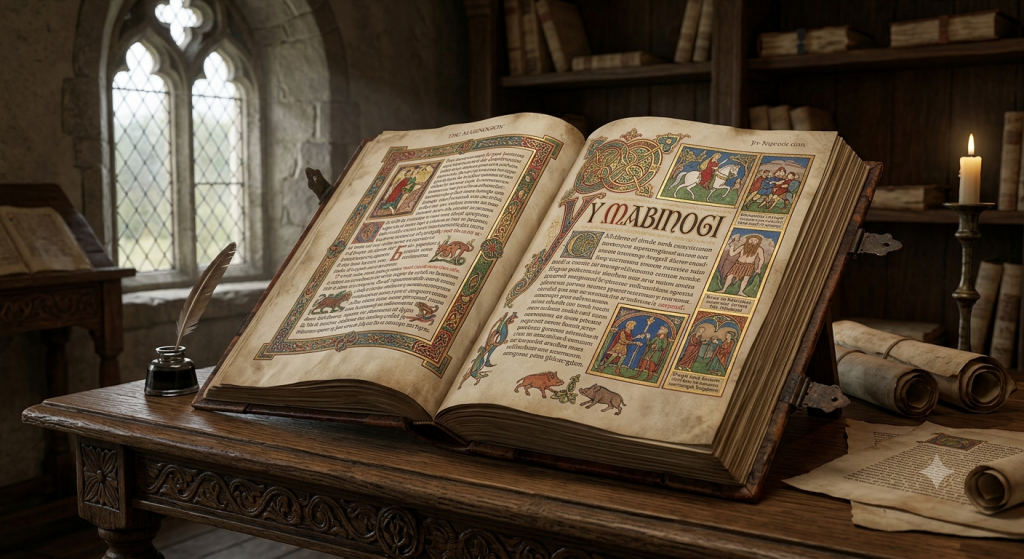
The Mabinogion is not a single text. It is a collection of eleven medieval Welsh tales, drawn from two manuscript sources, the White Book of Rhydderch compiled around 1350 and the Red Book of Hergest compiled around 1400, though the material they contain is considerably older than either manuscript. The name Mabinogion was applied to the collection by Lady Charlotte Guest, the Welsh scholar who produced the first English translation between 1838 and 1845, and it has stuck, though scholars have debated ever since what the word actually means: probably something like tales for young bards, or tales of youth, derived from the Welsh mab meaning son or youth.
The eleven tales are not uniform in character or origin. Four of them, the Four Branches of the Mabinogi, form a coherent mythological cycle dealing with the divine figures of Welsh tradition: Pwyll, Branwen, Manawydan, and Math. The remaining seven include Arthurian romances, a native Welsh Arthurian tale predating the continental tradition considerably, and tales that draw on a range of mythological and legendary traditions. What unites them is the manuscript tradition and the Welsh language, and the extraordinary vividness of the storytelling throughout.
The Four Branches
The Four Branches of the Mabinogi are the mythological heart of the collection and the texts most directly relevant to Welsh mythology as a tradition with its own theology and its own divine figures. They are connected to each other through recurring characters and through a shared cosmological world, though they do not form a single linear narrative.
The First Branch follows Pwyll, Prince of Dyfed, who exchanges places with Arawn, king of Annwn the Welsh Otherworld, for a year, and whose subsequent marriage to Rhiannon and the strange circumstances surrounding the birth of their son Pryderi establish the family whose story runs through all four branches.
The Second Branch is the story of Branwen, Daughter of Llŷr, whose marriage to the king of Ireland and the catastrophic war that results from her maltreatment there is one of the most devastating narratives in all of medieval Welsh literature. Only seven men return from Ireland alive, including the giant Brân whose severed head continues to speak and provide companionship for seven years after his death.
The Third Branch follows the devastation of Dyfed, the landscape emptied of all people and animals except for Pryderi and his mother Rhiannon and Manawydan, and the slow process of understanding and undoing what has been done to them.
The Fourth Branch is the strangest and most mythologically dense of the four: the story of Math son of Mathonwy, his nephew Gwydion, the curse placed on Gwydion’s brother Gilfaethwy, and the extraordinary sequence of events surrounding Arianrhod and her son Lleu Llaw Gyffes, who is made by magic from flowers and whose fate is bound by three impossible conditions his mother places on him.
The Welsh Divine Figures
The Four Branches preserve a Welsh mythological tradition that is related to but distinct from the Irish tradition, and whose divine figures are recognisably connected to figures in other branches of Celtic mythology while being specifically Welsh in their character and their stories.
Rhiannon is the most discussed figure in Welsh mythology scholarship, a woman who arrives on a horse that cannot be caught, who is falsely accused of infanticide and forced to carry visitors on her back like a horse as penance, and who is eventually cleared when her son is returned. Her name may derive from Rigantona, the Great Queen, connecting her to the sovereignty goddess tradition that runs through Celtic mythology. Her horse associations, her unjust suffering, and her eventual vindication are among the most analysed elements in the Four Branches.
Brân the Blessed, king of Britain in the Second Branch, is a giant whose size is such that no house can hold him, who carries his army to Ireland on his back when no boat is large enough, and whose severed head continues to speak and provide companionship for seven years after his death. The cauldron of rebirth he gives to the Irish king at the beginning of the Second Branch, which can restore the dead to life but leaves them without the power of speech, is one of the most significant objects in Welsh mythology and one of the most discussed in relation to the broader Celtic cauldron tradition.
Gwydion in the Fourth Branch is a magician and trickster of extraordinary power who creates a woman of flowers, transforms his brother and himself into animals as punishment for a crime, and navigates the impossibly complicated fate he has helped bring about for his nephew Lleu. He is one of the most vividly characterised figures in the entire collection.
The Arthurian Tales
Three of the eleven tales, Owain, Peredur, and Geraint, are Welsh versions of Arthurian romances that also appear in the French tradition of Chrétien de Troyes, and the relationship between the Welsh and French versions has been extensively debated. Whether the Welsh tales derive from the French or whether both derive from a shared earlier source is a question scholarship has not definitively resolved.
The native Welsh Arthurian tale Culhwch and Olwen is a different matter entirely: this is the earliest Arthurian narrative in any language, predating Geoffrey of Monmouth and the continental tradition significantly, and it shows Arthur in a form that is almost unrecognisable to readers familiar with the later tradition. He is a warrior chieftain, not a courtly king. He leads a warband of extraordinary individuals with supernatural abilities. The quest at the centre of the tale, thirty-nine impossible tasks required to win the hand of the giant Ysbaddaden’s daughter Olwen, has the character of the most archaic folk tale material: demanding, specific, and operating by a logic of its own.
Why the Mabinogion Matters
The Mabinogion matters for several reasons that go beyond its literary quality, though that quality is considerable. It is the primary surviving repository of Welsh mythology and the only substantial source for the Welsh divine tradition in narrative form. Without it, Welsh mythology would be largely inferrable only from fragments, glosses, and comparative study of related Celtic traditions. The Four Branches in particular give Welsh mythology a textual density and a narrative richness that allows genuine engagement with the tradition rather than mere reconstruction of it.
It also matters because it preserves traditions that are considerably older than the manuscripts that contain them. The Four Branches draw on material from the pre-Christian Welsh tradition, preserved by medieval storytellers and scribes who were themselves Christian but who recognised the value and the vitality of what they were recording. The process of preservation is similar to what happened with Irish mythology in texts like the Lebor Gabála Érenn: Christian monks writing down pre-Christian tradition, reshaping it to fit the framework they worked within but not destroying it.
Further Reading
If this article sparked your interest, these are the books worth reading next.
The Mabinogion
The foundational collection of Welsh mythology — the primary source for the Arthurian tradition, the four branches of Welsh legend, and the stories that sit at the heart of the Celtic world.
Celtic Myths and Legends
by Peter Berresford Ellis — the best single-volume introduction to the full range of Celtic mythology, covering Irish, Welsh, Scottish, Gaulish, and Breton traditions properly.
The Táin: Translated from the Old Irish Epic Táin Bó Cúailnge
The great Irish epic — Cu Chulainn, Queen Medb, and the Cattle Raid of Cooley. The closest thing the Celtic world produced to the Iliad, and considerably stranger.
For more on the Welsh mythology tradition, the Branwen article covers the Second Branch in full, one of the most devastating stories in medieval Welsh literature. The Arianrhod and Lleu article covers the strangest and most mythologically dense of the Four Branches. The Wales category has every article in the Welsh mythology and folklore cluster.
Never miss a myth
Thank you for being here. The site is brand new and every subscriber genuinely means something to me. If you're here, you care about this stuff as much as I do - and that's all the reason I need to keep going. New stories, videos and dark folklore from around the world, straight to your inbox. No algorithm. Just the stories, when they're ready.