Oisín was the son of Fionn Mac Cumhaill and the greatest poet of the Fianna, the warrior band his father led. He was present at the great hunts and the great battles and the great feasts, and he survived them all, and in his old age he sat with Saint Patrick and told him everything, and the stories he told are preserved in the Irish tradition as the Acallam na Senórach, the Colloquy of the Elders, one of the longest prose texts in medieval Irish literature.
He lived to be old because he had been to Tír na nÓg and come back. He had spent what felt like three years in the land of eternal youth, and when he returned to Ireland he found that three hundred years had passed, and everyone he had known was dead, and the world he belonged to had been replaced by something smaller and colder and more pious, and he was the last of his kind.
The story of Oisín in Tír na nÓg is a story about time and loss and the specific grief of outliving the world you were made for. It is one of the most melancholy stories in Irish mythology and one of the most beautiful.
Niamh of the Golden Hair
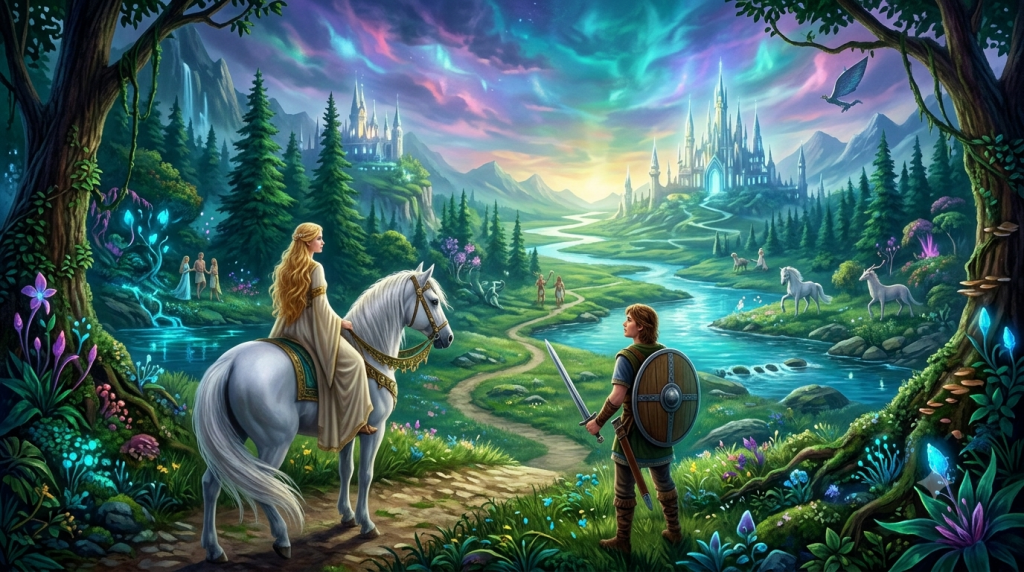
Oisín was hunting with the Fianna near Lough Leane in Kerry when a woman rode out of the sea on a white horse. She was Niamh Chinn Óir, Niamh of the Golden Hair, daughter of the king of Tír na nÓg, and she had come to find Oisín because she had heard of his poetry and his courage and had fallen in love with him from a distance.
She described Tír na nÓg to him: a land where no one grew old, where no one sickened, where the trees were always in fruit and flower simultaneously, where there was music and feasting and every pleasure without any ending. She asked him to come with her.
He agreed. He said goodbye to his father and to his companions and rode away with Niamh across the sea on her white horse, and the horse ran on the surface of the water as if it were solid ground, and the world they rode through was full of wonders: palaces underwater, great deer pursued by white hounds with red ears, a young woman on a white horse carrying a golden apple, a young man on a black horse pursuing her.
The tradition gives these visions without explanation. They are the landscape of the journey to the Otherworld, the images that belong to the threshold between the ordinary world and what lies beyond it, and they are not meant to be explained. They are meant to be seen.
The Three Years That Were Three Hundred
In Tír na nÓg, Oisín lived as Niamh’s husband and as a champion of the land, and he was happy there. But after what seemed to him three years, he began to think of Ireland and of his father and of his companions, and he asked Niamh if he could return to visit.
She agreed, reluctantly, and gave him the white horse to ride. She told him that as long as he did not dismount and did not let his feet touch Irish soil, he could go and come back safely. If he touched the ground, he could never return to Tír na nÓg.
He arrived in Ireland to find it changed. The people were smaller than he remembered. The places he had known were altered or gone. He came to Gleann na Smól, the Glen of the Thrushes, and found men trying to move a great stone that dozens of them could not shift. He leaned from his horse to help them, and the girth of the saddle broke, and he fell, and his feet touched the ground.
In the moment of touching the ground, three hundred years fell on him at once. The white horse fled back to Tír na nÓg. Oisín lay in the glen, ancient and blind, and could not rise.
The Colloquy with Patrick
The men who found Oisín brought him to Saint Patrick, who had arrived in Ireland to convert it to Christianity while Oisín was in Tír na nÓg. The encounter between Oisín and Patrick became the framing device for the vast body of Fenian lore collected in the Acallam na Senórach: Oisín, the last of the old world, telling the stories of the Fianna to a saint of the new world, who wrote them down.
The exchanges between Oisín and Patrick in the tradition are full of a gentle but persistent friction. Oisín describes the Fianna’s feasts and hunts and battles, and Patrick writes them down but reminds Oisín that Fionn and his companions are in hell because they died pagans. Oisín refuses to accept this. He argues for the Fianna’s virtue, their generosity, their courage, their honour. The tradition preserves both voices without resolving the argument, which is characteristic of how Irish Christianity handled the pre-Christian tradition: not suppressing it but placing it in dialogue with the new order, letting the two speak to each other across the gulf of time.
Oisín’s grief in these exchanges is not simply personal. It is the grief of a world that has ended, preserved in the voice of the last person who inhabited it, speaking to someone who represents everything that replaced it. Patrick has what Oisín has lost: a living community, a continuing tradition, a future. Oisín has what Patrick can never have: the direct memory of the Fianna, the first-hand account of what it was like to live in a world that is now only stories.
Tír na nÓg and the Irish Tradition of the Otherworld
Tír na nÓg, the Land of Youth, is one of several names in Irish mythology for the Otherworld, the realm that exists alongside the ordinary world and is accessible through the sea, through the sídhe mounds, through certain lakes and caves. It is called Mag Mell, the Plain of Delight, and Tír Tairngire, the Land of Promise, and Tír fo Thuinn, the Land Under the Wave, and each name emphasises a different aspect of the same place: its pleasure, its distance, its location beneath the surface of the world the living inhabit.
What distinguishes Tír na nÓg from other mythological Otherworlds is the specific nature of its gift: not power or knowledge or treasure, but time. The Otherworld does not age you. The three years Oisín spent there were three hundred years in Ireland, and the three years felt like three years, which means that in Tír na nÓg time passes at its ordinary pace while the world outside accelerates past it. The Otherworld is not timeless. It is running at a different speed from the ordinary world, and anyone who enters it and returns carries the consequences of that difference.
This treatment of the Otherworld as a place with its own temporal logic is one of the most sophisticated ideas in Irish mythology, and the Oisín story is its most fully realised expression. The man who comes back from paradise does not come back unchanged or empowered. He comes back three hundred years out of place, ancient in the moment of touching his home ground, with nothing left but stories and a saint willing to write them down.
Further Reading
If this article sparked your interest, these are the books worth reading next.
The Mabinogion
The foundational collection of Welsh mythology — the primary source for the Arthurian tradition, the four branches of Welsh legend, and the stories that sit at the heart of the Celtic world.
Celtic Myths and Legends
by Peter Berresford Ellis — the best single-volume introduction to the full range of Celtic mythology, covering Irish, Welsh, Scottish, Gaulish, and Breton traditions properly.
The Táin: Translated from the Old Irish Epic Táin Bó Cúailnge
The great Irish epic — Cu Chulainn, Queen Medb, and the Cattle Raid of Cooley. The closest thing the Celtic world produced to the Iliad, and considerably stranger.
For more on the Fenian tradition, the Fionn Mac Cumhaill article covers the father whose world Oisín returns to find vanished. The Salmon of Knowledge article covers how Fionn gained the wisdom that made him the greatest leader in Irish mythology. The Ireland category has every article in the Irish mythology and folklore cluster.
Never miss a myth
Thank you for being here. The site is brand new and every subscriber genuinely means something to me. If you're here, you care about this stuff as much as I do - and that's all the reason I need to keep going. New stories, videos and dark folklore from around the world, straight to your inbox. No algorithm. Just the stories, when they're ready.