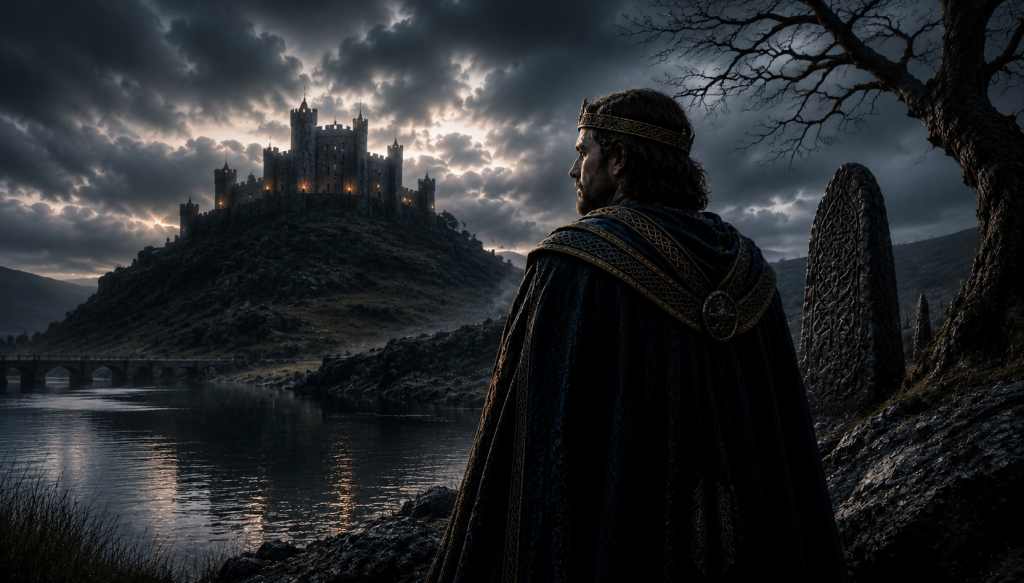
The Fourth Branch of the Mabinogi is the strangest story in Welsh mythology and one of the most mythologically dense texts in the entire Celtic tradition. It involves a woman who cannot become a foot-holder for the king of Gwynedd because she is not a virgin, a son born during the test for virginity who is immediately claimed and named by his uncle through trickery, three impossible conditions placed on that son by his mother, a wife made of flowers who commits adultery and is turned into an owl as punishment, and a man who can only be killed in a circumstance so specific and so contradictory that the only way to achieve it is through elaborate deception.
None of this is simple. The Fourth Branch rewards slow reading and sustained attention, and it has occupied scholars of Welsh mythology for generations without producing settled answers to its central questions. What follows is the story as the text gives it, with the acknowledgment that the story does not explain itself.
Math and the Foot-Holder
Math son of Mathonwy, king of Gwynedd, had a peculiarity: he could only survive during peacetime if his feet rested in the lap of a virgin. He had a foot-holder, Goewin, who held this position. Gilfaethwy, Math’s nephew, fell in love with Goewin and could not approach her because she was always with Math. His brother Gwydion devised a scheme to draw Math away from Goewin by manufacturing a war with the south, and while Math was away fighting, Gilfaethwy assaulted Goewin.
Math returned, discovered what had happened, and punished both brothers by transforming them into animals for three years: first a pair of deer, then a pair of pigs, then a pair of wolves. In each animal form they were opposite sexes, mated with each other, and produced offspring. The punishment is one of the most peculiar in Welsh mythology and has attracted considerable scholarly discussion about what it encodes about gender, sexuality, and the consequences of sexual violence in the tradition.
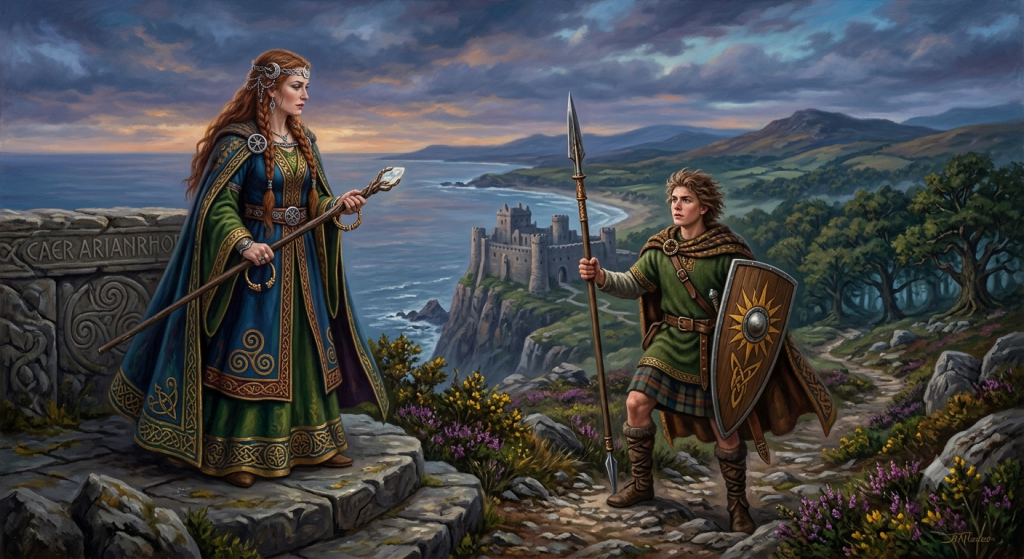
Math then needed a new foot-holder. Gwydion suggested his sister Arianrhod. She was brought before Math and asked if she was a virgin. She said she was. Math tested her by asking her to step over his magic wand. As she stepped over it, she dropped two things: a boy with golden hair who ran immediately to the sea, and something smaller that Gwydion snatched up and hid before anyone else could see it properly.
The Three Conditions
Arianrhod was furious at the public exposure of her status. She placed three conditions on the boy child, who was now Gwydion’s ward: he would have no name unless she gave him one, he would have no arms unless she armed him, and he would have no wife of the race that is now on this earth.
Each condition was meant to be impossible to fulfil, because she had no intention of providing any of them. Gwydion circumvented each one through disguise and trickery.
For the name: he took the boy to the shore below Arianrhod’s fortress disguised as a shoemaker, with the boy beside him also disguised. Arianrhod came down to have shoes fitted. The boy threw a stone at a wren and struck it on the leg between the tendon and the bone. Arianrhod said, without thinking, that the fair one has a deft hand. Gwydion revealed himself and told her she had just named the boy: Lleu Llaw Gyffes, the Bright One of the Deft Hand. She was enraged but the name was given.
For the arms: he took Lleu back to the fortress disguised as bards, with an apparent fleet of warships visible offshore. Arianrhod armed all the men in her fortress against the apparent threat, including the two disguised strangers. Gwydion dropped the disguise. She had armed her son. She was enraged again.
For the wife: Math and Gwydion made a woman from the flowers of the oak, the broom, and the meadowsweet. They named her Blodeuwedd, Flower-Face. She and Lleu were married.
Blodeuwedd and the Death That Could Not Happen
Lleu Llaw Gyffes could not be killed at any ordinary time. He could not be killed indoors or outdoors, on horseback or on foot. He could only be killed at dusk, not day and not night, neither inside nor outside, not riding and not walking, on a riverbank under a thatched roof with one foot on a goat’s back and one foot on a cauldron’s rim, with a spear that had been a year in the making worked on only during Sunday Mass. Every element of the death condition was a contradiction, a threshold state, neither one thing nor the other.
Blodeuwedd fell in love with a hunter named Gronw Pebr. Together they worked out how to kill Lleu. She told Lleu she was worried about his safety and asked him to show her the exact position in which he could be killed, so she could understand it and guard against it. He demonstrated. Gronw threw the spear he had spent a year making, and Lleu was struck and transformed into an eagle who flew away screaming.
Gwydion found him eventually, in an oak tree, wasting away. He coaxed him down with a poem, verse by verse, until the eagle descended into his lap, and he restored him to human form. Lleu and Gwydion pursued Gronw, who was killed. Blodeuwedd was transformed into an owl by Gwydion, to wander in daylight shunned by other birds, which is why the owl is called Blodeuwedd in Welsh to this day.
What the Fourth Branch Is About
The Fourth Branch has been read as a myth about the sovereignty of the land, with Arianrhod and Blodeuwedd representing different aspects of the female principle whose relationship to the male hero is essential to legitimate rule. It has been read as a story about the conflict between matrilineal and patrilineal inheritance, with Gwydion’s circumvention of Arianrhod’s conditions representing the imposition of patriarchal succession on an older matrilineal tradition. It has been read as a nature myth, with the flower-wife and the eagle-husband and the owl as transformations that encode seasonal and cosmic cycles.
All of these readings have merit and none of them is complete, which is characteristic of how the Fourth Branch works. It is a mythological text that is doing multiple things simultaneously and that resists reduction to any single meaning. The most honest approach is to read it carefully, to hold the multiple meanings in mind, and to accept that a text this old and this strange has depths that modern readings can illuminate without exhausting.
What is not in dispute is the quality of the storytelling. The Fourth Branch is one of the most skilfully constructed narratives in medieval Welsh literature, and its images, the wren struck by a stone, the flower-woman, the eagle in the oak tree, the owl named for the woman she was, have stayed in Welsh cultural memory in ways that testify to the power of the original.
Further Reading
If this article sparked your interest, these are the books worth reading next.
The Mabinogion
The foundational collection of Welsh mythology — the primary source for the Arthurian tradition, the four branches of Welsh legend, and the stories that sit at the heart of the Celtic world.
Celtic Myths and Legends
by Peter Berresford Ellis — the best single-volume introduction to the full range of Celtic mythology, covering Irish, Welsh, Scottish, Gaulish, and Breton traditions properly.
The Táin: Translated from the Old Irish Epic Táin Bó Cúailnge
The great Irish epic — Cu Chulainn, Queen Medb, and the Cattle Raid of Cooley. The closest thing the Celtic world produced to the Iliad, and considerably stranger.
For more on the Welsh mythology tradition, the Mabinogion article covers the full collection and its place in Welsh literature. The Branwen article covers the Second Branch, the most devastating of the four. The Wales category has every article in the Welsh mythology and folklore cluster.
Never miss a myth
Thank you for being here. The site is brand new and every subscriber genuinely means something to me. If you're here, you care about this stuff as much as I do - and that's all the reason I need to keep going. New stories, videos and dark folklore from around the world, straight to your inbox. No algorithm. Just the stories, when they're ready.