While Odysseus was away at Troy for ten years and then wandering for another ten, his wife Penelope waited faithfully, raised their son, managed their household, and resisted every attempt to make her accept that her husband was dead. She is the poem’s model of female virtue: loyal, patient, clever in the service of her husband’s eventual return.
In Book 24 of the Odyssey, Agamemnon’s ghost tells Odysseus directly how fortunate he is to have a wife like Penelope. The comparison he draws is explicit. His own wife, Clytemnestra, murdered him in his bath on the day he came home from Troy. She welcomed him back after ten years of war, offered him hospitality, and killed him while he was washing. The ghost of Agamemnon stands in the underworld as a warning about what happens when a man’s wife does not wait faithfully, and he uses his own death as the evidence.
What the Odyssey does not particularly dwell on is why Clytemnestra did it. For that you need Aeschylus, and when you read Aeschylus you find that the story of Clytemnestra is considerably more complicated than the ghost of Agamemnon suggests. She had reasons. They were not small ones. And when she stands over her husband’s body in the first play of the Oresteia and explains what she has done and why, she does not apologise. She presents the killing as justice, and the tradition has been arguing about whether she was right ever since.
Who She Was
Clytemnestra was the daughter of Tyndareus, king of Sparta, and Leda, whose famous encounter with Zeus in the form of a swan produced, in various combinations depending on which ancient source you consult, Helen, Clytemnestra, and the twin heroes Castor and Pollux. This makes Clytemnestra the full or half sister of Helen of Troy, which places her at the centre of the entire mythological complex surrounding the Trojan War before she has done anything at all.
Her name derives from the ancient Greek and has been interpreted variously as renowned suitor, famous in wooing, or in some readings simply as a name whose meaning was clear to ancient Greek speakers and is not fully recoverable now. She was queen of Mycenae by her marriage to Agamemnon, the most powerful king in Greece, who led the Greek expedition to Troy and spent ten years prosecuting the war against Priam’s city. She was left in charge of Mycenae during those ten years, which in the political reality of the Greek world meant she held a position of authority that would evaporate the moment her husband returned.
Iphigenia: The Thing That Cannot Be Undone
Before the Greek fleet could sail to Troy, it was becalmed at Aulis. The winds would not come. The seer Calchas told Agamemnon that the goddess Artemis was angry and would only release the winds if Agamemnon sacrificed his daughter Iphigenia. Agamemnon agreed.
The method by which Iphigenia was brought to Aulis varies across the ancient sources. In the version Euripides developed in his play Iphigenia at Aulis, Clytemnestra was told that her daughter was being brought to Aulis to be married to Achilles. She prepared for a wedding. What arrived instead was a sacrifice. In some versions Iphigenia was killed at the altar. In others, Artemis substituted a deer at the last moment and carried Iphigenia away to serve as her priestess, though Clytemnestra did not necessarily know about the substitution.
Aeschylus’s Agamemnon describes Iphigenia’s death in a choral ode that is among the most harrowing passages in Greek tragedy. She was gagged to prevent her prayers and curses from being heard. She was carried to the altar like a kid at the slaughter. The image is specific and deliberate: this was not a distant or abstract death. It was Agamemnon killing his own child with full understanding of what he was doing, for the sake of the military enterprise he wanted to undertake.
Clytemnestra waited ten years. Then Agamemnon came home.
Homer’s Clytemnestra Versus Aeschylus’s Clytemnestra
The two versions of Clytemnestra in the ancient tradition are so different that scholars sometimes treat them as almost separate characters who happen to share a name and a crime.
Homer’s Clytemnestra, in the Odyssey, is primarily a cautionary tale about female infidelity. She took a lover, Aegisthus, during her husband’s absence. She and Aegisthus conspired to kill Agamemnon on his return. In the Odyssey’s version of events, she is not given a speech defending her actions. She is not given much interiority at all. She is the negative example against which Penelope’s virtue is measured, and her motivation is presented primarily as adultery rather than justice. Agamemnon’s ghost in the underworld warns Odysseus never to be too kind to a woman and never to tell his wife everything, which is the lesson Homer draws from the story of Clytemnestra.
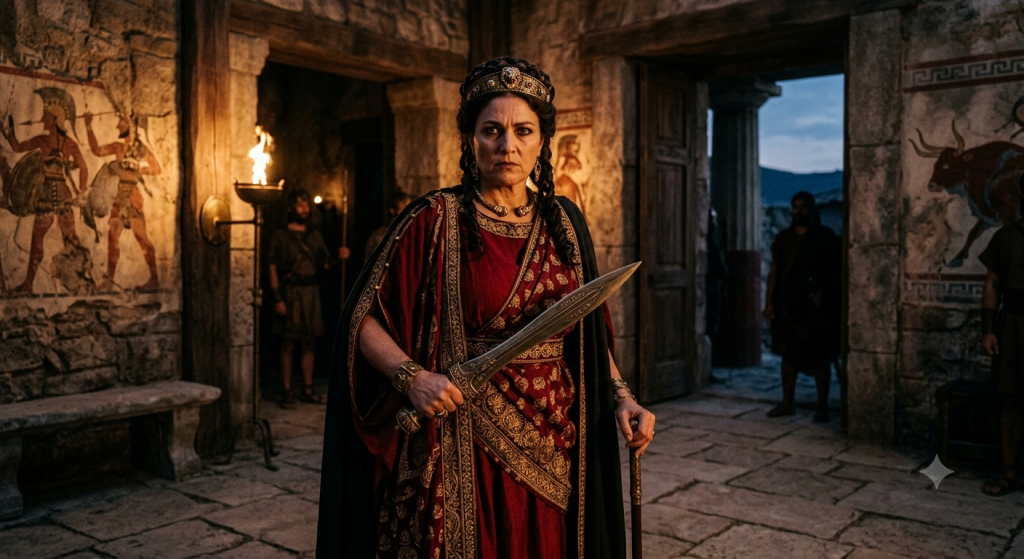
Aeschylus’s Clytemnestra, in the Oresteia written in 458 BC, is something entirely different. She is the most powerful figure in the first play of the trilogy, a woman of extraordinary intelligence and rhetorical skill who has been planning this moment for ten years and who executes it with complete deliberateness. She lures Agamemnon into the palace, gets him into the bath, wraps him in a robe or net that pins his arms, and strikes him down. Then she kills Cassandra, the Trojan prophetess Agamemnon has brought home as a concubine. Then she stands in front of the elders of Argos and explains herself.
Her speech is remarkable. She does not deny what she has done. She does not claim it was an accident or that Aegisthus was solely responsible. She presents the killing as justice: Agamemnon sacrificed Iphigenia, she has killed Agamemnon, the account is settled. She invokes the ancient principle of blood guilt, the idea that a death demands a death and that the killer of her child had a death coming to him. The elders are horrified. They tell her she will be driven into exile for what she has done. She tells them they have no power over her.
Reading the two versions side by side, what becomes clear is that Homer is not particularly interested in Clytemnestra as a person. She is a type: the faithless wife, the negative example. Aeschylus is deeply interested in her as a person, and what he finds there is someone with a case that the play takes seriously even as it ultimately condemns her.
The House of Atreus
Clytemnestra’s story does not begin with Iphigenia. It begins much earlier, with the curse on the House of Atreus that provides the theological framework for everything that follows.
Atreus, Agamemnon’s father, and his brother Thyestes were locked in a conflict whose specifics vary across the ancient sources but whose general outline is consistent: Atreus served Thyestes his own children as food at a feast, in revenge for Thyestes seducing Atreus’s wife. Thyestes cursed the house of Atreus. Aegisthus, Clytemnestra’s lover and co-conspirator, was the surviving son of Thyestes: his participation in Agamemnon’s murder is partly motivated by the family vendetta that predates both of them by a generation.
Aeschylus uses this background to frame Clytemnestra’s murder of Agamemnon not just as a personal act of revenge but as the latest episode in a multigenerational cycle of violence within a single family. The curse demands blood. Clytemnestra is both an agent of her own will and an instrument of something much older and much larger than herself, and Aeschylus holds both possibilities simultaneously without resolving them into a single clear reading.
This is what makes the Oresteia one of the greatest works in the Western tradition. It does not simplify Clytemnestra into a villain. It presents her crime as genuinely motivated, her grievances as genuinely legitimate, and her punishment as genuinely necessary within the framework of the emerging Athenian legal system. All three things are true simultaneously, and the tension between them is what the trilogy lives in.
The Trial and What It Decided
After Clytemnestra kills Agamemnon, her son Orestes returns and kills her in revenge. He is immediately pursued by the Erinyes, the Furies, divine beings whose specific function is to punish those who shed family blood. Killing your mother is a crime the Furies take very seriously, regardless of what the mother had done.
The Eumenides, the third play of the Oresteia, stages a trial at Athens in which Orestes is prosecuted by the Furies and defended by Apollo. Athena presides. The jury of Athenian citizens deadlocks. Athena casts the deciding vote for acquittal, with the argument that the father’s claim on a child outweighs the mother’s, because the mother is only the nurse of the seed implanted by the father.
The argument is the most philosophically loaded moment in Greek tragedy. It acquits Orestes by effectively deciding that mothers matter less than fathers, which resolves the immediate legal question but does so on grounds that the play does not present as simply or obviously correct. It is a decision about the relative weight of maternal and paternal claims in a new legal order, and Clytemnestra’s case loses not because her grievances were wrong but because the new system has decided whose deaths count more.
She is not rehabilitated. She is not vindicated. She is simply superseded by a legal framework that places her outside the category of victim whose death requires retribution. The Furies are placated and transformed into the Eumenides, the kindly ones, guardians of Athens. The old cycle of blood vengeance is replaced by legal process. And Clytemnestra, who operated according to the old rules, is left outside the new settlement.
Cassandra
One element of the story that most popular accounts handle briefly is Clytemnestra’s killing of Cassandra, the Trojan prophetess Agamemnon brought home as a concubine. Cassandra knows she is walking into the palace to her death. She has the gift of true prophecy and the curse that nobody will believe her. She stands outside the palace in Aeschylus’s play and describes in vivid detail what is about to happen, and the Argive elders watch her walk inside anyway.
Clytemnestra kills Cassandra immediately after Agamemnon. The act is usually read as the practical elimination of a witness, but it is also something more uncomfortable: Cassandra is a slave, a prisoner of war, a woman who had no choice in being brought to Mycenae as Agamemnon’s property. She is as much a victim of the situation as Iphigenia was. Clytemnestra kills her anyway, without apparent hesitation, which is the moment in the play that most clearly separates Clytemnestra’s justice from simple goodness. She is settling accounts, and the accounts she is settling do not include Cassandra’s.
Lupita Nyong’o and the 2026 Film
In Christopher Nolan’s Odyssey, Lupita Nyong’o plays Clytemnestra. The role in the film is necessarily limited compared to her presence in the Oresteia, since the Odyssey references her crime primarily through Agamemnon’s ghost in the underworld and through Telemachus’s journey, which takes him to hear about her from Nestor and Menelaus.
How Nolan uses Clytemnestra in a film primarily about Odysseus will depend on how much weight he gives to the parallel between Penelope and Clytemnestra that the Odyssey establishes. The two women are the poem’s contrasting models of female behaviour during a husband’s absence: one waited faithfully, one did not. In a film starring Anne Hathaway as Penelope, the presence of Clytemnestra as her dark counterpart has obvious dramatic potential, and Nyong’o’s casting suggests Nolan intends to give the role genuine weight rather than treating it as a brief reference.
The character who appears in the Odyssey is a diminished version of the Aeschylean Clytemnestra. She is defined by her crime and her infidelity rather than by her reasons. A filmmaker who wanted to honour the complexity of the tradition would find a way to let those reasons exist in the film even within the Odyssey’s framework. Whether Nolan does this is one of the more interesting questions the film raises.
Further Reading
If this article sparked your interest, these are the books worth reading next.
The Iliad — Homer (Penguin Classics)
by Homer — the primary source for everything in this article, and still the most vivid account of the Trojan War ever written.
The Odyssey — Homer (Emily Wilson translation)
by Homer, translated by Emily Wilson — the best modern English translation, and the book that contains Odysseus’s own account of the horse.
The Trojan War: A Very Short Introduction
by Eric Cline — the clearest and most up to date account of what archaeology actually tells us about Troy and whether any of it happened.
For more on the Greek tradition, the Artemis article covers the goddess who demanded the sacrifice of Iphigenia that set Clytemnestra’s revenge in motion. The Zeus article covers the divine order that Clytemnestra’s acts challenge. The Trojan Horse article covers the end of the war from which Agamemnon returned. The Greek Mythology hub page has every article in the cluster.
Never miss a myth
Thank you for being here. The site is brand new and every subscriber genuinely means something to me. If you're here, you care about this stuff as much as I do - and that's all the reason I need to keep going. New stories, videos and dark folklore from around the world, straight to your inbox. No algorithm. Just the stories, when they're ready.