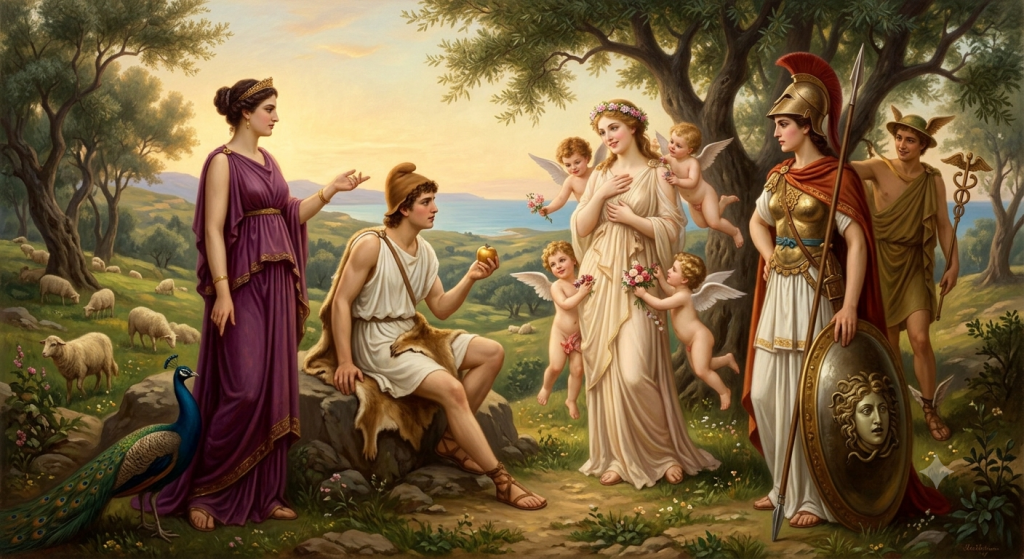
The Trojan War began at a wedding. Peleus and Thetis were married, and all the gods were invited except Eris, the goddess of discord. Eris arrived anyway and threw a golden apple among the guests inscribed with the words for the fairest. Hera, Athena, and Aphrodite all claimed it. Zeus refused to judge between them and appointed Paris, a prince of Troy living as a shepherd on Mount Ida, as judge.
Each goddess offered a bribe. Hera offered power over kingdoms and men. Athena offered wisdom and skill in battle. Aphrodite offered the most beautiful woman in the world. Paris chose Aphrodite. The most beautiful woman in the world was Helen, wife of Menelaus of Sparta. Paris went to Sparta as Menelaus’s guest, took Helen when he left, and the Greeks launched a thousand ships to get her back. The war lasted ten years. Troy was destroyed. Countless people died. All of it began because someone was not invited to a wedding.
Paris and His Background
Paris’s position as judge was not random. He had a reputation for fairness in settling disputes on Mount Ida, where he had been living since birth as a shepherd. He was living as a shepherd because of a prophecy: before his birth, his mother Hecuba dreamed she gave birth to a firebrand that set Troy on fire. The seer Aesacus interpreted this as meaning the child would cause Troy’s destruction. Priam and Hecuba had the infant exposed on Mount Ida to die. He was raised by shepherds and did not die.
The prophecy was not preventable. The child who would cause Troy’s destruction was raised in ignorance of his royal birth, judged a divine beauty contest, made a choice that set the war in motion, and went to Sparta to collect his prize. Every action taken to prevent the prophecy produced the circumstances in which it was fulfilled, as Greek prophecy consistently does.
The Three Bribes and What They Mean
The bribes the three goddesses offer Paris encode the three domains of human value that Greek culture took most seriously: political power, wisdom and military excellence, and erotic desire. Hera offers the first, Athena the second, Aphrodite the third. Paris chooses the third.
The tradition does not straightforwardly condemn this choice, though it presents its consequences as catastrophic. Paris is not presented as foolish for valuing love over power and wisdom. He is presented as human, which in Greek mythology means subject to the desires that Aphrodite governs, and those desires are not presented as shameful in themselves. The problem is not that Paris chose love. The problem is what love, in this specific case, cost everyone else.
Hera and Athena After the Judgement
The goddesses who lost the contest did not accept the result gracefully. Hera and Athena became the most consistent divine supporters of the Greek cause throughout the Trojan War, working against Troy with a persistence and effectiveness that the tradition presents as motivated directly by the slight of the Judgement. Hera deceives Zeus. Athena guides Diomedes’s spear against Ares. Both goddesses actively intervene in the fighting in ways that tip key moments against the Trojans.
The war is therefore partly a divine conflict in which the Judgement of Paris is still being disputed: two goddesses using the Trojan War as the extended consequence of Paris’s decision, backing the side that will destroy the city of the man who did not choose them. The apple thrown at the wedding, the contest on Mount Ida, and the fall of Troy are a single connected sequence, causally and theologically.
Further Reading
If this article sparked your interest, these are the books worth reading next.
The Iliad — Homer (Penguin Classics)
by Homer — the primary source for everything in this article, and still the most vivid account of the Trojan War ever written.
The Odyssey — Homer (Emily Wilson translation)
by Homer, translated by Emily Wilson — the best modern English translation, and the book that contains Odysseus’s own account of the horse.
The Trojan War: A Very Short Introduction
by Eric Cline — the clearest and most up to date account of what archaeology actually tells us about Troy and whether any of it happened.
For more on the Greek tradition, the Aphrodite article covers the goddess whose bribe won the contest and whose promise to Paris set the war in motion. The Hera article covers the goddess whose loss in the contest shapes her conduct throughout the Iliad. The Trojan Horse article covers the end of the war the Judgement began. The Greek Mythology hub page has every article in the cluster.
Never miss a myth
Thank you for being here. The site is brand new and every subscriber genuinely means something to me. If you're here, you care about this stuff as much as I do - and that's all the reason I need to keep going. New stories, videos and dark folklore from around the world, straight to your inbox. No algorithm. Just the stories, when they're ready.