Daedalus was the greatest craftsman and inventor in Greek mythology. He built the Labyrinth that contained the Minotaur. He made the wooden cow that Pasiphae used to conceive the Minotaur in the first place. He gave Ariadne the thread that allowed Theseus to navigate the Labyrinth and escape. For this last act, which undermined Minos’s most important security installation, Minos imprisoned him and his son Icarus in a tower on Crete.
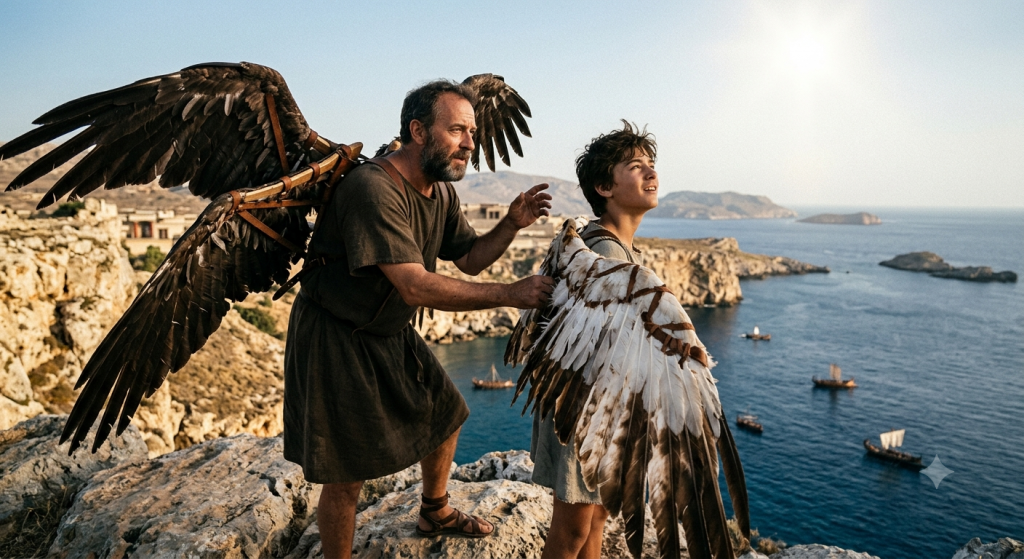
Daedalus built wings from feathers and wax and escaped with Icarus through the air. He told Icarus before they left: do not fly too low, because the sea spray will weigh down the feathers, and do not fly too high, because the sun will melt the wax. Fly at a middle height. Icarus flew too high. The wax melted. He fell into the sea and drowned. The sea where he fell is called the Icarian Sea, and the island nearest to where he fell is called Icaria.
Daedalus and His Craft
Daedalus represents the archetype of the inventor whose creations exceed his ability to control their consequences. The Labyrinth is his masterpiece of engineering: a structure so perfectly designed that even its creator, imprisoned within it, could not find the exit by conventional means. He had to go over it rather than through it. The wooden cow he built for Pasiphae is the invention that set the whole sequence in motion: without it there is no Minotaur, without the Minotaur there is no Labyrinth, without the Labyrinth there is no imprisonment, without the imprisonment there are no wings.
His nephew Perdix showed signs of surpassing him as an inventor at a young age, already credited with inventing the saw and the compass. Daedalus threw him from the Acropolis in Athens. Athena caught him and transformed him into a partridge, which is what perdix means in Greek. The partridge is said to avoid high places because of this origin, and when Daedalus was burying Icarus on the island near where he fell, a partridge watched from a tree and clapped its wings in satisfaction. The inventor’s greatest failure was witnessed by the bird that was his earlier victim.
What the Myth Means
The Icarus story has become one of the most widely used metaphors in Western culture for overreaching: the hubris of attempting more than human limits permit, the destruction that follows from ignoring good advice, the fatal attraction of going further than is safe. This reading is accurate but incomplete.
The myth is equally a story about Daedalus, who survives. He gives the correct advice, watches his son ignore it, and arrives safely in Sicily while his son drowns. The father who knows the limits and respects them continues. The son who cannot resist the pull of the sun does not. The myth does not celebrate Daedalus’s survival or condemn Icarus’s fall with any particular vehemence. It simply describes what happened when a boy was given wings and told where not to fly.
Further Reading
If this article sparked your interest, these are the books worth reading next.
The Iliad — Homer (Penguin Classics)
by Homer — the primary source for everything in this article, and still the most vivid account of the Trojan War ever written.
The Odyssey — Homer (Emily Wilson translation)
by Homer, translated by Emily Wilson — the best modern English translation, and the book that contains Odysseus’s own account of the horse.
The Trojan War: A Very Short Introduction
by Eric Cline — the clearest and most up to date account of what archaeology actually tells us about Troy and whether any of it happened.
For more on the Greek tradition, the Minotaur article covers the creature whose containment Daedalus designed and whose labyrinth led to his imprisonment. The Theseus article covers the hero who used Daedalus’s thread to escape the Labyrinth. The Greek Mythology hub page has every article in the cluster.
Never miss a myth
Thank you for being here. The site is brand new and every subscriber genuinely means something to me. If you're here, you care about this stuff as much as I do - and that's all the reason I need to keep going. New stories, videos and dark folklore from around the world, straight to your inbox. No algorithm. Just the stories, when they're ready.