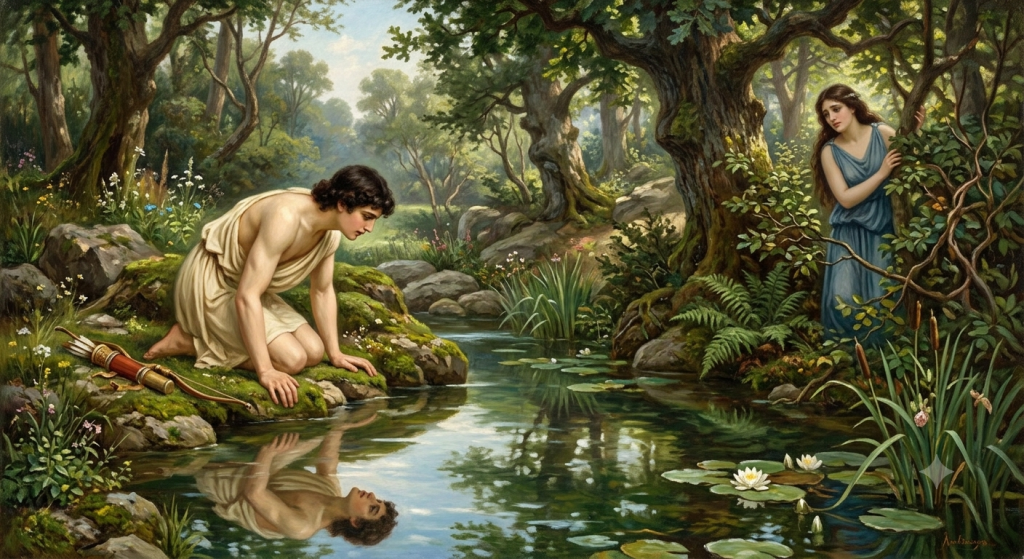
Narcissus was the most beautiful young man in Greece and he knew it. He rejected every person who fell in love with him, male and female, with a consistency and a coldness that the tradition presents not as virtue but as a kind of violence: the repeated rejection of genuine feeling as beneath his interest. The nymph Echo was the most prominent of those he rejected, and her fate is the first half of a story whose second half is Narcissus’s own.
Echo could only repeat the last words spoken to her, a punishment imposed by Hera for covering Zeus’s affairs with conversation. When Narcissus called out asking if anyone was there, she could only repeat his words back to him. When he said let us come together, she emerged from the trees and tried to embrace him. He pushed her away and told her he would die before he let her have power over him. She spent the rest of her life pining in caves and lonely places, her body fading until only her voice remained, which still repeats the last words said near it.
Narcissus came to a pool and saw his own reflection and fell in love with it. He lay by the pool unable to leave and unable to possess what he saw, and eventually died there. The narcissus flower grew where he had lain.
The Myth’s Psychological Precision
The myth of Narcissus is one of the most psychologically acute in the Greek tradition, which is why Freud borrowed the name for the psychological condition narcissism and why the word has remained in use in exactly the sense Ovid described it two thousand years before Freud was born.
Narcissus is destroyed not by loving himself too much in the sense of self-care or self-respect, but by being unable to love anything outside himself. His rejection of Echo and everyone else is the same incapacity expressed outward that his obsession with his reflection expresses inward: he cannot make genuine contact with another person. The reflection in the pool is the perfect love object for someone with this incapacity because it responds to everything he does, reflects everything he is, and requires nothing of him in return. It is also completely impossible to possess, which means he is trapped in desire for something he cannot have that is simultaneously himself.
The punishment fits the person in a way that distinguishes this myth from the simple divine-retribution stories: Narcissus is not punished by a god for a specific offence. He is destroyed by his own nature, following its own logic to its own conclusion. The pool is not a trap. It is the natural destination of someone who cannot love outward.
Echo’s Half of the Story
Echo’s story is often treated as simply the setup for Narcissus’s, but it is worth reading in its own right. She had been punished by Hera for using her conversational gifts to distract the goddess while Zeus conducted his affairs, which means she was punished for being useful to Zeus, which is the kind of divine justice that the Greek tradition delivers without apparent irony.
Her reduced to only repetition is a precise inversion of her original nature: she was famous for her voice and her conversation, and the punishment removes everything except the mechanical echo of other people’s words. She loves Narcissus and can only say back to him what he says first, which means she can never initiate, never express, never be anything other than a reflection of whatever he brings to the encounter. She is reduced to the same condition as Narcissus’s pool: reflecting rather than originating, unable to make genuine contact.
The two figures mirror each other in this way: he can only love a reflection of himself, she can only reflect what others say. Neither can make genuine contact with the other. The myth puts them together and shows two forms of the same incapacity failing to connect.
Further Reading
If this article sparked your interest, these are the books worth reading next.
The Iliad — Homer (Penguin Classics)
by Homer — the primary source for everything in this article, and still the most vivid account of the Trojan War ever written.
The Odyssey — Homer (Emily Wilson translation)
by Homer, translated by Emily Wilson — the best modern English translation, and the book that contains Odysseus’s own account of the horse.
The Trojan War: A Very Short Introduction
by Eric Cline — the clearest and most up to date account of what archaeology actually tells us about Troy and whether any of it happened.
For more on the Greek tradition, the Hera article covers the goddess who punished Echo for covering Zeus’s affairs. The Zeus article covers the god whose affairs Echo was helping to conceal. The Greek Mythology hub page has every article in the cluster.
Never miss a myth
Thank you for being here. The site is brand new and every subscriber genuinely means something to me. If you're here, you care about this stuff as much as I do - and that's all the reason I need to keep going. New stories, videos and dark folklore from around the world, straight to your inbox. No algorithm. Just the stories, when they're ready.