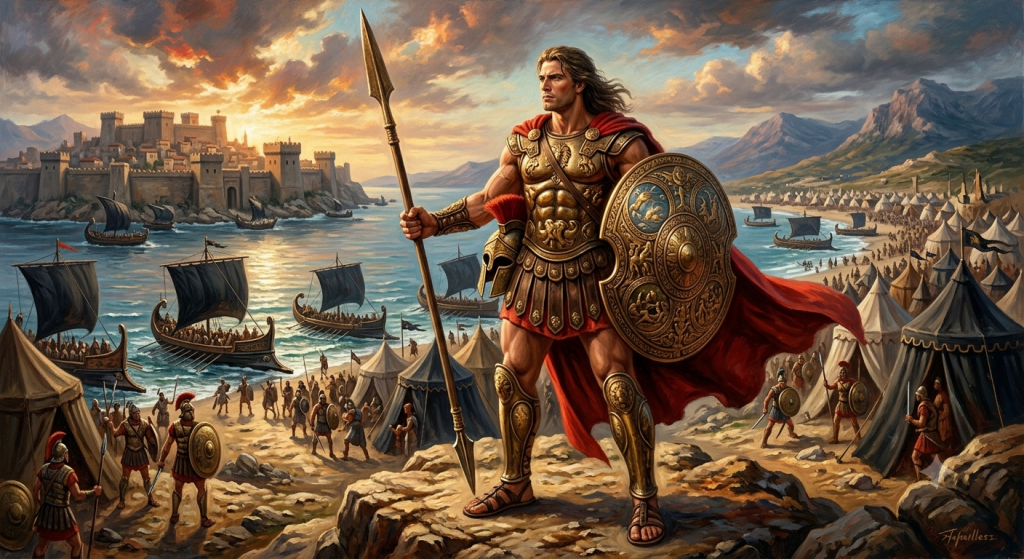
The Iliad begins with one word: rage. Not the Trojan War, not the gathering of the Greek fleet, not Paris and Helen. The opening word of the oldest epic in Western literature is the rage of Achilles, and the poem is about what that rage costs him and everyone around him rather than about the war itself.
Achilles is the greatest warrior in the Greek army at Troy, possibly the greatest warrior in the mythology. He is also the hero who withdraws from the fighting over a matter of honour, whose withdrawal allows the Trojans to push the Greeks back to their ships and nearly end the war in Trojan victory, whose best friend dies partly as a consequence of that withdrawal, and who returns to the fighting not to save the Greeks but to avenge his friend and specifically to kill Hector, and who knows that killing Hector will lead to his own death, and who kills Hector anyway.
He is not a simple hero. He is the most complex figure in Homer and one of the most psychologically specific in any mythology.
The Birth and the River
Achilles was the son of the mortal Peleus and the sea nymph Thetis. His mother, knowing he was fated to die young if he went to Troy, attempted to make him immortal. The most famous version of this, which does not actually appear in Homer but enters the tradition through later sources, describes Thetis dipping the infant Achilles in the River Styx, holding him by the heel, and making his entire body invulnerable except for the heel by which she held him. This is the origin of the Achilles heel.
An earlier tradition described Thetis burning away the mortal parts of the infant Achilles in fire at night and anointing him with ambrosia by day. Peleus discovered her doing this, misunderstood what he was witnessing, and interrupted the process before it was complete. Thetis left him. The incomplete immortalisation either produced the vulnerable heel or left Achilles mortal throughout, depending on which version of the tradition is being followed.
Thetis also tried to hide Achilles from the war by dressing him as a girl and concealing him among the daughters of King Lycomedes on the island of Scyros. Odysseus found him there by the stratagem of presenting gifts that included weapons: the other girls ignored the weapons but Achilles picked them up, and he was identified. He went to Troy, knowing what it would cost him.
The Quarrel with Agamemnon
The Iliad opens in the ninth year of the Trojan War with a quarrel between Achilles and Agamemnon, the commander of the Greek forces. Agamemnon had taken a woman named Chryseis as a war prize, and her father, a priest of Apollo, asked for her return. Agamemnon refused. Apollo sent a plague on the Greek camp. The seer Calchas explained the cause. Agamemnon agreed to return Chryseis but demanded compensation: he took Briseis, Achilles’s own prize.
Achilles’s rage at this is the rage the Iliad opens with. He does not simply withdraw from the fighting. He asks his mother Thetis to petition Zeus to make the Greeks lose without him, so that Agamemnon will be forced to acknowledge what Achilles’s absence costs. Zeus agrees. The consequences play out across the poem with the relentlessness of a divine machine fulfilling its own logic.
The Death of Patroclus
As the Greeks are pushed back toward their ships, Achilles’s closest companion Patroclus asks to be allowed to fight in Achilles’s armour, to encourage the Greeks and drive back the Trojans. Achilles agrees but gives specific instructions: drive the Trojans back from the ships and return. Do not pursue them to the walls of Troy.
Patroclus drove the Trojans back and then kept going. Apollo struck him and stunned him. Euphorbos wounded him. Hector killed him and took the armour. When the news reached Achilles, his grief was absolute and physical: he tore his hair, rolled in the dust, and his mother came from the sea to mourn with him.
His grief transformed the rage. It was no longer about honour and Agamemnon. It was about Hector. He would return to the fighting and he would kill Hector and he would accept that his own death would follow Hector’s death, because nothing else mattered. Thetis had Hephaestus forge him new armour. He returned to the battlefield.
Hector and the Consequences
The killing of Hector in Book 22 of the Iliad is the emotional climax of the poem and one of the most carefully constructed sequences in ancient literature. Hector stands his ground outside the walls of Troy while his parents plead with him to come inside. He waits for Achilles. When Achilles appears, Hector runs. Athena tricks him into turning and facing Achilles by disguising herself as his brother. Achilles kills him.
What follows is the most disturbing passage in Homer. Achilles ties Hector’s body to his chariot and drags it around the walls of Troy while Hector’s parents watch from the walls. He does this repeatedly over multiple days. The gods are divided about whether this desecration should be permitted to continue. Eventually Zeus sends Hermes to escort Hector’s aged father Priam through the Greek camp to Achilles’s tent to ransom the body. The meeting between Priam and Achilles, two men who have lost everything, is the final scene of the Iliad and one of the most humane in ancient literature.
The Heel and the Death
The Iliad ends before Achilles dies. His death is described in later sources: Paris, guided by Apollo, shot an arrow that struck Achilles in the heel, the one vulnerable point, and killed him. The tradition treats this as fulfilment of prophecy and as appropriately ironic: the greatest warrior in the mythology is killed by the least martial figure in Troy, guided by a god, hitting the one spot that could kill him.
The Achilles heel has entered the language as the phrase for a critical vulnerability in an otherwise strong system, which is the most durable legacy of a myth that is ultimately about what it costs to be the greatest at something: the foreknowledge of your own death, the loss of everyone you love before you, and the final reduction of all that power and all that rage to an arrow in the foot.
Further Reading
If this article sparked your interest, these are the books worth reading next.
The Iliad — Homer (Penguin Classics)
by Homer — the primary source for everything in this article, and still the most vivid account of the Trojan War ever written.
The Odyssey — Homer (Emily Wilson translation)
by Homer, translated by Emily Wilson — the best modern English translation, and the book that contains Odysseus’s own account of the horse.
The Trojan War: A Very Short Introduction
by Eric Cline — the clearest and most up to date account of what archaeology actually tells us about Troy and whether any of it happened.
For more on the Greek tradition, the Trojan Horse article covers the war Achilles fought and the trick that finally ended it. The Zeus article covers the god whose agreement with Thetis set the Iliad’s consequences in motion. The Greek Mythology hub page has every article in the cluster.
Never miss a myth
Thank you for being here. The site is brand new and every subscriber genuinely means something to me. If you're here, you care about this stuff as much as I do - and that's all the reason I need to keep going. New stories, videos and dark folklore from around the world, straight to your inbox. No algorithm. Just the stories, when they're ready.