At some point in the mythological history of Thebes, a young man named Tiresias was walking on Mount Cithaeron and came across two snakes mating. He struck them with his staff. The reasons given for why he did this vary across the ancient sources: anger, disgust, curiosity, or simply because striking snakes with a staff was something people did when they encountered them on a mountain path. Whatever the reason, the consequence was immediate and permanent. He was transformed into a woman.
Seven years passed. Tiresias, now a woman, came across two snakes mating again, in the same place or a similar one, and this time left them alone. The transformation reversed. He was a man again.
This experience made him, in the logic of Greek mythology, uniquely qualified to answer a question that the gods themselves were debating. Zeus and Hera, in one of their more domestic disputes, were arguing about which sex experienced greater pleasure from love. They chose Tiresias to settle the matter because he was the only person who had experienced it from both sides. He said women experienced nine times more pleasure than men. Hera, furious at this answer for reasons the sources do not fully explain, blinded him. Zeus, unable to reverse another god’s action but feeling that some compensation was owed, gave him the gift of prophecy and a life that would span seven generations.
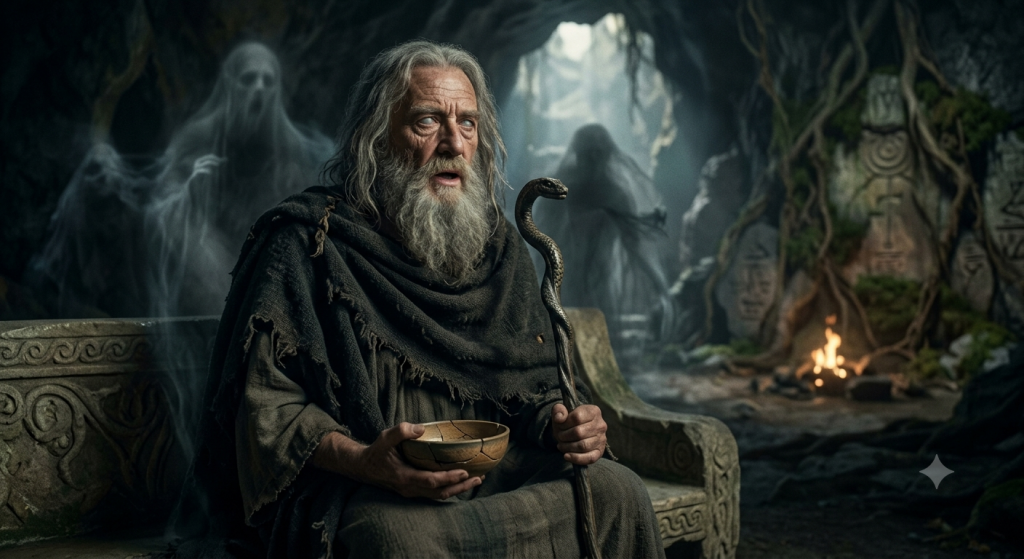
He went on to be the most consulted and most ignored prophet in Greek mythology, present in Thebes from its founding through its destruction, advising kings who almost never listened until it was too late, and retaining his gifts in the underworld after his death so that Odysseus could consult him there. He is the one continuous human thread through some of the greatest works of Greek literature, and the paradox that defines him is present from the beginning: the man who knows everything cannot change anything, and the man who can see everything cannot see at all.
Interested in Greek Mythology? Check out my YouTube channel below
The Two Accounts of His Blindness
The snakes and the divine dispute is the version of Tiresias’s blindness that most ancient sources and most modern retellings follow. But a second account exists in parallel, attributed primarily to the Hellenistic poet Callimachus, and it offers a very different explanation that has its own coherence and its own set of implications.
In Callimachus’s version, Tiresias was blinded because he accidentally saw the goddess Athena bathing. His mother Chariclo was Athena’s closest companion, and Tiresias had grown up with access to the goddess that no ordinary mortal would have had. One day, hunting on the mountain, he came upon a spring where Athena was bathing and saw what no mortal was permitted to see. Athena blinded him immediately, not from cruelty but from divine necessity: there were rules about mortals seeing gods in their full divine form, and those rules had to be enforced regardless of circumstances or intent.
Chariclo pleaded with Athena to restore his sight. Athena said she could not undo what divine law required, but she could compensate. She cleaned his ears so that he could understand the language of birds, which was the primary method of augury in the Greek tradition. Pliny the Elder credits Tiresias with inventing augury, the practice of reading omens from bird behaviour, and in this version of the story the gift is a direct substitute for the sight he lost: he cannot see the world but he can hear its warnings in forms that other men cannot interpret.
The two accounts are not reconciled in the ancient sources and were clearly circulating as alternative traditions rather than as a single coherent narrative. What they share is the structure of compensation: blindness given or enforced by divine power, then offset by a prophetic gift that makes the blind man more perceptive than the sighted. Whether it was Hera punishing him for an answer she disliked, or Athena enforcing divine law reluctantly, the result is the same. Tiresias loses the ability to see the physical world and gains the ability to see everything else.
Seven Generations in Thebes
The lifespan Zeus granted Tiresias, seven generations of ordinary human life, makes him the institutional memory of Theban history in a way that no other figure in Greek mythology manages. He is present at the founding of the city under Cadmus. He advises Cadmus’s grandson Pentheus about the arrival of Dionysus in Euripides’s Bacchae, urging him to acknowledge the god’s divinity and being ignored. He is present through the reign of Laius, through the catastrophe of Oedipus, through the events of Antigone and the Phoenician Women. He outlives every king he advises.
That continuity gives his appearances in the Theban tragedies a particular weight. When Tiresias appears in Oedipus Rex and tells Oedipus the truth about his parentage and his crime, he is not offering new information that he has just discovered. He has known for years, possibly for the entirety of Oedipus’s life, and has said nothing until directly asked and then pressed. The question of why he waited, of what the ethics of prophetic knowledge actually require, is one that the play raises without answering. Tiresias knows the truth and has the authority to speak it. He also knows, from generations of experience, that the truth is almost never what kings want to hear and that speaking it too early or too forcefully tends not to go well for the prophet.
Oedipus, in that play, accuses Tiresias of having conspired with Creon to invent the prophecy as a political manoeuvre. The accusation is absurd but it is the instinctive response of a man who cannot accept what he is being told, and Tiresias’s response to it is one of the more remarkable speeches in Greek tragedy. He tells Oedipus that the truth he is refusing to hear will destroy him regardless of whether he accepts it, and that the curse Oedipus called down on the murderer of Laius will find its target even if Oedipus spends the rest of his life refusing to look at the evidence. He is correct on every point. Oedipus ignores him. The play ends as Tiresias said it would.
The same pattern repeats in Antigone, where Tiresias warns Creon that his refusal to bury Polynices and his imprisonment of Antigone are offending the gods and will bring disaster. Creon accuses him of being bribed. Tiresias leaves. Creon’s son kills himself over Antigone’s body. Creon’s wife kills herself over her son. Creon is left alone with what he has done. Tiresias was right about everything and Creon knew it and chose to ignore it anyway.
The curse of Tiresias, which several ancient commentators identify explicitly, is not the blindness or the gender transformation or any of the individual misfortunes the tradition attributes to him. It is the condition of knowing things that are true and being unable to make the people who need to hear them believe what they are being told. He is accurate in every tragedy he appears in. He is dismissed, accused, threatened, and ignored in every tragedy he appears in. The accuracy and the dismissal are inseparable. People who are told things they do not want to hear do not become more receptive because the teller has a good track record.
The Underworld and the Odyssey
Tiresias dies near the end of the Theban cycle, drinking from the spring of Tilphussa while fleeing the city’s destruction. The spring, in some accounts, was poisoned. He takes one drink and collapses. The long life Zeus granted him ends on a road outside a burning city, which is the kind of ending that Greek mythology specialises in providing for figures who were never quite comfortable in the world they were given.
Persephone, the queen of the underworld, grants him something no other shade receives: the retention of his consciousness and his prophetic powers after death. The other souls in Homer’s underworld are described as strengthless heads, the remnants of the dead who have lost their individual identity and their capacity for reason. They can speak and remember only after drinking blood, which temporarily restores something of what they were in life. Tiresias needs no blood. He arrives at Odysseus’s sacrificial pit already himself, already capable of speech and prophecy and the clear assessment of what lies ahead.
Circe sends Odysseus to consult him because she understands, better than Odysseus does at this point, that the journey home requires information she cannot provide. She knows the geography and the creatures. She does not know the divine politics of what Odysseus has set in motion by blinding Polyphemus, or what Poseidon’s opposition will require of him, or how the situation with Helios’s cattle will play out. Tiresias knows all of this because he always knows, and because being dead has not changed that.
What he tells Odysseus in Book 11 is precise and conditional. He confirms Poseidon’s anger and its cause. He warns specifically about the cattle of Helios on the island of Thrinacia: if those cattle are harmed, the ship and crew will be destroyed, and even if Odysseus himself survives he will return home alone, on a foreign ship, to find trouble waiting. He describes what will happen after Odysseus returns: the killing of the suitors, the need to travel inland with an oar until he reaches a place where no one knows what an oar is, the sacrifice to Poseidon that will finally end the sea god’s anger, and the gentle death in old age away from the sea that will eventually come if all of this is done correctly.
The prophecy is accurate on every point. The crew does eat the cattle. The ship is destroyed. Odysseus does return alone on a foreign vessel. The suitors are killed. Whether he makes the inland journey and plants the oar is told in the lost epic called the Telegony rather than in Homer, but the tradition confirms it. Tiresias, in the underworld, is as reliable as he ever was in life, and as little listened to: Odysseus hears the warning about the cattle, his crew eats them anyway, and the consequence Tiresias specified follows exactly on schedule.
What He Represents
Tiresias has attracted more sustained scholarly and literary attention than almost any figure in Greek mythology who is not a god or a primary hero, and the reason is not difficult to identify. He embodies a paradox that is both specific to Greek tragedy and universal in its resonance: knowledge without power to act on it.
His blindness and his prophetic sight are not simply a trade, sight for insight, in the way that the compensation mythology describes. They are a statement about what knowledge is and what it cannot do. Tiresias sees truly. He sees things as they are and as they will be, without the distortions of desire or fear or self-interest that make other characters misread their situations. And this makes him, in every tragedy, the most isolated figure on the stage. He cannot share what he sees in a way that changes anything. The knowledge is perfect and completely ineffective.
The seven years as a woman are part of this too, though the tradition tends to treat them as background rather than as a continuous influence on his character. Having experienced both sides of human existence, he has a perspective on the human condition that no one born straightforwardly male or female can match. This should make him the wisest person in any room he enters. In the tragedies, it makes him slightly alien: a figure who understands too much to be easily accommodated by people who understand less and are not interested in being corrected.
T.S. Eliot used him as the central consciousness of The Waste Land, describing him as the most important personage in the poem and noting that what Tiresias sees is the substance of the poem. The choice says something precise about what Eliot was doing: he needed a figure who had seen everything, experienced everything from every perspective, and found it exhausting rather than transcendent. The Tiresias of the underworld, still knowing, still unable to change anything, watching Odysseus’s crew eat the cattle they were told not to touch, is the figure Eliot was reaching for.
He is still there in the mythology, at the spring of Tilphussa where he died, or in the underworld where he does not quite fit among the strengthless shades, knowing things that have not happened yet and waiting for someone to come and ask. The asking rarely changes what happens. He answers anyway, because that is what he is for, and because the alternative to speaking the truth is silence, and Tiresias, in every version of his story, has never been able to manage that.
Further Reading
If this article sparked your interest, these are the books worth reading next.
The Iliad — Homer (Penguin Classics)
by Homer — the primary source for everything in this article, and still the most vivid account of the Trojan War ever written.
The Odyssey — Homer (Emily Wilson translation)
by Homer, translated by Emily Wilson — the best modern English translation, and the book that contains Odysseus’s own account of the horse.
The Trojan War: A Very Short Introduction
by Eric Cline — the clearest and most up to date account of what archaeology actually tells us about Troy and whether any of it happened.
For more on the Greek tradition, the Oedipus article covers the king who is told the truth by Tiresias and spends the rest of the myth refusing to accept it. The Zeus article covers the god whose dispute with Hera Tiresias was called to settle. The Hades article covers the underworld Odysseus visits to speak with Tiresias’s shade. The Greek Mythology hub page has every article in the cluster.
Never miss a myth
Thank you for being here. The site is brand new and every subscriber genuinely means something to me. If you're here, you care about this stuff as much as I do - and that's all the reason I need to keep going. New stories, videos and dark folklore from around the world, straight to your inbox. No algorithm. Just the stories, when they're ready.