After leaving the island of Aeolus for the second time, his bag of winds opened and his fleet blown back to the starting point by his own crew’s greed, Odysseus had twelve ships and the men to crew them. He arrived at the land of the Laestrygonians with twelve ships. He left with one.
The encounter with the Laestrygonians in Book 10 of the Odyssey is the single most catastrophic military defeat in the poem, and it happens with a speed that Homer renders almost unbearable to read. Eleven ships destroyed, their crews harpooned like fish and carried off to be eaten, in the time it takes to read four pages of text. Before the Laestrygonians, Odysseus commanded a fleet. After them, he was the captain of a single vessel with nowhere near enough men to crew it properly, making his way toward Circe’s island with a diminished company and the knowledge of what he had just failed to prevent.
What makes the episode so striking is not the scale of the violence but the reason Odysseus survived it. He did not outwit the Laestrygonians. He did not devise a clever plan in time. He survived because of a habit of caution so deeply ingrained that he acted on it without knowing why, and that habit is what separates him from every man who died in the harbour.
Interested in Greek Mythology? Check out my YouTube channel below
What Homer Says
The fleet arrives at Telepylos, the city of the Laestrygonians, after sailing for six days and six nights without rest. They find a natural harbour of unusual perfection: a narrow entrance between high cliffs opening into a sheltered bay where the water is calm regardless of the weather outside. Eleven of the twelve ships sail in and moor along the shore. Odysseus, for reasons Homer does not explain, ties his own ship to a rock outside the harbour entrance rather than going in with the others.
He sends three scouts inland to find out who lives there. They find a road, follow it, and encounter a young woman drawing water from a spring called Artacia. She is the daughter of Antiphates, king of the Laestrygonians, and she is described as large. She leads the scouts to her father’s house. The queen of the Laestrygonians, Homer says, is as large as a mountain, and the scouts are horrified by the sight of her. Antiphates seizes one of the scouts immediately and eats him. The other two run.
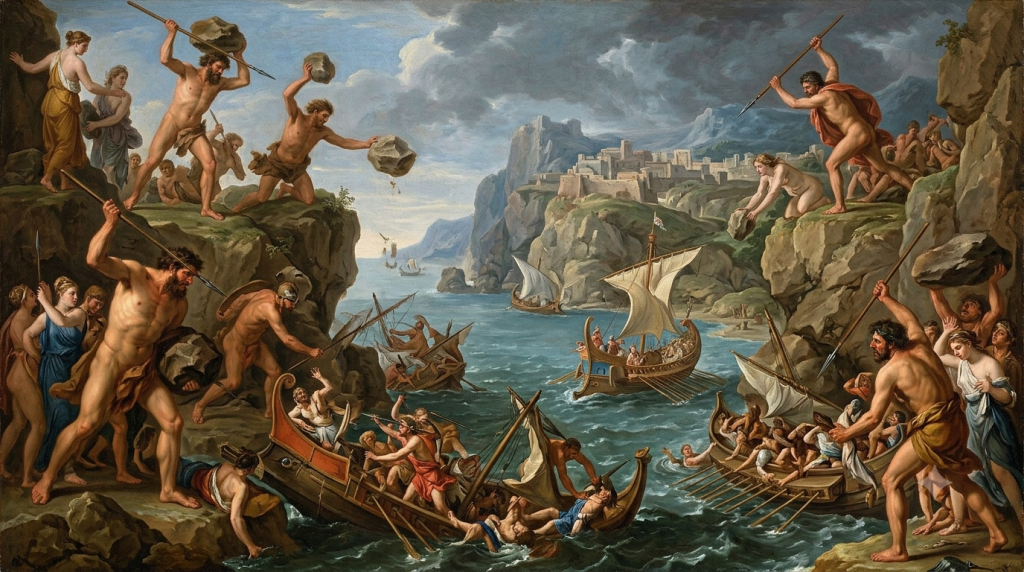
Antiphates raises the alarm. The Laestrygonians come from all directions, thousands of them, not men but giants, and they line the cliffs above the harbour and hurl rocks down onto the ships below. The ships are trapped by the geography that made the harbour so attractive. The rocks smash them. The Laestrygonians spear the men in the water like fish and carry them off. Inside the harbour there is no escape and nowhere to go.
Odysseus, watching from outside, cuts his ship’s rope with his sword, orders his crew to row, and gets out. He does not try to help the others. He cannot. He rows away from the cliffs and into open water and watches the ships burning behind him, and then he sails on, sick at heart, toward Circe’s island.
The Decision That Saved Him
The detail that Odysseus moored outside the harbour rather than inside it is one of the most discussed tactical decisions in the Odyssey, and Homer’s silence about the reason for it is deliberate. He does not say Odysseus suspected danger. He does not say a god warned him. He simply says that Odysseus tied his ship to a rock outside while the others went in, and the reason for that choice is left entirely to the reader.
The most persuasive reading is that this is what Odysseus always does. He is consistently the man who keeps an exit available, who does not fully commit to a position until he has assessed it, who stays slightly outside whatever situation everyone else is entering until he knows what that situation contains. He does the same thing in the Cyclops’s cave, where he keeps his men back from the deepest part of the cave despite their desire to explore it, though in that case the caution is not enough to prevent disaster. At Telepylos, it saves his life because the harbour that looks perfect is a trap, and traps only work if you go all the way in.
The Laestrygonians do not know Odysseus exists until his ship is already out of reach. They destroy eleven ships without ever seeing the twelfth. The most devastating attack in the Odyssey is survived by its hero not through cunning or divine help but through a disposition toward caution that he exercises so automatically he does not even explain it to himself.
Who the Laestrygonians Were
Homer gives the Laestrygonians a genealogy that connects them to the same divine lineage as the Cyclopes. They are descended from Laestrygon, a son of Poseidon and in some accounts also of Gaia, the primordial earth goddess. This makes them cousins, in mythological terms, of Polyphemus, the Cyclops Odysseus blinded two episodes earlier, and it means that in destroying their fleet Odysseus has now grievously offended Poseidon twice. The connection is not made explicit in Homer but it is there in the tradition, and it deepens the sense that the sea god’s opposition to Odysseus has a cumulative quality: each act against his descendants makes the next disaster more likely.
Unlike the Cyclopes, who are pastoral and solitary, the Laestrygonians have what Homer describes as a functioning society. They have a king and a queen. They have a city with a name. They have roads and a communal spring. They hold assemblies. When Antiphates raises the alarm, they respond in an organised and coordinated way, lining the cliffs with military efficiency rather than rushing down in chaos. The detail that their attack involves spearing men in the water like fish rather than simply throwing rocks suggests a division of labour: some giants throwing from above, others working in the water below to maximise the kill.
The organised savagery is what makes the Laestrygonians more unsettling than the Cyclopes in some ways. Polyphemus is dangerous because he is a solitary giant with no interest in human social norms. The Laestrygonians are dangerous because they have all the social organisation that should, in the Greek understanding of the world, make a people trustworthy and safe to deal with, and they use that organisation exclusively to hunt and eat outsiders with maximum efficiency.
Their land is described in terms that have generated considerable scholarly discussion. Homer says it is a place where the paths of day and night are close together, where a man who could go without sleep could earn double wages by working both the cattle shift and the sheep shift because the nights are so short. This description has been taken as evidence for a northern location, somewhere above the Arctic Circle where summer days are nearly endless. Thucydides and other ancient sources placed them in Sicily, near the town of Leontini. Pliny the Elder mentioned Laestrygonian plains on the Italian coast. The most specific identification connects Telepylos with the area around Formia on the coast of Lazio in Italy, where the harbour at Gaeta, with its narrow entrance and high surrounding cliffs, matches Homer’s geographical description closely enough that ancient travellers pointed to it as the location.
The Sardinian Connection
One of the more intriguing proposals for the origin of the Laestrygonian legend comes from Sardinia. In the 1970s and 1980s, archaeologists excavating a site called Mont’e Prama on the Sinis Peninsula of Sardinia discovered a remarkable collection of stone statues, now known as the Giants of Mont’e Prama. The statues, which date to the early Iron Age, are considerably larger than life-size representations of warriors and athletes, carved in a style unique to the Nuragic civilisation of Sardinia and unlike anything else in the Mediterranean world of the same period.
The proposal is that Greek sailors encountering these colossal stone figures in a landscape they did not know, in a culture they could not read, might have generated stories of giant inhabitants to explain what they were seeing. The harbours of Sardinia, particularly on the western coast near Mont’e Prama, include examples of the cliff-lined enclosed bay that Homer describes at Telepylos. The stone giants of a vanished civilisation, standing guard over an unfamiliar coast, could plausibly have been the seed around which the Laestrygonian legend grew.
The theory is speculative and not universally accepted among scholars. But it belongs to a pattern that runs through several of the Odyssey’s monsters: the possibility that Homer’s extraordinary beings are partly explained by Greek encounters with things that were real and strange, filtered through the interpretive frameworks available to sailors who had no other way to account for what they were seeing. The Laestrygonians may be pure mythology. They may also be Sardinian stone giants, glimpsed from the sea by sailors who did not stay long enough to look more carefully.
The Vatican Fresco
The Laestrygonians appear in one of the most important surviving examples of Roman wall painting. The Odyssey Landscapes, a series of fresco panels discovered in Rome in 1848 and now housed in the Vatican Museums, depict scenes from the Odyssey in a continuous landscape format that was highly influential in the development of Western landscape painting. The panels are dated to roughly 60 to 40 BC and are among the earliest known examples of illusionistic landscape in ancient art.
The Laestrygonian panel is one of the most dramatic in the series. It shows the harbour at Telepylos with the giants massed on the cliffs above, hurling rocks down onto the ships below. The scale of the giants relative to the ships and the men in the water makes the disproportion of the encounter viscerally clear in a way that text alone cannot quite achieve. The panel captures the moment of maximum catastrophe: ships breaking apart, men in the water, giants working methodically from above. Odysseus’s ship is not visible, which is either because the artist ran out of space or because the single ship that escaped is deliberately absent from a scene that depicts total destruction.
The fresco is one of the earliest visual representations of the episode and its survival in the Vatican collection means it has been continuously available to Western artists since its discovery. It is worth seeing alongside the text because it makes concrete something that Homer’s compressed account can leave slightly abstract: this was eleven ships, hundreds of men, and an attack so fast that nobody inside the harbour had time to do anything except die.
What the Episode Is Actually About
The Laestrygonians are sometimes treated as a relatively minor episode in the Odyssey, less philosophically interesting than the Sirens or the Lotus Eaters, less dramatically satisfying than the Cyclops. That reading misses what the episode is actually doing in the structure of the poem.
Before the Laestrygonians, Odysseus is still, in some sense, the commander of a fleet. He has lost men along the way, but he still has twelve ships and the resources and authority that come with them. After the Laestrygonians he is something different: a man alone with one ship, responsible for a small group of survivors, with no fleet to fall back on and no resources beyond what he can carry. The transformation is permanent. He never commands a fleet again. The rest of the Odyssey is the story of a man trying to get home with almost nothing, and the Laestrygonians are the moment when almost nothing became the whole of what he had.
The fact that his survival was due to a habit rather than a plan is also significant. The Odyssey is often read as a poem about cunning intelligence, about a hero who survives through cleverness where other heroes would rely on strength. The Laestrygonian episode complicates that reading. Odysseus does not outwit the Laestrygonians. He survives them because of something that is closer to instinct than strategy, a deep reluctance to fully commit himself to any position until he knows what it contains. That quality saves him here and fails him elsewhere in the poem, and the inconsistency is part of what makes him a more interesting hero than the pure cunning-over-strength reading suggests.
Further Reading
If this article sparked your interest, these are the books worth reading next.
The Iliad — Homer (Penguin Classics)
by Homer — the primary source for everything in this article, and still the most vivid account of the Trojan War ever written.
The Odyssey — Homer (Emily Wilson translation)
by Homer, translated by Emily Wilson — the best modern English translation, and the book that contains Odysseus’s own account of the horse.
The Trojan War: A Very Short Introduction
by Eric Cline — the clearest and most up to date account of what archaeology actually tells us about Troy and whether any of it happened.
For more on the world of the Odyssey, the Scylla and Charybdis article covers the two monsters Odysseus encountered later in the same journey. The Circe article covers the sorceress whose island he reached immediately after leaving the Laestrygonians behind. The Is the Odyssey a True Story article examines the broader question of what is historically real in Homer’s poem.
Never miss a myth
Thank you for being here. The site is brand new and every subscriber genuinely means something to me. If you're here, you care about this stuff as much as I do - and that's all the reason I need to keep going. New stories, videos and dark folklore from around the world, straight to your inbox. No algorithm. Just the stories, when they're ready.