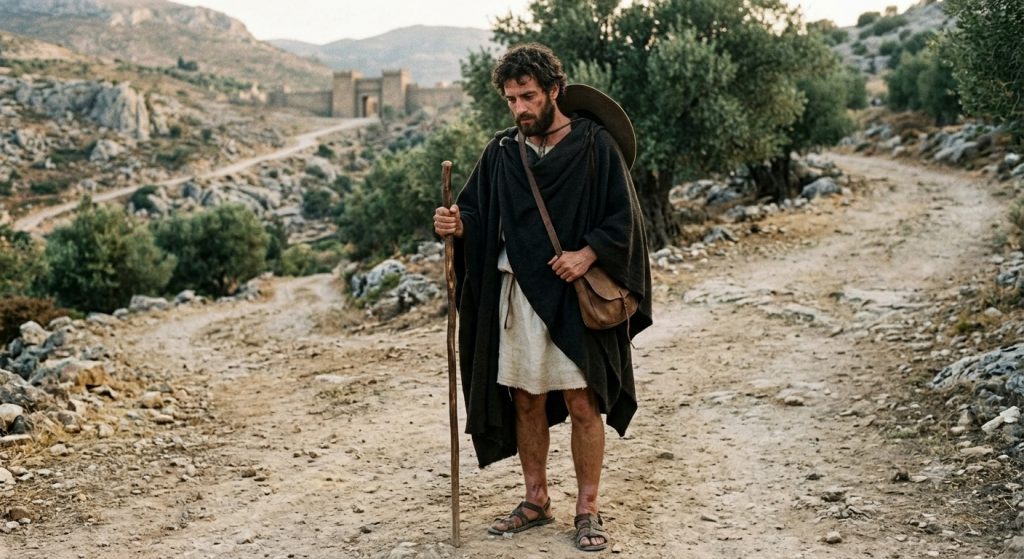
The Oracle at Delphi told Laius, king of Thebes, that his son would kill him and marry his wife. Laius had his infant son’s feet pierced and bound and gave him to a shepherd with instructions to leave him on the mountainside to die. The shepherd gave the child to another shepherd instead, who brought him to the king and queen of Corinth, who raised him as their own. They named him Oedipus, which means swollen foot.
When Oedipus was grown, he heard a rumour that he was not the king of Corinth’s true son. He went to the Oracle at Delphi to ask who his real parents were. The Oracle did not answer that question. Instead it told him that he would kill his father and marry his mother. Oedipus, believing the king and queen of Corinth to be his parents, decided not to return home. He went toward Thebes instead.
At a place where three roads met, he encountered an old man in a chariot whose servants tried to force him off the road. In the altercation that followed, Oedipus killed the old man and most of his retinue. The old man was Laius, his father.
The Sphinx and the Throne of Thebes
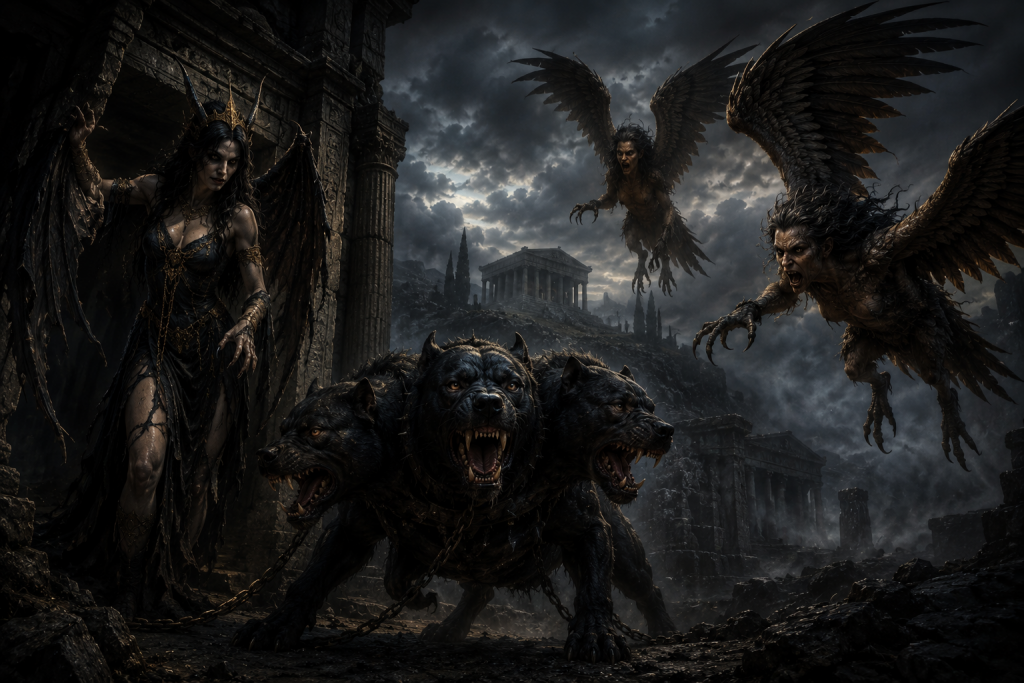
Oedipus arrived at Thebes to find the city under a curse. The Sphinx, a creature with the head of a woman, the body of a lion, and the wings of a bird, sat outside the city and asked travellers a riddle. Those who could not answer were killed and eaten. The city was paralysed.
The riddle was this: what walks on four legs in the morning, two legs at noon, and three legs in the evening? Oedipus answered correctly: a human being, who crawls as an infant, walks upright as an adult, and uses a staff in old age. The Sphinx threw herself from her rock and died. Oedipus entered Thebes as a hero.
The throne of Thebes was vacant because Laius had recently died. The city gave Oedipus the throne and the hand of the widowed queen Jocasta. Oedipus married his mother. He had four children with her. He ruled Thebes well for some years, and the city prospered.
The Discovery
A plague came to Thebes. Oedipus, the king who had solved the Sphinx’s riddle, sent to Delphi to find the cause. The Oracle told him that the plague was divine punishment for the unpunished murder of the previous king, Laius, and that the murderer must be found and expelled or killed.
Oedipus investigated with the thoroughness and intelligence that had brought him to Thebes in the first place. Tiresias the blind prophet, when pressed, told him that he himself was the murderer he was looking for. Oedipus refused to believe it. He accused Tiresias of lying and Creon, his brother-in-law, of conspiracy.
The evidence accumulated regardless of his refusal to accept it. The shepherd who had been ordered to expose him as an infant and had instead given him to the Corinthian shepherd was still alive. The Corinthian messenger who had brought the news of the king of Corinth’s death and had then revealed that Oedipus was adopted was present. Jocasta understood what was happening before Oedipus did and begged him to stop asking questions.
He kept asking. He found out.
The Ending
Jocasta hanged herself. Oedipus took the pins from her dress and blinded himself with them, then went into exile from Thebes with his daughter Antigone as his guide. He eventually died at Colonus near Athens, where the gods took him in a death that was mysterious and apparently peaceful, his body becoming a sacred protection for the land where he died.
Sophocles’s two plays, Oedipus the King and Oedipus at Colonus, are the most important treatments of the myth and among the finest works in the history of drama. The third play of the trilogy, Antigone, follows Oedipus’s daughter rather than Oedipus himself, and concerns the conflict between divine law and the law of the state over the burial of her brother.
What the Myth Is Actually About
Oedipus is the paradigmatic case in the Greek tradition of the impossibility of escaping fate, and it is constructed with precision to make that impossibility as stark as possible. Every action taken to prevent the prophecy is the action that fulfils it. Laius’s attempt to expose the child produces the Corinthian upbringing that sends Oedipus away from Corinth to avoid the prophecy, which takes him to Thebes via the crossroads where Laius is travelling. Oedipus’s attempt to avoid his parents by leaving Corinth takes him directly toward them. The investigation he conducts to save Thebes reveals the truth that destroys him.
Sigmund Freud took the myth as the name for the psychological complex he identified, and the Oedipus complex entered the language as the term for the child’s unconscious desire for the opposite-sex parent. The appropriateness of the name has been debated since Freud proposed it: Oedipus had no conscious desire for his mother and no knowledge that she was his mother, which is precisely the opposite of what Freud meant by the complex. The myth names an unconscious dynamic while describing a conscious tragedy, which is either deeply appropriate or a significant misreading of the original depending on your position.
Further Reading
If this article sparked your interest, these are the books worth reading next.
The Iliad — Homer (Penguin Classics)
by Homer — the primary source for everything in this article, and still the most vivid account of the Trojan War ever written.
The Odyssey — Homer (Emily Wilson translation)
by Homer, translated by Emily Wilson — the best modern English translation, and the book that contains Odysseus’s own account of the horse.
The Trojan War: A Very Short Introduction
by Eric Cline — the clearest and most up to date account of what archaeology actually tells us about Troy and whether any of it happened.
For more on the Greek tradition, the Tiresias article covers the blind prophet who tells Oedipus the truth he does not want to hear. The Sphinx article covers the creature outside Thebes whose riddle Oedipus solves and whose death gives him the throne. The Greek Mythology hub page has every article in the cluster.
Never miss a myth
Thank you for being here. The site is brand new and every subscriber genuinely means something to me. If you're here, you care about this stuff as much as I do - and that's all the reason I need to keep going. New stories, videos and dark folklore from around the world, straight to your inbox. No algorithm. Just the stories, when they're ready.