In 1659, the Oxford English Dictionary records the following observation about the English public: “Most People are agast at them, like children at Raw-head and Bloody-bones.” The comparison assumes that the reader already knows what Rawhead and Bloody Bones is and why the name produces fear. No explanation is offered. No description of the creature is given. The name alone is sufficient to communicate the concept of absolute childish terror, which tells you something important about how thoroughly embedded this figure was in the English imagination by the mid-17th century.
It also tells you something important about the problem at the centre of the Rawhead tradition, which is this: for a creature so well-known that a 17th century writer could invoke it without explanation, Rawhead and Bloody Bones has almost no actual stories attached to it. The name survives. The fear survives. The specific tales that would tell you what Rawhead does, how it behaves, where it lives, and what rules govern it: those are almost entirely gone.
M.R. James, the great English ghost story writer, noted this in 1925 with evident frustration. He had been researching the figure and found abundant evidence of the name’s currency in the oral tradition but almost no narrative content. The name had persisted across centuries of English folklore while the stories that gave the name its meaning had vanished. What remained was the threat: a bogeyman invoked by parents, a darkness under the stairs, a thing that took children who misbehaved. The specifics of how it did this, what it was, where it came from, had somehow been lost in transmission.
What the Name Means
The name itself is one of the more viscerally effective in English folklore. Rawhead: a head that has been flayed or skinned, a skull without its covering, a thing that should not be seen. Bloody Bones: the skeletal remainder, the body stripped to its structural components, clattering and red. Together they describe something assembled from the aftermath of violence rather than from the conventional materials of living creatures, which places Rawhead in a category of English supernatural figures that are defined not by what they are but by what has been done to them.
The earliest written appearance is in the Oxford English Dictionary’s citation of approximately 1548, making Rawhead and Bloody Bones one of the oldest named bogeyman figures in the English record. It appears in variant forms across the centuries: Tommy Rawhead, Old Bloody Bones, Raw Head, Rawbones. Regional variations accumulate different names without changing the essential character. John Locke referenced it in 1693, observing that such figures were used to awe children and keep them in subjection. Samuel Johnson defined Rawhead in his dictionary as a spectre mentioned to frighten children, which is a definition that tells you about the function rather than the creature.
What Locke and Johnson both make clear is that by the 17th and 18th centuries, Rawhead and Bloody Bones was being used by educated commentators as an example of the kind of irrational fear that children were subjected to and that adults should presumably move beyond. The creature had already been domesticated into a pedagogical example before most of its stories had been written down, which may be part of why so little survived.
What Fragments Remain
The most specific description of Bloody Bones in the English tradition comes from Ruth Tongue’s Somerset Folklore, collected in the 20th century from oral sources. Tongue records that Bloody Bones lived in a dark cupboard, usually under the stairs. If you were brave enough to look through a crack in the door, you would see a dreadful, crouching creature with blood running down its face, seated on a pile of raw bones that had belonged to children who told lies or said bad words. It was waiting. The bones were evidence. The creature was patient.
The cupboard location is significant. Rawhead and Bloody Bones in the English tradition is a domestic horror, living inside the house rather than outside it. The threat is not the forest or the moor or the water but the space under the stairs, the dark cupboard, the interior darkness that every child knows exists and that adults insist contains nothing. The creature validates the child’s suspicion that the darkness inside the house is as dangerous as the darkness outside it, which is a considerably more disturbing proposition than an external threat.
In the north of England, particularly in Lancashire and Yorkshire, a different configuration appears. Here Rawhead is associated with water: deep ponds, old marl pits, and riverbanks where misbehaving children who ventured too close might hear hollow footsteps before being dragged under. This aquatic version connects Rawhead to a broader tradition of English water spirits and pool monsters, distinct from the cupboard version but sharing the same basic function: a creature that takes children who go where they should not go or do what they should not do.
A Yorkshire nursery rhyme recorded in the 19th century gives the creature its most concentrated narrative form:
Rawhead and Bloody Bones
Steals naughty children from their homes,
Takes them to his dirty den,
And they are never seen again.
Four lines. A name, a method, a location, a consequence. The nursery rhyme form strips the creature to its functional minimum and in doing so preserves exactly what parents needed preserved: the threat, the mechanism, the outcome. What the den looks like, what happens inside it, what Rawhead actually is: these details were never part of the function and apparently never survived.
The Atlantic Crossing
One of the more interesting aspects of the Rawhead tradition is what happened to it when English settlers carried it to North America. The name and the basic concept crossed the Atlantic intact and took root in the folklore of the American Southeast, Appalachia, and the Ozarks, where it persisted into the 20th century in communities that had largely lost contact with the English tradition it came from.
In the American South, Rawhead and Bloody Bones developed in ways the English tradition had not. It grew larger and more specific. It acquired a backstory in some versions: a razorback hog killed by a hunter, whose spirit returned as a monstrous figure seeking revenge. It became associated with swamps and bayous rather than cupboards and ponds, adapting to the landscape of its new home. It appeared in collections of Ozark and Appalachian ghost stories well into the 20th century, showing how the South preserved and developed a tradition that had largely contracted to a name in its country of origin.
The transatlantic journey is documented in the folklore record: the figure was so widespread in the English oral tradition by the time of the major settlement periods that it crossed with the settlers as naturally as their language and their domestic habits. What the American tradition did with it says something interesting about how folklore adapts: the English version had lost its stories but retained its name and its terror; the American version rebuilt the stories around the name, using the materials of the new landscape rather than the old one.
Clive Barker and the Reinvention
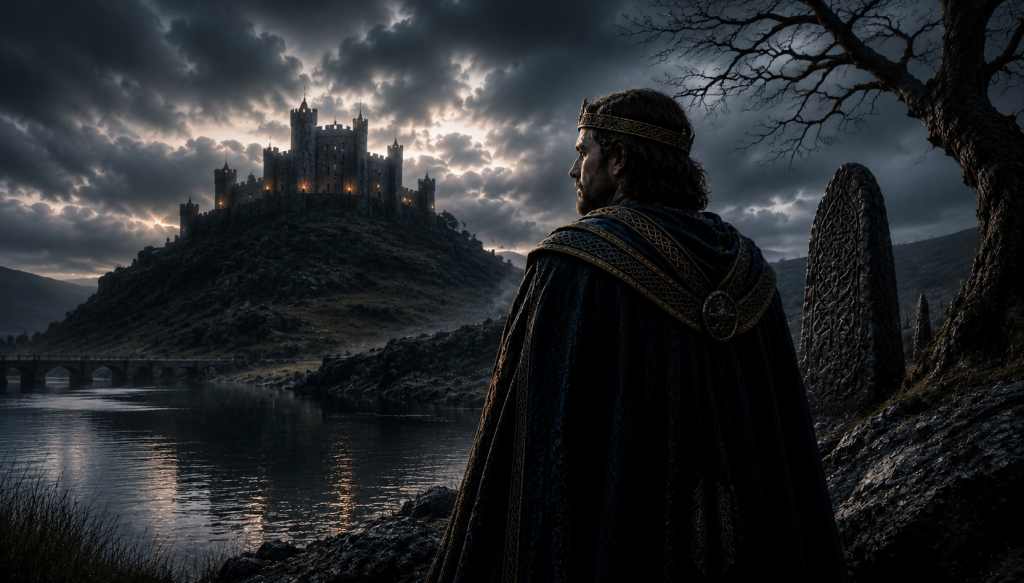
In 1984, Clive Barker published a short story called Rawhead Rex in his Books of Blood anthology. The story takes the name from English folklore and does something radical with it: it imagines Rawhead not as a nursery bogeyman but as an ancient pagan deity, something that existed in Britain before Christianity arrived and that had been buried under a field in rural England, its power contained by a standing stone. When a farmer ploughs up the stone, Rawhead is freed and proceeds to rampage through the English countryside in a manner that is explicitly sexual as well as violent, reading the coming of Christianity as a castration of the old powers and taking his revenge accordingly.
Barker’s Rawhead is enormous, nine feet tall in some descriptions, with a head that gives the story its title: a vast, raw, skull-like thing that is the most terrifying thing about him. He is not a bogeyman designed to frighten children into obedience. He is a pre-Christian force of nature, the kind of thing that the Christianisation of Britain suppressed rather than defeated, and whose return represents the return of everything that suppression was designed to contain.
The story was adapted into a film in 1986, set in Ireland rather than England, which Barker himself was famously dissatisfied with. The film is generally considered a lesser version of the source material, though it introduced Rawhead Rex to an audience that would not otherwise have encountered either the short story or the folklore behind it.
What Barker did with the tradition is worth examining because it represents one of the more intelligent uses of English folklore in modern horror fiction. He took a figure whose original stories had been lost and asked what kind of creature would have generated a name that specific and a fear that persistent. His answer, an ancient pagan deity whose nature was antithetical to the Christian world that had replaced him, is not derived from the historical folklore but it is consistent with it in an oblique way: the absence of specific stories about Rawhead is explicable if Rawhead was the kind of thing that the incoming religious tradition had an active interest in suppressing rather than preserving.
That reading is speculative and Barker would be the first to say it is fiction rather than folklore scholarship. But it raises a genuine question about the English tradition that the folklorists who noted the absence of stories never quite answered: what kind of creature generates a name that lasts from 1548 to the present without any of its stories surviving? The bogeyman explanation is sufficient for the nursery rhyme version. It is less satisfying for something that M.R. James considered worth researching and could not find.
Rawhead and the English Bogeyman Tradition
Rawhead and Bloody Bones belongs to a category of English folklore figure that is defined by function rather than by narrative: the bogeyman, the thing invoked to make children behave, the darkness given a name so that the name itself can do the disciplinary work. This category includes the Boggart, which you will find covered elsewhere on this site, and various regional figures whose names vary while their function remains consistent.
What distinguishes Rawhead within this category is the persistence of the name and the specificity of the image. Most English bogeymen are genuinely vague, defined by their function alone with no fixed appearance. Rawhead has the raw flayed head, the bloody bones, the cupboard under the stairs, the pile of children’s remains. The image is precise even when the narrative is absent, which suggests that something specific was once attached to it and has since been lost rather than that nothing was ever there.
The Boggart, by comparison, has a rich body of stories in the Lancashire and Yorkshire tradition, full of specific incidents and specific behaviours and specific methods of dealing with it. Rawhead has the name and the bones. The disparity is difficult to explain and several folklorists have tried without fully succeeding.
One possibility is that Rawhead was always more of a verbal threat than a narrative tradition, a name invoked rather than a story told, and that what was lost was never stories in the conventional sense but the specific intonation and context that made the name work in the moment of invocation. A child threatened with Rawhead in 1650 was not being told a story. They were being confronted with a word that had accumulated enough cultural weight to function as a threat without any story attached. When that cultural weight dissipated, the word remained but the weight behind it did not.
The name is still there. Clive Barker found it and did something with it. The nursery rhyme is still findable. The cupboard under the stairs is still dark. Whether whatever Rawhead originally was is also still there, waiting for someone to look through the crack in the door, is a question the English folklore tradition has never quite answered.
For more on the bogeyman tradition of England, the Boggart article covers the domestic supernatural figure from Lancashire and Yorkshire whose story survived where Rawhead’s did not. The broader England category has more on the creatures and legends of the English tradition.
Never miss a myth
Thank you for being here. The site is brand new and every subscriber genuinely means something to me. If you're here, you care about this stuff as much as I do - and that's all the reason I need to keep going. New stories, videos and dark folklore from around the world, straight to your inbox. No algorithm. Just the stories, when they're ready.