
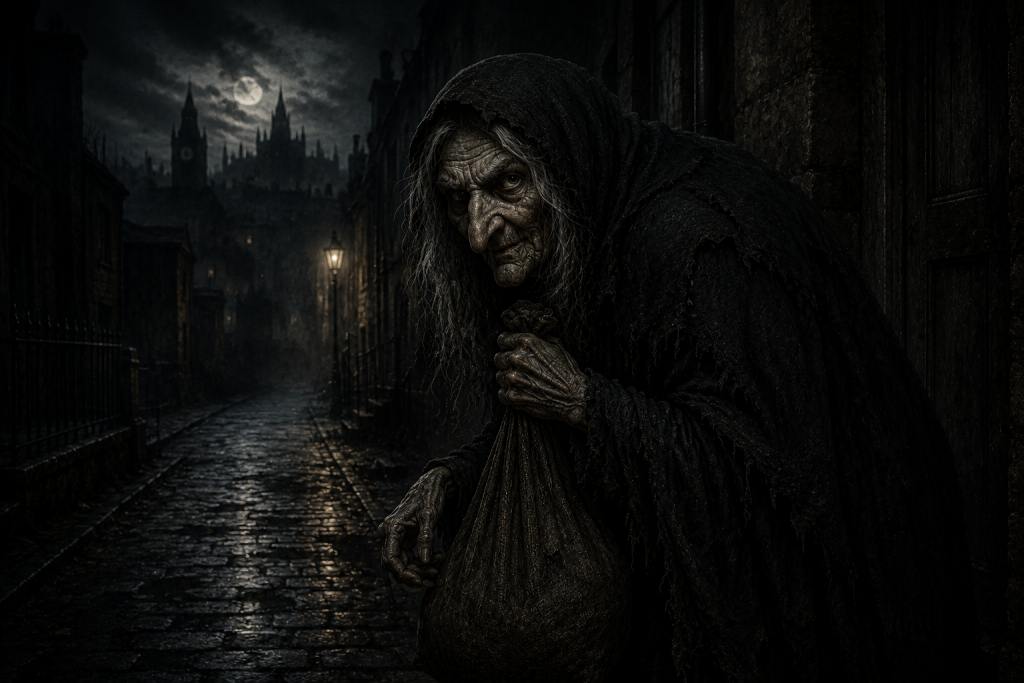
Glasgow Folklore: The Darker Side of Scotland’s Biggest City
Glasgow does not have the obvious mythology of Edinburgh. It has no castle on a volcanic rock, no Royal Mile lined with ghost tour operators, no Mary King’s Close. What it has instead is stranger and in many ways more interesting: a folklore that grew directly out of the city itself, shaped by its tenements, its cemeteries, its demolished neighbourhoods, its industrial history, and its particular talent for producing stories that refuse to go away.
The children who marched into the Southern Necropolis in 1954 to hunt a vampire with iron teeth were not acting on ancient tradition. They had invented something new, something that belonged entirely to Glasgow, to its streets and its school playgrounds and its particular way of processing the frightening. Maggie Murphy, the child-stealing monster of the back closes, is not found in any Scottish folklore compendium. She was made in Glasgow, by Glasgow, for Glasgow children. Jenny wi’ the Iron Teeth predates both of them and belongs to the same lineage: a local monster for a local community, a story that does what all the best stories do, which is to take the real fears of a real place and give them a shape you can name.
This page collects everything on this site about Glasgow’s folklore, ghosts, urban legends, and hidden history. The articles below cover the famous stories and the ones that are barely known outside the city, the ones that deserve a wider audience, and the ones that have been waiting for someone to take them seriously.






Every major city has a mythology. London has Jack the Ripper and Spring-Heeled Jack and the ravens at the Tower. Edinburgh has Burke and Hare and the ghost of Mary King’s Close and Greyfriars Bobby. Glasgow’s mythology is less tidy than either of those, less packaged for tourism, and considerably harder to find in any one place. That is partly what makes it worth finding.
Glasgow’s stories tend to come from the streets rather than from the history books. The Gorbals Vampire was never in a medieval chronicle. Maggie Murphy was never catalogued by a Victorian folklorist. These are living traditions, oral traditions, the kind that get passed from older siblings to younger ones in the back courts of tenement buildings, and they have the quality that living traditions always have: they change, they adapt, they attach themselves to new locations and new generations, and they keep working because they are doing something real for the communities that tell them.
The articles on this site treat Glasgow’s folklore the way it deserves to be treated: as serious material, worth investigating properly, worth tracing to its sources, worth asking hard questions about. Where a story turns out to have a documented history, that history is examined. Where a story turns out to be genuinely mysterious, that mystery is respected rather than explained away.
Glasgow has more of this material than most people realise, and this site intends to cover all of it.