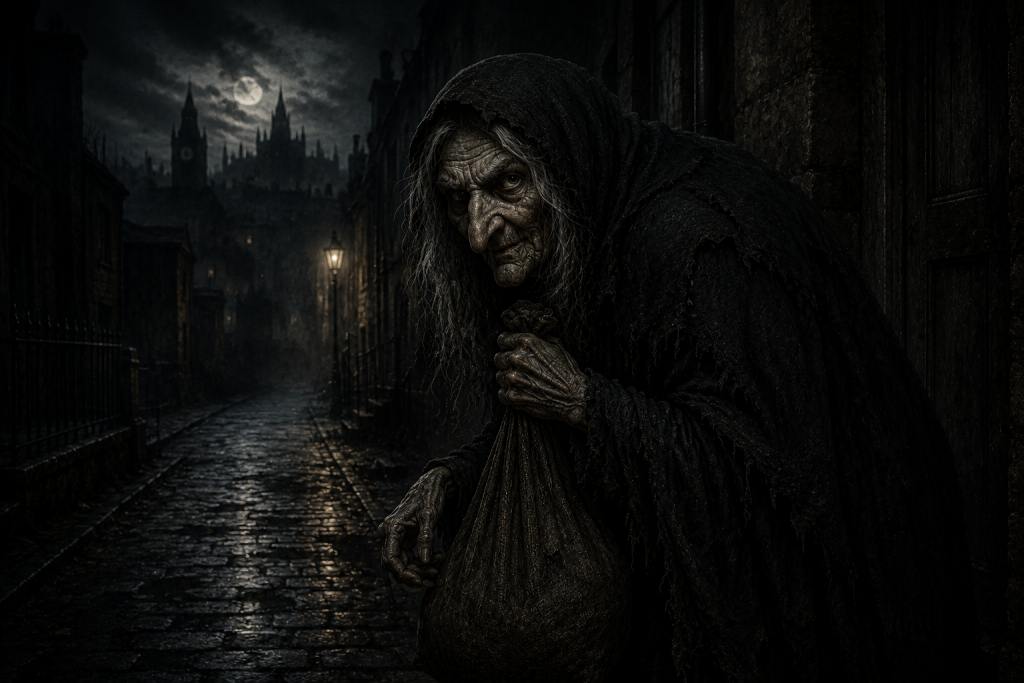

Pollok House sits in the south side of Glasgow, surrounded by the rolling parkland of Pollok Country Park, its Georgian facade giving little outward indication of the darker history that played out on its grounds three and a half centuries ago. The Maxwell family lived on this site for six centuries, one of the most powerful landed dynasties in the west of Scotland, and their history contains the full range of things that powerful Scottish families accumulated across those centuries: war, politics, religion, art, and, in the winter of 1676, an accusation of witchcraft that sent five people to their deaths and launched one servant girl on a trajectory so strange that it eventually reached the other side of the Atlantic.
The story of the Witches of Pollok is not simply a local curiosity. It is one of the better documented cases in the history of Scottish witch trials, with named individuals, a specific location, a clearly reconstructable sequence of events, and one of the most genuinely puzzling central figures in the entire Scottish witchcraft record. It is also, if the tradition that has attached itself to Pollok House is to be believed, a story that has not entirely ended.
The accused are still in the house, according to those who have spent time there. They are looking for Janet Douglas.
Sir George Maxwell and His Dark Mission
Lord George Maxwell of Pollok was, in the Scotland of the 1670s, a man who took his religious and civic duties seriously to a degree that, in retrospect, looks considerably more disturbing than virtuous. He was an active participant in the prosecution of witchcraft, a man who attended trials and took satisfaction in the outcomes, who understood himself to be doing God’s work in the identification and destruction of those who had made pacts with the Devil.
In 1676, Maxwell returned from a witch trial and fell ill almost immediately afterward with what he described as a hot and fiery distemper, an agony in his side that he attributed to being stabbed by an unseen force. The illness was serious enough and sudden enough that his household was thrown into the anxious management of a sick man that absorbed considerable attention and energy in a large seventeenth century household.
Among those working in that household was a young woman named Janet Douglas. Janet was deaf and mute, had been for as long as anyone in the house could remember, and had consequently occupied exactly the position that a deaf and mute servant would occupy in a seventeenth century Scottish household: invisible, hardworking, unremarked upon, and entirely without social standing beyond the small world of domestic service.
Then Janet Douglas began to speak.
The Servant Who Found Her Voice
The return of speech to someone who had been mute is a dramatic event in any context, and in the world of seventeenth century Scotland it carried an immediate weight of supernatural significance that the modern world does not easily replicate. Janet’s sudden ability to speak was not understood as a medical recovery. It was understood as a sign.
And what Janet said with her recovered voice was specific, confident, and immediately directed at her neighbours.
She proclaimed that Lord Maxwell’s illness was the result of a dark spell laid upon him by witches. She named Janet Mathie, the midwife of the nearby village of Pollokshaw, as the primary culprit. She led servants from Pollok House to Mathie’s home and directed them to search it, announcing with the same calm authority that had appeared from nowhere along with her voice that they would find a wax figurine hidden behind a portrait near the fireplace.
They found it.
This discovery was the trigger for everything that followed. The finding of a wax figure, understood as a poppet used for sympathetic magic against a specific target, was precisely the kind of physical evidence that witch trial proceedings of the period treated as confirmation of diabolical practice. Janet’s accusation was now supported by material evidence, and the investigation that followed had momentum that the accused had very little means of stopping.
The Accused and What Happened to Them
The accusations spread from Janet Mathie with the speed that witchcraft accusations had always spread in seventeenth century Scotland, gathering in names and connections and confessions extracted under the particular pressures that the legal process of the period deployed.
Bessie Weir, the wife of a weaver from Paisley, was accused. Margaret Jackson was accused. Marjory Craig was accused. John Stewart, Janet Mathie’s own son, was accused. And Annabel Stewart, Mathie’s fourteen-year-old daughter, was accused alongside the rest of them.
The confessions that followed the arrests told a consistent story, or at least a story that had been made consistent through the process of its extraction. All of the accused confirmed meeting with the Devil. All confirmed that their bond in the meeting was a shared hatred of Lord Maxwell, who had been the instrument of previous prosecutions. The mechanics of the curse were distributed among the accused in ways that spread the guilt while ensuring that no single person could claim the specific act had been theirs alone.
The trial took place in 1677. All of the adult accused were convicted. Bessie Weir, Margaret Jackson, Marjory Craig, Janet Mathie, and John Stewart were strangled and burned at Gallows Green in Paisley. They were ordinary people in the most specific sense that the historical record can confirm: a midwife, a weaver’s wife, a woman with a mysterious Irish past that became evidence against her, a family destroyed from within by accusation and counter-accusation. None of them were the monstrous figures that the witch trial tradition sometimes conjured. They were neighbours and tradespeople who found themselves in the path of something they could not stop.
Annabel Stewart, fourteen years old, was spared execution. She was instead sent to a convent, separated from the community that had known her entire life, expected to be grateful for a mercy that had cost her everyone she had ever known.
What Happened to Lord Maxwell
The object of the entire episode, Lord George Maxwell, recovered from his illness during the course of the proceedings. Whether this was attributed to the breaking of the spell by the arrests and executions, to ordinary medical recovery from whatever had actually afflicted him, or to some combination of the two in the minds of those around him, is not clearly established in the surviving record.
Maxwell died in 1677, the same year as the executions, of natural causes unrelated to the original illness. The man whose sickness had set everything in motion was dead before the year was out, leaving behind the burned and buried remains of five people and a fourteen-year-old girl in a convent somewhere in Scotland.
The wax figure was never conclusively explained. It was found where Janet Douglas said it would be found. Whether it was placed there by Janet Mathie for the purpose accused, whether it had some entirely different innocent explanation that the interrogators were not interested in pursuing, or whether Janet Douglas had more direct knowledge of its location than her story of supernatural revelation implied, are questions that the historical record raises without resolving.
Janet Douglas and the Road to Salem
Of all the extraordinary elements in the Pollok House story, none is stranger than what is reported to have happened to Janet Douglas after the events of 1676 and 1677.
The servant whose sudden recovery of speech had initiated the entire sequence, who had led men to the wax figure, who had named the accused, did not remain in the comfortable position her apparent supernatural gifts might have secured for her in the Maxwell household. According to the tradition preserved by the National Trust for Scotland and by historians of the period who have examined her case, Janet Douglas eventually travelled to America, and appeared in connection with the Salem witch trials of 1692.
The Salem trials, the most notorious episode of witch prosecution in American history, took place sixteen years after the Pollok events, and the suggestion that Janet Douglas was present at or connected to them draws a line between the west of Scotland and colonial Massachusetts that is as remarkable as it is difficult to fully document. What her role was, whether as accuser, witness, or something else entirely, is not specified in the accounts that make this claim. The tradition preserves the connection without supplying its full details.
What can be said with some confidence is that Janet Douglas was a figure sufficiently unusual, with sufficiently well-developed instincts for the mechanics of witchcraft accusation, that the idea of her moving through the Atlantic world of the late seventeenth century and leaving marks wherever she went is not straightforwardly implausible. The accusation cultures of Scotland and New England in this period were connected by genuine transatlantic religious and cultural links, and individuals moved between them with more frequency than the distance might suggest.
The question of what Janet Douglas actually was, a genuinely clairvoyant woman whose recovered speech was a real supernatural event, a calculating and deliberate instrument of a community’s anxieties, or something more complex and less easily categorised than either of those readings, is one that the historical record has never answered and probably never will.
The Ghosts That Remain
The tradition associated with Pollok House holds that the women who were accused and executed have not entirely left the grounds and the building. Their presences are reported in the house, and the specific quality attributed to them, that they wander the building searching for Janet Douglas, gives the haunting a narrative continuity that connects the seventeenth century events to the present in a specifically purposeful way.
They are not random presences, in this tradition. They are looking for someone. The women who were strangled and burned at Gallows Green in Paisley are understood to have unfinished business with the servant girl who spoke their names aloud in the winter of 1676, and that business has kept them in the vicinity of the house where it all began.
Pollok House is currently closed for restoration works while a major programme of investment addresses the building’s fabric, with a planned reopening after the works are completed. When the house reopens, the tradition will still be there. The women will still be walking the rooms. And whoever stands in those rooms for the first time, knowing the story of what happened here in 1676, will understand what they are walking into, and who might be looking back.
If you enjoyed this article, the creatures and legends of Scotland are collected in my book Tales of Myth and Magic, Volume I: Scotland — 25 tales told in full, each traced to its earliest sources, with a map, glossary, and full bibliography. Available in paperback for £11.99.
Find Out More →Further Reading
If this article sparked your interest, these are the books worth reading next.
Scottish Urban Legends: 50 Myths and True Stories
by Aaron Mullins — fifty Scottish urban legends including stories from Glasgow, Edinburgh, and the Highlands. The kind of tradition that Maggie Murphy belongs to, collected properly in one volume.
Scottish Urban Myths and Ancient Legends
by Grace Banks and Sheena Blackhall — vampires, werewolves, devil encounters, and the school playground legends of Scotland. A genuinely good collection of the stories Scots have been telling each other for generations.
The Lore of Scotland: A Guide to Scottish Legends
by Jennifer Westwood and Sophia Kingshill — the most comprehensive collection of Scottish legend in print, covering Glasgow to Shetland, exploring origins and historical basis. Endorsed by Terry Pratchett as the real macabre.
For more on Glasgow’s dark history, the Granny Kempock article covers the ancient stone that witches danced around and sailors feared to offend. The Provan Hall article covers Glasgow’s most haunted medieval building. The Glasgow Folklore page has every article on the city’s dark history in one place.
Never miss a myth
Thank you for being here. The site is brand new and every subscriber genuinely means something to me. If you're here, you care about this stuff as much as I do - and that's all the reason I need to keep going. New stories, videos and dark folklore from around the world, straight to your inbox. No algorithm. Just the stories, when they're ready.