
Before the iron bones of Glasgow Central Station took shape, before the platforms roared and the tunnels filled with the human tide of a working city, there stood a quieter and in some ways gentler place. Grahamston. Brick by brick it was erased, and forgotten by time. But not entirely.
This is the story of the Lady in Black, and it begins not with a ghost hunt or a paranormal investigation but with a book. Two books, in fact, written by someone who had actually lived in Grahamston before the demolition came, who had walked its streets and known its buildings and recorded what daily life in that vanished community had looked and felt like. I came across these accounts quite by accident while researching the village’s history, and they are a fascinating read in their own right, the kind of primary source that gives a demolished place its texture and its specific gravity back.
In one of these books, the author describes something the local schoolchildren believed with the particular conviction that children reserve for things that have genuinely frightened them.
The Villa at the Upper End
At the upper end of Grahamston, where West Jaw Street now cuts through the heart of the modern city, there stood a row of detached villas. Dignified buildings, proud even. Their windows had once framed hills instead of chimneys, and their gardens had known roses rather than weeds.
But by the late 1800s, the westernmost villa in the row had become something else entirely. The other villas on the street were kept up well enough, maintained by their occupants in the ordinary way of things. This one was different. Its windows had been shattered, not slowly by time but by the accumulated attentions of the boys of Melville Street. Its garden had gone wild with creeping ivy and rust-coloured nettles. The gate leaned at the angle of something that had given up. The front steps were green with moss.
People walked past quicker than they used to. Some crossed the road without quite realising they were doing it.
Everyone knew that house was haunted.
Not haunted in the way children’s books describe, with chains and candles and dusty portraits shifting on their own. This was a different kind of haunting. Still. Heavy. A growing sense that the house did not want you near it. No creaks, no strange music. Just the particular quiet that some buildings acquire when something has happened inside them that the walls have not recovered from.
The Testing Ground
The garden with its strange hush and looming windows became, as abandoned properties in working-class Victorian communities often did, a testing ground for courage. The boys from Drury Lane and the surrounding streets made a sport of it in the way that boys always have and probably always will. You were not really brave until you had jumped the fence. You were not really from Grahamston until you had touched the iron railings and not flinched.
Even the boldest children avoided it at night. By night, those railings turned cold enough to burn skin on contact. And those who lingered after dark said they heard breathing.
On one clear afternoon, the account records, a group of boys sat across from the house. Their laughter had dimmed in the way laughter dims when certain subjects come up. The talk turned, as it always turned eventually in that street, to the woman in black.
There’s no such thing, said Davey, the tallest of them, wearing his father’s army jacket with the unearned authority of a boy who has not yet been properly frightened. My cousin was in last month. Just empty rooms.
The challenge took its natural shape. Four of them rose. Davey. Tommy. Wee Billy. Fraser. They crossed the lane, boots on gravel. The rusted gate gave way with the groan of something not expecting to be opened. The front door, swollen with years of rain, swung inward like a theatre curtain going up.
They stepped inside.
Inside the Villa
The air was thick with the smell of rotten old fires. Wallpaper hung from the walls in strips. Floorboards sagged. Somewhere in the darkness, water dripped in the irregular, unhurried way of abandoned buildings.
They called out. They taunted the empty rooms. They yelled into the shadows with the specific kind of bravado that is mostly performance and only partly genuine.
Lady in black, are you home? Where are you? Come out and scold us.
The laughter bounced off the walls.
Then the laughter stopped, as if something had swallowed the sound.
Then came the scream.
Not the kind of scream you laugh at later. The kind that freezes the marrow. They bolted, all four of them, colliding with each other in their hurry to leave. Tommy scraped his knee on the gate going out. Billy dropped his hat and did not go back for it. The others had gathered outside, alerted by the noise, and they surrounded the returning four with the laughter and mockery that the situation called for, until the door creaked again.
And every voice fell silent.
The Lady in Black
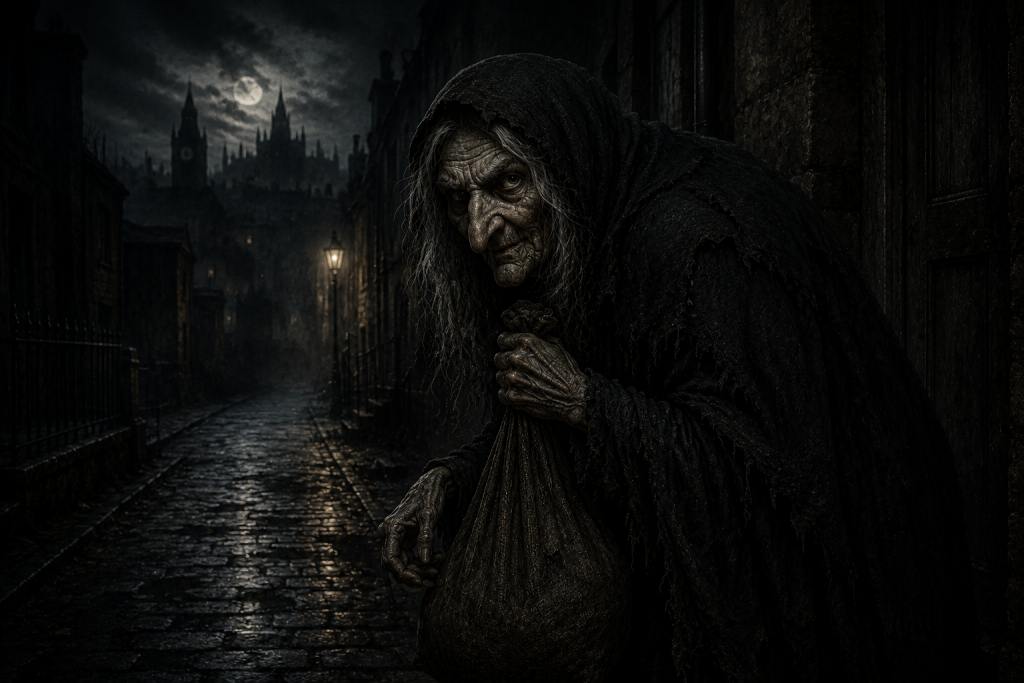
From the gloom of the ruined villa, a figure emerged.
A woman. Tall. Unmoving. Dressed head to toe in black.
The historical account is specific about this, and it is the detail that lodges in the memory most firmly. Her garments were not dusty or ragged. They hung clean, regal, as if mourning had made her eternal. A black veil draped her face. And yet every child who was there that day later swore that they had felt her stare move over them. Not judging. Measuring.
No one ran. No one spoke.
She raised one arm. Her hand curled into a tight fist. She shook it once, slowly, silently, with a finality that closed the moment like a door being shut.
Then she turned back into the house and the door closed behind her. It was not a slam. It was not rushed. It was deliberate, like punctuation at the end of a sentence that no one present had any intention of reading aloud.
The account records that the house was demolished within the year. Locals were told it was structurally unsound, which it certainly was by that point, and new buildings rose where it had stood. The westernmost villa of the row at the upper end of Grahamston disappeared along with the rest of the village as the station construction consumed the district.
But for the children who had seen her, the Lady in Black did not disappear with it.
What She Was and What She Wanted
There were theories, of course. There are always theories.
Some said she had been a widow, unhinged by grief, who had retreated into the villa and refused to leave as everything around her deteriorated. In this reading she was a tragic and human figure rather than a supernatural one, a woman who had simply chosen the company of a crumbling house over whatever waited for her outside it, and whose unexpected appearance in a doorway she had every right to stand in had terrified a group of children who had no business being there.
Others, particularly the ones who did not tell their full stories until much later if they told them at all, believed something different. They believed that she had been waiting. That the specific quality of her appearance, the immaculate black dress in a house that had been derelict for years, the veil, the measured stare, the single slow shake of a fist that was not anger but something older and more considered, suggested a figure that was not simply an eccentric resident clinging to a condemned property.
She had been waiting for someone to open the door. For someone to come into the space where Grahamston had been and remember, even accidentally, even out of nothing more substantial than a dare, what had been buried beneath the concrete and the stone.
Whether the Lady in Black was the ghost of someone who had died in that villa, a figure from the broader history of a community being erased, or something that existed only in the collective memory and collective fear of Grahamston’s children and was therefore no less real for that, I cannot tell you.
What I can tell you is that the account I found of her was written by someone who had been there, who had known the community, who recorded this specific building and this specific tradition without sensationalism or embellishment, in the same tone and the same careful attention to detail with which he recorded the baker’s hours and the school’s location and the names of the families who had lived in the dignified villas before the westernmost one began its long decline.
He wrote it down because it had happened. The children had seen her. And the account of what they saw has survived the demolition of every building it describes, which is its own kind of haunting.
Grahamston is gone. The station is built on what it left behind. The Lady in Black stood in a doorway that no longer exists, in a house that was pulled down within the year, and shook her fist at a group of children who spent the rest of their lives not entirely sure what they had seen.
She has nowhere left to appear.
Unless, of course, she is still down there in the foundations, in the dark below the platforms, in the corridors that nobody has fully mapped, waiting with the patience of something that has been waiting since the 1870s for someone to finally open the right door.

If you enjoyed this article, the creatures and legends of Scotland are collected in my book Tales of Myth and Magic, Volume I: Scotland — 25 tales told in full, each traced to its earliest sources, with a map, glossary, and full bibliography. Available in paperback for £11.99.
Find Out More →Further Reading
If this article sparked your interest, these are the books worth reading next.
Scottish Urban Legends: 50 Myths and True Stories
by Aaron Mullins — fifty Scottish urban legends including stories from Glasgow, Edinburgh, and the Highlands. The kind of tradition that Maggie Murphy belongs to, collected properly in one volume.
Scottish Urban Myths and Ancient Legends
by Grace Banks and Sheena Blackhall — vampires, werewolves, devil encounters, and the school playground legends of Scotland. A genuinely good collection of the stories Scots have been telling each other for generations.
The Lore of Scotland: A Guide to Scottish Legends
by Jennifer Westwood and Sophia Kingshill — the most comprehensive collection of Scottish legend in print, covering Glasgow to Shetland, exploring origins and historical basis. Endorsed by Terry Pratchett as the real macabre.
The full history of Grahamston, including the hidden Victorian platform beneath Glasgow Central Station and the carved stone room found beneath Union Street, is covered in the Grahamston article. The Glasgow Folklore page has every article on the city’s dark history in one place.
Never miss a myth
Thank you for being here. The site is brand new and every subscriber genuinely means something to me. If you're here, you care about this stuff as much as I do - and that's all the reason I need to keep going. New stories, videos and dark folklore from around the world, straight to your inbox. No algorithm. Just the stories, when they're ready.