
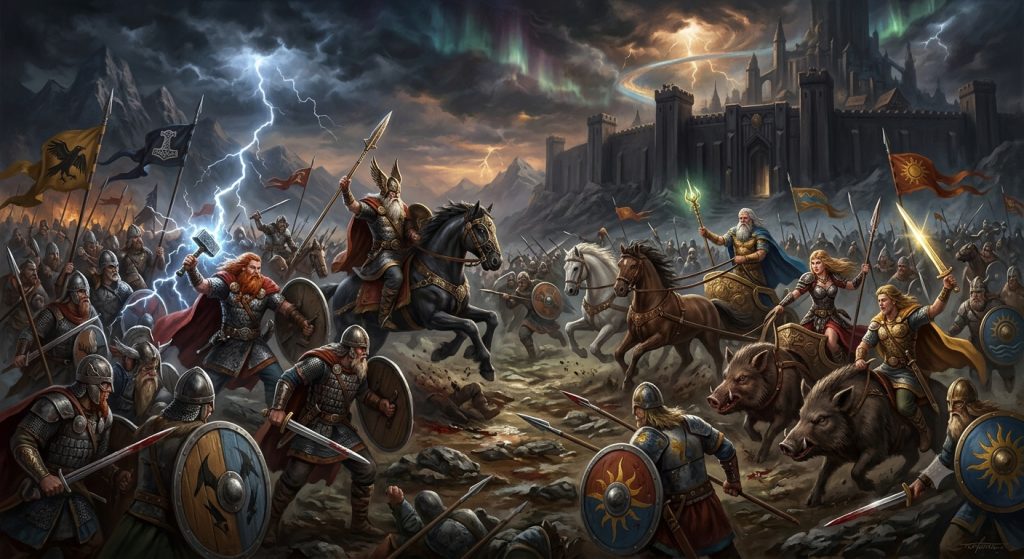
The Norse gods as most people know them are a single community: Odin, Thor, Frigg, Freyr, Freyja, Njörðr, all living together in Asgard under Odin’s authority. This picture is not wrong but it is incomplete. The community that exists in the Eddas is the result of a war, and before that war there were two separate groups of divine beings who fought each other to a standstill and then merged into the single pantheon the tradition preserved.
The Aesir-Vanir War is the least well-known major event in Norse mythology and arguably the most consequential. Without it, the three most important Vanir deities would not be in Asgard. Without it, Kvasir the wisest being ever created would not exist, and without Kvasir there would be no Mead of Poetry and no poetic inspiration in the Norse cosmos. Without it, Mímir’s head would still be attached to Mímir’s body rather than being kept in Odin’s possession as a counselling resource, which is one of the more grotesque arrangements in world mythology. The war determined the shape of the tradition, and the tradition preserves only fragments of why it happened and almost nothing about how it was fought.
The Primary Sources and Their Limits
The Aesir-Vanir War is documented in the Völuspá in the Poetic Edda, in the Skáldskaparmál section of the Prose Edda, and most extensively in the Ynglinga Saga which forms the opening section of Snorri’s Heimskringla. The three accounts do not fully agree with each other, and none of them provides a comprehensive account of the war’s causes, course, or resolution. What they preserve are specific events: the incident that started the conflict, the exchange of hostages that ended it, and the creation of Kvasir from the peace settlement.
This incompleteness is significant. The war is the foundational event of the Norse divine community, the moment that produced the pantheon as it exists in all subsequent sources, and the tradition has preserved it in fragmentary form. This suggests either that the war predates the Eddic tradition by enough time that the details had been lost before they were written down, or that the war’s origins were understood as sensitive or complex in ways that made full documentation difficult, or simply that the tradition was more interested in the consequences of the war than in its conduct.
Gullveig: The Woman Who Was Burned Three Times
The Völuspá’s account of the war’s beginning is one of the most cryptic passages in the entire Eddic tradition, and it is worth presenting carefully because it is both the oldest account of the war’s cause and the least fully explained.
A figure called Gullveig, whose name means gold drink or gold power, came to Asgard. The Aesir speared her and burned her body in the hall of the High One, Odin’s hall. She burned. She was reborn. They burned her again. She was reborn again. They burned her a third time. She rose from the flames and became a figure called Heiðr, a völva, a seeress who practised seiðr magic and was welcomed everywhere she went.
The Völuspá then states that the gods threw spears: the first war in the world. Odin threw Gungnir into the host of the Vanir, and the war began.
Who Gullveig was, why the Aesir burned her, what the burning was supposed to accomplish, and how her transformation into Heiðr connects to the outbreak of war: the poem does not explain any of these things. Scholars have proposed that Gullveig was a Vanir goddess whose association with gold represents the fertility and prosperity magic of the Vanir tradition, and that her burning by the Aesir represents an act of aggression against Vanir religious practice that made war inevitable. Others have proposed that she was a witch who corrupted Asgard with the desire for gold. Others have proposed that the three burnings and rebirth encode a sacrificial ritual practice that the tradition preserves without fully understanding.
None of these interpretations is established as correct by the sources, and the Gullveig passage remains one of the most debated and least resolved questions in Norse scholarship. What it establishes beyond doubt is that something happened involving a woman, fire, and an act of violence in Asgard before the spear was thrown. The war had a cause. The cause involved a woman the Aesir could not destroy. That is all the tradition clearly gives us.
A War Neither Side Could Win
The sources are consistent on one point about the war’s conduct: neither side won. The Ynglinga Saga describes the two sides fighting, losing ground, regaining it, and eventually concluding that they could continue indefinitely without either achieving victory. The Aesir, the gods of war and governance, could not defeat the Vanir. The Vanir, the gods of fertility and natural power, could not defeat the Aesir. The war ended not because one side surrendered but because both sides recognised that it could not be won and chose to stop.
The means of stopping is the detail that makes this the strangest peace settlement in world mythology. Both sides came together and spat into a single vessel. Every Aesir and every Vanir who participated in the war added their spittle to the same container, combining the essence of both divine families into a single mingled substance. From that substance they created a being: Kvasir.
The spitting ceremony is understood in the tradition as a formal act of peace-making, a biological merging of the two groups into a shared creation that belongs to neither side exclusively. It is also, from a practical standpoint, one of the more unusual peace rituals in recorded religious tradition. The tradition presents it without apparent embarrassment as simply what was done and what was appropriate.
Kvasir: The Wisest Being Ever Created and His Immediate Murder
Kvasir, fashioned from the combined spittle of both divine families, was the wisest being in the cosmos. No question could stump him. No matter how complex or profound the inquiry, he had the answer. He travelled the worlds sharing knowledge, which is the function the tradition assigns to the living symbol of the peace between the Aesir and the Vanir: a being who embodies combined divine wisdom and distributes it freely.
Then two dwarves named Fjalarr and Galarr invited Kvasir to visit them. They killed him, drained his blood into two vats and a pot called Boðn, Són, and Óðrerir, mixed his blood with honey, and brewed it into the Mead of Poetry. Anyone who drinks the Mead of Poetry becomes a poet or a scholar: the most gifted possible user of language, capable of wisdom and beauty beyond ordinary human reach.
The dwarves killed the wisest being ever created to make a drink. The peace settlement that ended the first war in the world produced something extraordinary, and the extraordinary thing was immediately stolen and turned into something else by beings with no interest in the peace that produced it. The Mead of Poetry eventually passes through a giant named Suttungr, who receives it as weregild for the dwarves killing his parents, into the possession of his daughter Gunnlöðr, from whom Odin retrieves it through three nights of seduction and three draughts from the containers. Odin brings the mead to Asgard and shares it with the gods and with worthy humans.
The entire tradition of poetic inspiration in the Norse world, the gift that makes the skalds’ poetry possible, the capacity for language that the Eddas themselves demonstrate, traces back to the murder of Kvasir by dwarves and the subsequent adventures of his blood. The most important cultural product of the Norse tradition, poetry itself, originates in a peace settlement and a killing.
The Hostage Exchange
Alongside the spitting ceremony, the peace settlement included an exchange of high-status hostages: prominent members of each divine family would go to live with the other as guarantors that the peace would hold.
From the Aesir, the gods sent Hœnir and Mímir. Hœnir was tall and impressive, appearing wise and capable, which made the Vanir believe they had received an excellent hostage. The problem emerged when they discovered that Hœnir’s apparent wisdom entirely depended on having Mímir nearby to advise him. Whenever Hœnir was consulted on a difficult matter and Mímir was not present, his response was invariably some version of let others decide. The Vanir, feeling they had been deceived in the exchange, decapitated Mímir and sent the head back to Asgard.
Odin received the severed head of the wisest of the Aesir, chanted magic poems over it, embalmed it with herbs, and kept it. The preserved head of Mímir continued to give Odin counsel in times of need for the remainder of the pre-Ragnarök cosmos. The well over which Mímir’s head presides is the Well of Wisdom from which Odin sacrificed his eye for a drink, and Mímir the severed head is the guardian of the most important source of cosmic knowledge in the Norse tradition.
This is among the more disturbing arrangements in world mythology and the tradition presents it without particular comment: Odin keeps the decapitated head of his companion because the head is still useful. The practicality is entirely characteristic of the Norse tradition’s relationship to death and its consequences.
From the Vanir, the gods sent Njörðr, his son Freyr, and his daughter Freyja. All three integrated successfully into Asgard and became major members of the Aesir community, though their Vanir origin is consistently noted in the sources. Freyja taught the Aesir seiðr magic. Freyr received Alfheim as a tooth gift. Njörðr became the father-in-law of Skadi. The three Vanir who came to Asgard as hostages of war became three of the most important deities in the entire tradition.
What the War Was Actually About: The Scholarly Question
The question of what the Aesir-Vanir War represents beneath its mythological surface has generated serious scholarly discussion since the 19th century, and the most compelling reading treats it as a preserved memory of the merger of two distinct religious traditions in pre-Viking Scandinavia.
The Aesir and the Vanir represent genuinely different religious principles. The Aesir are associated with war, governance, fate, and the maintenance of cosmic order. They are the gods of kings and warriors and the institutions of power. The Vanir are associated with fertility, the sea, natural abundance, and the prosperity of the agricultural and fishing communities. They are the gods of farmers, fishermen, and the cycles of the natural world.
The hypothesis is that these two divine groups were originally the divine systems of two different populations in Scandinavia, possibly representing two distinct religious traditions that came into contact and eventually merged. The war is the mythological memory of that contact, and the peace settlement, the hostage exchange that brought the Vanir into Asgard, is the mythological memory of the merger that produced the unified pantheon. The tradition that survived is the merged tradition, which is why both Aesir and Vanir are present in the same stories despite their distinct origins and characters.
The evidence for this interpretation is not definitive, and several scholars have offered alternative readings. The war could be an eschatological myth about cosmic conflict rather than a historical memory. It could be a mythological explanation for religious diversity within a single tradition. It could be something else entirely that the sources do not preserve fully enough to identify with confidence.
What the war cannot be is simply a story about two groups of gods fighting and making up. The consequences of the war are too consequential for that: the shape of the entire pantheon, the existence of Kvasir and therefore of all poetry, the preservation of Mímir’s head as an ongoing resource. These are the structural foundations of the Norse tradition, and they all trace back to a war whose causes the tradition preserves only in the cryptic burning of a woman who could not be destroyed.
What Came After
After the Aesir-Vanir War, the two groups of gods never fought again. The Vanir who came to Asgard became integrated members of the divine community. The Mead of Poetry eventually found its way to Asgard and became available to gods and worthy humans. Odin acquired Mímir’s head and used it for counsel for the remainder of the cosmos’s existence. The war produced a situation that nobody could have predicted from its causes: a pantheon substantially stronger and more complete than either the Aesir or the Vanir would have been alone, with access to forms of wisdom and magic that neither group possessed independently.
The Norse gods who face Ragnarök are a community forged by war and merger, carrying with them the Vanir’s knowledge of seiðr and the Aesir’s knowledge of fate and governance, the wisest counsellor’s head in a jar, and the tradition of poetic wisdom that originated in a peace settlement and survived a murder. The tradition that produced the Eddas is itself the product of the war: a merged culture expressing a merged mythology in a form that would not have existed without the conflict that created it.
Further Reading
If this article sparked your interest, these are the books worth reading next.
Norse Mythology
by Neil Gaiman — the most accessible modern retelling of the Norse myths, written with genuine respect for the source material.
The Prose Edda (Penguin Classics)
by Snorri Sturluson — the thirteenth century Icelandic text that is the primary source for almost everything we know about Norse mythology.
The Viking Spirit
by Daniel McCoy — the best modern scholarly introduction to Norse mythology, written for general readers without being dumbed down.
For more on the figures whose origins connect to the war, the Freyja article covers the most important of the Vanir who came to Asgard as part of the hostage exchange. The Freyr article covers her brother, whose sword given away for love traces back to the same Vanir origins. The Odin article covers the god who threw the first spear, received Mímir’s head, and kept it for the rest of the mythology.
Never miss a myth
Thank you for being here. The site is brand new and every subscriber genuinely means something to me. If you're here, you care about this stuff as much as I do - and that's all the reason I need to keep going. New stories, videos and dark folklore from around the world, straight to your inbox. No algorithm. Just the stories, when they're ready.

