
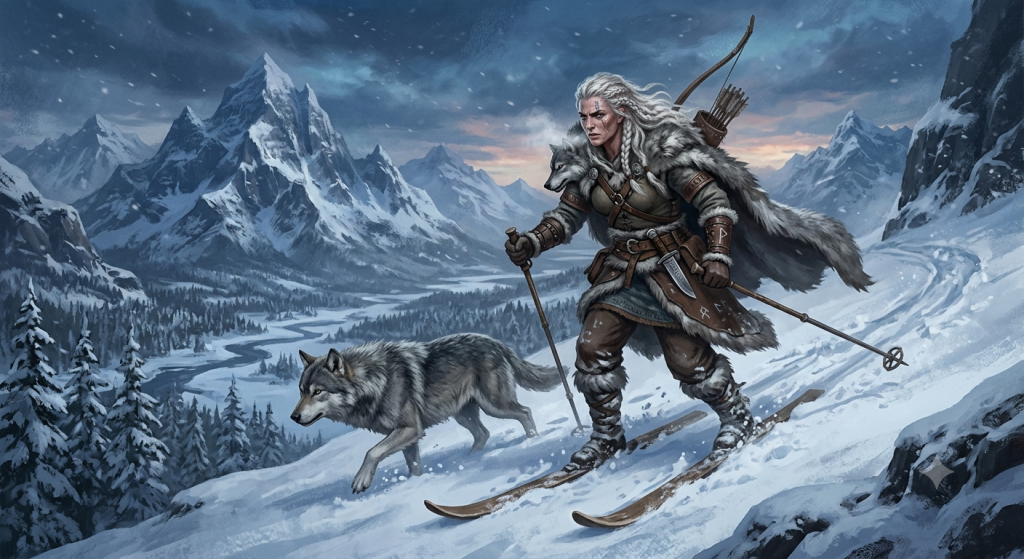
When Skadi arrived in Asgard after the gods killed her father Þjazi, she came armed. She came in full armour with weapons ready, a giantess who had decided that what had been done to her family required a response, and that the appropriate response was to present herself at the gates of the divine realm and demand satisfaction.
The gods did not fight her. They negotiated instead, and the terms they agreed to are among the most specific and unusual in the Norse tradition: they would make her laugh, which she had sworn not to do, and she could choose a husband from among the gods on the condition that she chose by looking only at their feet. She chose the feet she thought belonged to Baldr, the most beautiful of the gods. They belonged to Njörðr, the sea god.
The marriage that followed is one of the most entertainingly documented failed relationships in world mythology, producing verses that both parties composed about why they hated each other’s home. It ended in separation. Skadi went back to her mountains. The tradition seems entirely comfortable with this outcome.
She is the most fully realised non-Aesir, non-Vanir figure in Norse mythology: a giantess who negotiated her way into the divine community on her own terms, chose her own husband badly, made the best of an impossible marriage, left when it was clearly over, and went back to skiing through the mountains and hunting with her bow. Her story is the most purely individual in the tradition.
Her Name and the Scandinavia Question
Skadi’s name in Old Norse is Skaði, and it is either identical with the Old Norse common noun skaði meaning harm or damage, or it derives from a related Germanic root preserved in Gothic skadus and Old English sceadu, both meaning shadow. Both derivations connect her to darkness and damage rather than to the cold and snow she is associated with in the mythology, which is an interesting gap between her name and her domain.
The more remarkable etymological possibility is the connection between her name and the word Scandinavia. Several scholars have proposed that Skaði lent her name to the land, making the largest peninsula in northern Europe named after a frost giantess who skied through mountains and placed a serpent above the bound Loki. Whether Skaði named Scandinavia or Scandinavia gave its name to Skaði, or whether the connection is coincidental, is a genuinely unresolved scholarly question, and the sources do not settle it. But the possibility that the name of an entire region of the world derives from a Norse mythological figure is striking enough to note and honest enough to mark as uncertain.
Þjazi and the Death That Started Everything
To understand Skadi’s arrival in Asgard it is necessary to understand what happened to her father. Þjazi was a giant who kidnapped the goddess Iðunn, keeper of the apples that maintain the gods’ youth. Loki, who had helped engineer the kidnapping in the first place, was sent to retrieve her and did so by borrowing Freyja’s falcon cloak to fly into Þjazi’s hall, turning Iðunn into a nut, and carrying her back to Asgard.
Þjazi pursued in the form of an eagle. The gods lit a fire at Asgard’s walls. Þjazi, unable to stop in time, flew into the fire and was killed.
From Skadi’s perspective, the gods lured her father into a trap and burned him to death. The apples are not her concern. The morality of why Þjazi was killed is not something the tradition asks her to accept as a justification. Her father is dead at the gods’ hands, and she responds by arming herself and going to Asgard.
The tradition presents her response as legitimate. The gods do not tell her she has no right to compensation. They acknowledge that something is owed and they negotiate a settlement. The settlement has three parts: they will make her laugh against her oath, she can choose a husband from among them, and Odin will take her father’s eyes and throw them into the sky as stars. The last element is presented without elaboration, which is characteristic of the Norse tradition’s willingness to include details that raise more questions than they answer. Þjazi’s eyes are in the sky. Skadi presumably finds this satisfactory. The tradition moves on.
The Laughter and the Goat
The condition that the gods will make Skadi laugh despite her oath not to is fulfilled by Loki, which is the first of two significant interactions between them in the mythology, and considerably more pleasant than the second.
Loki ties one end of a rope to a goat and the other end to his own genitals. The goat and Loki then pull against each other, both squealing, until Loki falls into Skadi’s lap. She laughs. The oath is broken. The settlement is complete.
The scene is played for comic effect and it succeeds. Loki’s willingness to be humiliated in service of the gods’ diplomatic needs is one of his more endearing qualities in the tradition, and the specificity of the method, the goat, the rope, the squealing, the fall into the giantess’s lap, suggests genuine oral tradition rather than literary invention. Nobody makes up a detail that specific unless they need to.
What the scene also establishes is Skadi’s capacity for genuine laughter, which is not simply a personality detail. A being who has sworn not to laugh and who has just lost her father to the gods’ trap is being asked to find something funny in their hall. That she can be moved to genuine laughter, by Loki of all people, suggests something about her character that the subsequent marriage story extends: she is not simply a figure of cold vengeance. She is a complete person who can be amused even in grief.
The Marriage: Nine Nights Each Way
The marriage between Skadi and Njörðr is the most fully documented failed relationship in Norse mythology and one of the most human stories in the tradition despite involving a giantess and a sea god.
Njörðr is the Vanir god of the sea, of wind, of fishing and sailing and coastal prosperity. He lives in a hall called Nóatún by the shore. Skadi lives in her father’s mountain hall Þrymheimr at heights where the snow never melts. The incompatibility of their habitats is the incompatibility of their natures: she is the mountains in winter, he is the sea in summer, and there is no reasonable compromise location between those two things.
They attempt a compromise anyway. Nine nights in his hall by the shore, nine nights in her hall in the mountains, alternating. Both try. Neither can bear it. The tradition records their mutual failure in verses that the Prose Edda attributes to each of them directly, which is unusual. The gods and mythological beings of the Eddic tradition rarely get to speak their own feelings in verse. Njörðr and Skadi both do.
Njörðr’s verse: Hateful for me are the mountains, I was not long there, only nine nights. The howling of wolves seemed ugly to me compared to the song of swans.
Skadi’s verse: Sleep I could not on the sea beds for the screaming of birds. That gull wakes me every morning coming from the sea.
The specific complaints are perfectly observed. He cannot stand the wolves. She cannot stand the gulls. Neither complaint is unreasonable. Neither is a negotiating position. They are simply reports of genuine incompatibility from two beings who tried in good faith to make something work that could not work. The marriage ends. Skadi goes back to Þrymheimr. The tradition records this without judgment.
What She Does There
Skadi in her mountain hall is one of the most precisely described figures in Norse mythology in terms of what she actually does day to day. She hunts. She skis. She travels through the mountains with her bow and her snowshoes. The Grímnismál describes her as living in Þrymheimr and enjoying skiing, hunting, and shooting her bow. The description is specific enough that some scholars have identified her as the original divine patron of skiing, which would make her the goddess of the oldest Scandinavian sport, and the one still practised in the mountains that bear her name.
The image of Skadi skiing through her mountains with a bow is one of the clearest and most consistent in Norse mythology: a heavily armed hunter moving through alpine terrain that would kill most people, entirely at home in an environment that drove her husband away in nine days. She is defined by her competence in that landscape rather than by any relationship to the gods or to the divine community. After the marriage ends, she returns to what she is rather than continuing to negotiate her place among beings whose world is not hers.
The Serpent Above Loki
The second significant interaction between Skadi and Loki is considerably less pleasant for Loki. After his role in Baldr’s death and his subsequent capture by the gods, Skadi is the one who places the serpent above his bound body so that its venom drips onto his face.
The tradition does not extensively explain why Skadi is the one who does this rather than one of the Aesir gods. She may have particular reason to hate Loki given his role in her father’s death: it was Loki who helped engineer Þjazi’s trap and Loki who led the pursuit that resulted in Þjazi’s burning. The punishment of Loki is in some sense Skadi taking a measure of revenge that the laughter and the marriage settlement never fully provided.
The serpent above Loki is the detail that ties her, across the entire mythology, to two of its most important moments: the death of her father that brings her to Asgard and the punishment of the being most responsible for that death. She arrives because of what was done to Þjazi. She places the serpent because of what Loki has done to the gods. The trajectory of her mythology is shaped by her relationships to death and to consequence rather than to the divine social world she navigated through marriage.
What She Is
Skadi is described in the sources as both jötunn and goddess: born a frost giant, accepted into the divine community through negotiation and marriage, but never fully assimilated into the Aesir world and never particularly trying to be. She keeps her father’s hall. She keeps her father’s mountains. She hunts alone.
Her independence is the most consistent thing about her. She came to Asgard armed and left with what she demanded. She chose her husband on her own terms, badly, and left when the marriage was finished. She placed the serpent above Loki because she judged it appropriate. She skis through mountains that no god would be comfortable in.
The tradition treats all of this as simply who she is rather than as admirable or problematic. She is a figure whose nature is not defined by her relationship to the divine hierarchy but by her relationship to the landscape she inhabits. The mountains existed before the gods imposed order on the cosmos, and Skadi exists in them with the ease of something that belongs to the same ancient layer. She was there before the current order and the strong suggestion of her mythology is that she will be there after it.
For more on the Norse tradition, the Loki article covers the figure who helped kill her father, made her laugh against her oath, and received her serpent in return. The Freyr article covers Njörðr’s son, which makes him Skadi’s stepson or the child of her ex-husband depending on which source you follow. The Ragnarök article covers the end that the tradition places her outside of, in the mountains that have always been hers.
Never miss a myth
Thank you for being here. The site is brand new and every subscriber genuinely means something to me. If you're here, you care about this stuff as much as I do - and that's all the reason I need to keep going. New stories, videos and dark folklore from around the world, straight to your inbox. No algorithm. Just the stories, when they're ready.

