
Ragnarök does not mean Twilight of the Gods. That translation comes from Richard Wagner, who used Götterdämmerung, the German for twilight of the gods, as the title of the final opera in his Ring Cycle in 1876. The phrase was dramatic and it stuck, and it has been attached to the Norse apocalypse ever since in a way that has subtly but significantly changed how most people understand what the tradition is actually describing.
Ragnarök in Old Norse means the Fate of the Gods or the Doom of the Powers. The word rök means fate, origin, or reason, not twilight. Twilight suggests something passive and elegiac, a fading, a gradual dimming. Fate suggests something foretold, deliberate, and in some sense chosen. The Norse gods know exactly what is coming. They have known for a long time. Odin has spent centuries preparing for it. They walk toward it with open eyes.
That is a completely different story from a twilight, and it is a considerably more interesting one.
The Sources
The primary source for Ragnarök is the Völuspá, the Prophecy of the Seeress, the opening poem of the Poetic Edda. It is structured as a vision delivered by a völva, a female seer, who recounts the entire arc of cosmic history to Odin: the creation of the world, the deeds of the gods, the death of Baldr, and the sequence of events that constitute Ragnarök itself, ending with the description of the new world that rises from the water afterward.
The Völuspá is one of the most carefully constructed poems in the Norse tradition. The seeress is dead and has been called back from death by Odin to deliver her vision, which gives the poem a specific framing: this is knowledge from beyond death, delivered to the god who seeks knowledge above all else, describing the end of everything including the god who is listening. Odin hears the account of his own death from a dead woman he has raised for the purpose. The tradition is not understated about its own themes.
The Prose Edda, particularly the Gylfaginning section written by Snorri Sturluson around 1220, provides a prose retelling of the same events that is more linear and more accessible than the allusive verse of the Völuspá. Snorri was a Christian writing about a pagan tradition, and scholars have debated whether the rebirth elements of Ragnarök in his account were influenced by Christian eschatology. The Völuspá itself includes the rebirth, however, so the question of Christian influence is more nuanced than a simple before-and-after division.
Fimbulwinter: The Three Winters
Ragnarök is not announced by a dramatic supernatural event. It is announced by weather.
Fimbulwinter, the great winter, is the first and in some ways most psychologically devastating of the signs that Ragnarök is approaching. Three consecutive winters fall with no summer between them. Snow comes from every direction. The cold is extreme and unrelenting. The light fails. The world darkens.
During Fimbulwinter, the social bonds that hold human communities together dissolve. The Völuspá describes brothers killing each other, fathers and sons in conflict, no one sparing anyone else. The moral order that civilisation depends on collapses alongside the natural order. The world does not simply grow cold. It grows violent and lawless as the cold removes the conditions under which human cooperation is possible.
The Fimbulwinter tradition has attracted attention from climate historians because the mid-6th century AD saw a series of volcanic eruptions whose ash clouds caused dramatic global cooling, crop failures, and social disruption across the Northern Hemisphere. The years 536 to 545 AD have been identified as the worst decade for human life in recorded history, featuring the most severe and sustained cooling events before the 20th century’s volcanic effects. Norse communities living through this period would have experienced something that felt like exactly what the Fimbulwinter tradition describes. Whether the tradition preserves a memory of real catastrophic winters or whether the real catastrophic winters confirmed an existing mythological framework is a question the evidence cannot fully answer. Both possibilities are consistent with what is known.
The Signs: What Comes Before the End
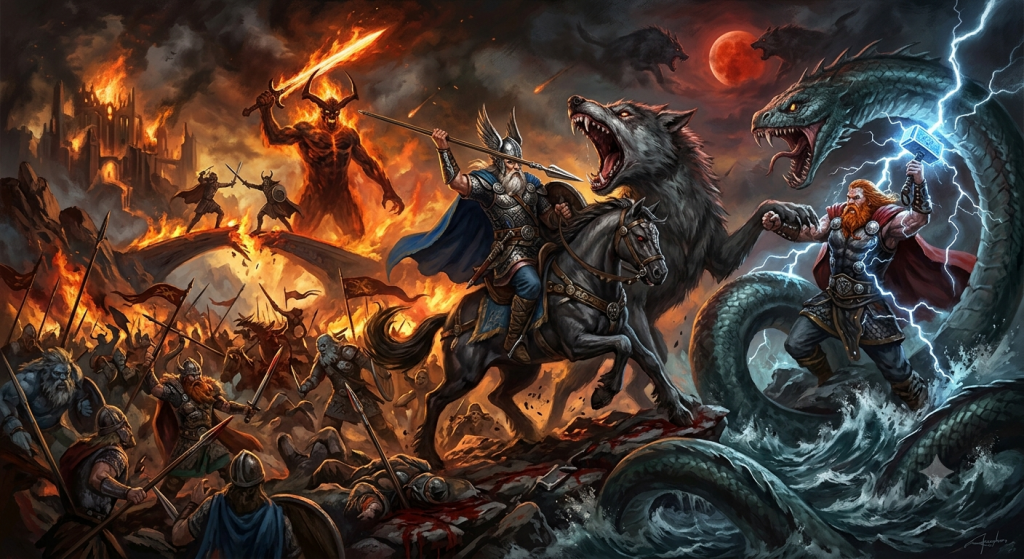
Between Fimbulwinter and the battle itself, a sequence of events announces that the end has begun. The wolf Sköll, who has chased the sun across the sky for the entire duration of the cosmos, finally catches it. His brother Hati catches the moon. The stars fall from the sky. The earth shakes. Every chain and fetter in the nine realms breaks simultaneously, which means Fenrir is free and Loki is free, both at the same moment.
The ship Naglfar, made from the fingernails and toenails of the dead, launches from the east with a crew of the dead aboard and Loki at the helm. The World Serpent Jörmungandr rises from the ocean depths, its emergence causing floods that cover the land. Surtr, the fire giant who has waited in Muspelheim since before the cosmos was formed, rides north with a sword of flame brighter than the sun.
Heimdall, the watchman of the gods, blows Gjallarhorn to alert the Aesir that the end has begun. Odin rides to consult Mimir’s head for the last time. The gods arm themselves. The Einherjar pour out of Valhalla’s five hundred and forty doors, eight hundred warriors abreast from each door. The full force that Odin has spent centuries assembling advances to meet what is coming.
The tradition presents this sequence with the precision of a military operation that has been planned in advance rather than the chaos of an unexpected catastrophe. Both sides have known this was coming. Both sides have prepared. The horror is not surprise. It is the arrival of something that has been inevitable from the beginning and that all the preparation cannot prevent.
The Battle: Who Kills Whom
The individual combats of Ragnarök are among the most precisely detailed events in the Norse tradition. The gods fight their specific enemies and die in specific ways, and the tradition records each exchange with the attention to detail that the Eddic tradition gives to things that matter absolutely.
Odin fights Fenrir. The wolf swallows him. Odin’s son Víðarr avenges him immediately, tearing Fenrir’s jaws apart with his iron-shod foot, the shoe that has been accumulating material from cobblers’ scraps since the beginning of the cosmos.
Thor fights Jörmungandr. He kills the World Serpent with Mjolnir. He then takes nine steps and falls dead from the serpent’s venom, dying from the same creature he has spent his entire existence fighting and has finally killed.
Freyr fights Surtr, the fire giant. Freyr has given away his magical sword, the one that fights on its own against giants, as a bride price for the giantess Gerðr. He faces Surtr without it and is killed. The tradition has been noting the absence of Freyr’s sword since it was given away, which means the reader who knows the story understands that the moment Freyr meets Surtr without it has been coming for a long time.
Loki and Heimdall kill each other. The two beings who have been opposed throughout the mythology, the boundary-crosser and the boundary-guardian, the shapeshifter and the watchman who sees everything, meet at the end of the world and destroy each other simultaneously. The tradition does not describe the combat in detail. The outcome is sufficient.
Tyr fights Garm, the hound of Hel. Both die.
Surtr survives all of this and sets the world on fire with his flaming sword, burning the nine realms until they sink into the sea.
The Gosforth Cross: Ragnarök in Cumbria
The most remarkable physical evidence for the depth of Ragnarök belief in the Norse world outside Scandinavia stands in the churchyard of St Mary’s church in Gosforth, Cumbria, England. The Gosforth Cross, carved around 940 AD during the period of Norse settlement in northwest England, is one of the tallest and most elaborately decorated Viking Age stone monuments in Britain.
Its carvings include scenes that scholars have identified as Ragnarök imagery: a figure being attacked by a serpent, interpreted as Odin and Fenrir or as Víðarr’s revenge; a figure bound with a serpent dripping venom overhead, identified as the bound Loki; a figure fishing, interpreted as Thor’s fishing expedition to catch Jörmungandr; and a figure on a horse, possibly one of the Ragnarök riders.
The cross also includes explicitly Christian imagery, which places it in the conversion period when Norse settlers in northwest England were navigating between the two traditions. The combination of Ragnarök scenes and Christian imagery on a single monument suggests that the conversion was not a simple replacement of one cosmology with another but a period of genuine overlap in which the Norse apocalypse and the Christian one existed alongside each other in the same community’s religious imagination.
Gosforth is approximately forty miles from the Scottish border. The cross was carved by people whose grandparents or great-grandparents came from Scandinavia and who were in the process of becoming Christian while maintaining enough connection to the Norse tradition to commission detailed Ragnarök carvings on a churchyard monument. The mythology covered on this site was not ancient history to the people who carved that cross. It was living belief in the process of transformation.
What Survives
The Völuspá does not end with the burning. The seeress’s vision continues past the destruction to what comes after, and what comes after is not simply darkness.
From the sea, a new earth rises. It is green and fertile. Waterfalls flow. Eagles fly over mountains. Fields grow without having been sown. The surviving gods, Víðarr, Váli, Baldr returning from Hel, and Thor’s sons Magni and Móði carrying Mjolnir, meet on the fields of the new world and speak together of what happened. They find in the grass the golden playing pieces the gods used in the age before everything ended. The game was interrupted by Ragnarök. In the new world, they can play it again.
Two humans survive by sheltering inside Yggdrasil during the burning. Their names are Líf and Lífthrasir, Life and Life’s Desire. They emerge to find the new world and repopulate it. The sun that was swallowed by the wolf has a daughter who rises to take her mother’s place in the sky.
The tradition built human survival into the Norse apocalypse explicitly, which is the detail that most changes how Ragnarök is understood. It is not straightforwardly an end. It is a transition, a destruction that clears space for renewal, a catastrophe that the cosmos survives in a different form. The new world is not the old world restored: the old gods are mostly dead, the old structures mostly gone. What remains are the survivors and the golden playing pieces in the grass.
Why It Is Not Simply Pessimism
The most common misreading of Ragnarök treats the Norse mythology as fundamentally pessimistic: a tradition that believed everything would end badly and that courage consisted of fighting anyway. This reading has been enormously influential and is not without textual support. The gods do die. The world does burn.
But it is an incomplete reading, and the incompleteness matters. The Norse tradition knew that the world it described had ended: the old religion was gone, the old gods were no longer worshipped, the world the Eddas described was a world that had passed. Ragnarök is not a prophecy for a tradition that still expected the future to look like the past. It is a cosmological framework for understanding how things end and what, if anything, comes after.
The answer the Völuspá gives is neither simply hopeful nor simply despairing. Things end. The ending is complete and terrible. Some things survive the ending in forms that could not have been predicted from within the world that ended. The golden pieces are in the grass. The game can be played again.
That is not pessimism. It is something more honest and more difficult: an acknowledgment that ending and beginning are not opposites but the same event seen from different positions in time.
Further Reading
If this article sparked your interest, these are the books worth reading next.
Norse Mythology
by Neil Gaiman — the most accessible modern retelling of the Norse myths, written with genuine respect for the source material.
The Prose Edda (Penguin Classics)
by Snorri Sturluson — the thirteenth century Icelandic text that is the primary source for almost everything we know about Norse mythology.
The Viking Spirit
by Daniel McCoy — the best modern scholarly introduction to Norse mythology, written for general readers without being dumbed down.
For more on the figures whose fates Ragnarök determines, the Odin article covers the Allfather who spends the entire mythology preparing for a death he cannot prevent. The Fenrir article covers the wolf whose binding by the gods creates the rage that kills Odin at the end. The Loki article covers the figure whose punishment mirrors his son’s and whose release at Ragnarök is one of its primary signs. The Valkyries article covers the beings whose entire function is to prepare for the battle that Ragnarök finally brings.
Never miss a myth
Thank you for being here. The site is brand new and every subscriber genuinely means something to me. If you're here, you care about this stuff as much as I do - and that's all the reason I need to keep going. New stories, videos and dark folklore from around the world, straight to your inbox. No algorithm. Just the stories, when they're ready.

