
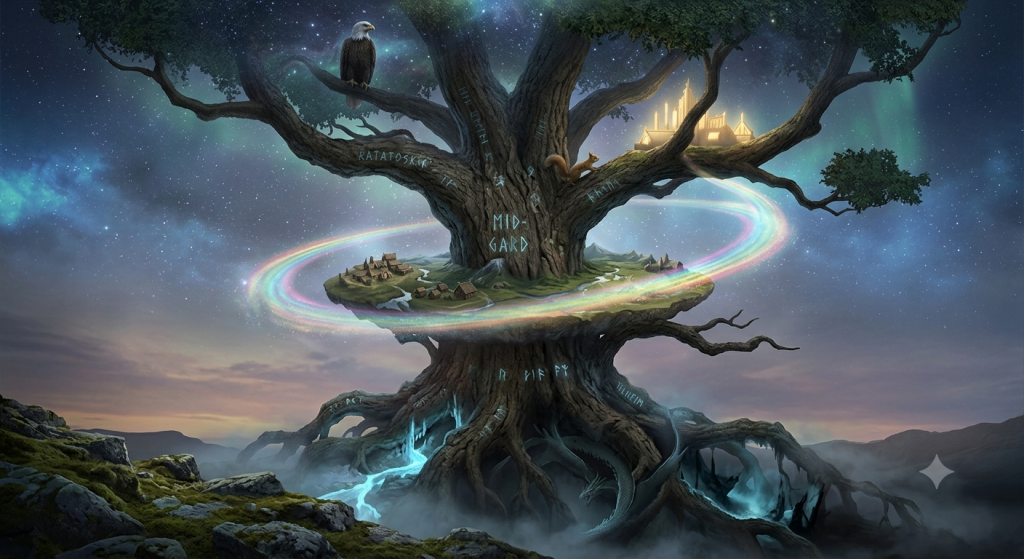
The name Yggdrasil contains more compressed meaning than almost any other word in Norse mythology, and unpacking it is the most direct route into understanding what the world tree actually is in the tradition.
Yggr is one of Odin’s names. It means the Terrible One. Drasill means horse. The Norse kenning tradition, the system of compound metaphors that Old Norse poetry used to describe familiar things in unfamiliar ways, called the gallows the horse of the hanged. When a man was hanged, he was said to ride the gallows horse. Yggdrasil is therefore Odin’s horse, and the horse it refers to is the gallows. The world tree is named after the gallows on which Odin hung for nine days and nine nights in his self-sacrifice to gain the runes.
The tree and the sacrifice are not simply connected events in the mythology. They are the same thing. The axis of the Norse cosmos, the structure around which all nine worlds are arranged and by which they are connected, is named after Odin’s instrument of self-torture and enlightenment. The universe is held together by a gallows. Everything that exists depends on the site of the most terrible act of deliberate self-destruction in the tradition. The name was chosen with precision, and the precision is the point.
What the Sources Say
Yggdrasil is described most extensively in two sections of the Eddic corpus: the Grímnismál in the Poetic Edda, where Odin recites an encyclopedic account of Norse cosmology while enduring torture between two fires in the hall of King Geirröðr, and the Gylfaginning section of Snorri Sturluson’s Prose Edda, which gives a more systematic prose account drawing on the Grímnismál and other poetic sources.
The Grímnismál account is the more original and the more strange of the two. It comes in the form of a catalogue, a list of names and details delivered in alliterative verse by a god under torture, and it assumes its audience already knows the framework it is filling in rather than explaining the framework from the beginning. Snorri’s prose version is more accessible but is also more organised by a 13th century Christian scholar than by the tradition itself, and some of what appears systematic in his account may be Snorri’s ordering of material that was originally more dispersed and less consistent.
Both sources agree on the fundamental structure. Yggdrasil is an immense ash tree at the centre of the cosmos. Its branches extend into the heavens. Its three roots reach respectively to the well of Urðarbrunnr in Asgard, to the spring of Hvergelmir in Niflheim, and to the well of Mímir in the realm of the giants. The gods meet daily at the tree to hold their councils. The tree is sacred, perpetually renewed, and simultaneously under constant attack from the creatures that inhabit it.
The Creatures of the Tree
Yggdrasil is not simply a cosmic structure. It is an ecosystem, and the creatures that live in it are among the most specifically described beings in Norse cosmology.
At the top of the tree sits an eagle of enormous size and wisdom, whose beating wings cause the winds that blow through the world of humans. Between the eagle’s eyes sits a hawk named Veðrfölnir, who is less explained than simply noted as present. The eagle and the serpent Níðhöggr at the roots are ancient enemies, and their hostility is the dynamic tension that runs from the top to the bottom of the cosmos.
Níðhöggr, the corpse-gnawer, gnaws at the roots of the tree from below. This is not a peripheral threat. Níðhöggr’s gnawing is a permanent feature of the cosmos, not a crisis to be resolved but a condition of existence. The world tree is being eaten from the roots even as the gods meet in its branches to conduct their affairs. The erosion is structural and endless, which means Yggdrasil’s survival is not guaranteed by its nature but by the continuous work of the Norns who water its roots from the well of Urðarbrunnr and pack white clay around them.
Four stags, named Dáinn, Dvalinn, Duneyrr, and Duraþrór, run across the branches and eat the buds continuously. The dew that falls from their antlers becomes the rivers of the world. Their perpetual feeding, like Níðhöggr’s perpetual gnawing, is an ongoing consumption of the tree that the tree somehow survives.
And then there is Ratatoskr.
Ratatoskr is a squirrel. He runs up and down the trunk of Yggdrasil carrying messages between the eagle at the top and Níðhöggr at the roots. The messages are specifically described as insults. Ratatoskr runs from the eagle to the serpent with the eagle’s insults, and from the serpent to the eagle with the serpent’s insults, maintaining and inflaming the enmity between the two beings at the cosmic extremes. He has no other described function. His entire role in the Norse cosmos is to make the relationship between the eagle and the serpent worse than it would otherwise be.
Why the tradition includes this detail is not explained. The squirrel carrying insults between cosmic enemies is simply there, at the centre of the universe, doing what it does. The Norse tradition’s willingness to include genuinely strange and comic details alongside its most serious cosmological material is one of the things that makes it feel genuinely alive rather than simply grand.
The Three Wells and What They Contain
The three roots of Yggdrasil reach to three wells, and each well is the most important source of something essential in the Norse cosmos.
The well of Urðarbrunnr, the Well of Fate, sits beneath the root that reaches to Asgard. This is where the Norns live and work. The three Norns, Urðr, Verðandi, and Skuld, whose names roughly translate as What Has Been, What Is Becoming, and What Shall Be, draw water from this well and mix it with the white clay around the well’s edge to pack around Yggdrasil’s roots each day, maintaining the tree. They also weave the fates of gods and humans, cutting threads to determine the length of lives, and the well from which they draw their materials is therefore the source of all fate in the Norse cosmos. Everything that will happen comes from this well in some fundamental sense.
The well of Mímir sits beneath the root that reaches to the realm of the giants. Mímir, the guardian of the well, is one of the oldest and most knowledgeable beings in the Norse cosmos. His well contains the waters of cosmic wisdom, and it is to this well that Odin comes to sacrifice his eye in exchange for a drink. The wisdom in the well is the deep structure of things, the understanding of how the cosmos works and what will happen within it, and it is guarded by a being who drinks from it daily through the horn Gjallarhorn. Odin’s sacrifice gives him access to what Mímir knows, at the cost of an eye he carries in the well thereafter.
The spring of Hvergelmir sits beneath the root that reaches to Niflheim, the primordial realm of ice and mist. It is the source of the rivers that flow through all the worlds, the origin of the water that sustains existence across the nine realms. Níðhöggr gnaws at the root above Hvergelmir, which places the creature that is eroding the cosmic structure directly above the source of cosmic water: the tree is being eaten at the point closest to its life source.
The Nine Worlds: What the Sources Actually Say
Almost every popular account of Norse mythology includes a neat diagram of the nine worlds arranged vertically around Yggdrasil, with Asgard at the top and Hel at the bottom and Midgard in the middle. These diagrams are useful. They are also interpretations rather than direct transcriptions from any single source, and the confidence they project about the arrangement and identity of the nine worlds is somewhat misleading.
The Norse sources consistently mention nine worlds but never provide a single complete and consistent list of what those nine worlds are. The Völuspá refers to nine worlds. The Vafþrúðnismál refers to nine worlds. But neither poem lists all nine in one place, and when scholars have assembled a list from across the various sources, the identifications involve some degree of interpretive work rather than simple transcription.
The worlds most clearly attested across the sources are Asgard, home of the Aesir gods; Vanaheim, home of the Vanir gods; Midgard, the realm of humans, connected to Asgard by the rainbow bridge Bifröst; Jotunheim, the realm of the giants; Niflheim, the primordial realm of ice; Muspelheim, the primordial realm of fire; Helheim, the realm of the dead who do not go to Valhalla; Alfheim, realm of the light elves; and Svartalfheim or Nidavellir, realm of the dwarves. Nine names, which fits the number consistently given, but assembled from across multiple sources rather than from any single passage that lists them all.
What the sources are consistent about is that the worlds are connected by Yggdrasil rather than simply stacked vertically around it. They interpenetrate and influence each other. The rivers that flow from Hvergelmir reach into multiple worlds. The Bifröst bridge is a specific connection between specific worlds. The roots of the tree reach into different realms. The cosmological structure is a network rather than a hierarchy, and the tree is the network’s infrastructure rather than simply its vertical axis.
Yggdrasil and Odin’s Sacrifice
The connection between Yggdrasil and Odin’s hanging is established by the name and confirmed by the Hávamál, in which Odin describes hanging from a windy tree for nine nights. The tree is not named in that passage, but the tradition’s identification of the windy tree with Yggdrasil is consistent across the sources and is encoded in the name itself.
This means that the site of the most important act of cosmic knowledge-acquisition in the Norse tradition is the axis of the cosmos itself. Odin does not hang from a tree in order to reach the runes. He hangs from the structure that connects all of reality, looking down into the darkness beneath that structure, and the runes rise up to meet him from the depths below the world tree’s roots. The knowledge he gains is not knowledge about the cosmos. It is knowledge that is the cosmos, the deep structure of existence encoded in the runic symbols that he perceives from the most painful possible position at the centre of everything.
The name Yggdrasil therefore does double or triple work simultaneously. It names the tree after the instrument of hanging, which names it after Odin’s sacrifice, which connects the cosmic structure to the act that gave Odin his deepest knowledge, which connects the existence of everything to the deliberate self-destruction through which that knowledge was obtained. The world exists. Odin understands it. His understanding cost everything it cost. The tree that holds the world together is named after what it cost.
What the Tree Survives
Yggdrasil is simultaneously the most important and the most precarious structure in the Norse cosmos. It is being gnawed at the roots by Níðhöggr. It is being stripped of its buds by four perpetually feeding stags. Its branches are in constant use as pathways between worlds. The dragon Níðhöggr is not simply attacking it: the tradition specifies that the tree moans and groans under the strain of everything it supports and endures.
That it survives is a function of continuous care rather than inherent indestructibility. The Norns water it daily. White clay is packed around its roots. The dew that falls from the stags’ antlers sustains it even as they strip its branches. Yggdrasil persists through a dynamic equilibrium of destruction and renewal that is maintained by active effort rather than by the tree’s own nature.
At Ragnarök, Yggdrasil shakes but does not fall. The Völuspá describes the tree trembling as the cosmic battle proceeds, and the two humans who survive Ragnarök do so by sheltering inside it. The tree that was being eaten at the roots throughout the entire pre-Ragnarök cosmos is the thing inside which human life is preserved through the end of that cosmos. The gallows named after Odin’s sacrifice is the shelter that saves humanity when everything else is destroyed.
Further Reading
If this article sparked your interest, these are the books worth reading next.
Norse Mythology
by Neil Gaiman — the most accessible modern retelling of the Norse myths, written with genuine respect for the source material.
The Prose Edda (Penguin Classics)
by Snorri Sturluson — the thirteenth century Icelandic text that is the primary source for almost everything we know about Norse mythology.
The Viking Spirit
by Daniel McCoy — the best modern scholarly introduction to Norse mythology, written for general readers without being dumbed down.
For more on the Norse tradition, the Odin article covers the sacrifice that gives Yggdrasil its name and what Odin gained from it. The Ragnarök article covers the end that Yggdrasil survives and the humans it shelters through it. The Fenrir article covers the wolf whose binding and release frames the Norse cosmos from beginning to end.
Never miss a myth
Thank you for being here. The site is brand new and every subscriber genuinely means something to me. If you're here, you care about this stuff as much as I do - and that's all the reason I need to keep going. New stories, videos and dark folklore from around the world, straight to your inbox. No algorithm. Just the stories, when they're ready.

