
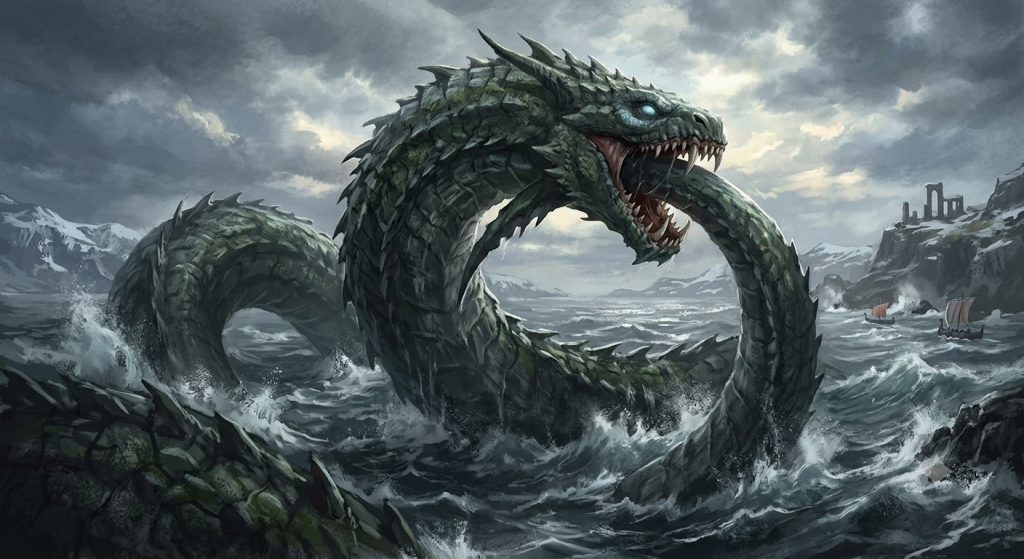
Jörmungandr is usually described as Thor’s nemesis, the monstrous serpent that kills the god of thunder at Ragnarök and is killed in return. This is accurate but incomplete, and the incompleteness matters.
Jörmungandr does not simply live in the ocean that surrounds Midgard. He encircles it. The serpent’s body forms the boundary between the ordered world of gods and humans and the formless chaos that lies beyond it. He holds his own tail in his mouth, the image known as the Ouroboros, and the holding is what keeps the boundary intact. While Jörmungandr maintains his grip on his own tail, Midgard has an edge. When he releases it at Ragnarök, the ocean floods inward, the boundary collapses, and the end of the world has begun.
The monster is the world’s perimeter. The thing Thor has been trying to kill for the entire duration of Norse mythology is the thing that, by existing in the form it does, keeps the cosmos from dissolving into what it was before the gods imposed order on it. His death at Ragnarök is simultaneously a catastrophe and a structural inevitability: once the serpent is dead and no longer holding his tail, there is no longer anything to hold.
Origin and the Three Siblings
Jörmungandr is the son of Loki and the giantess Angrboða, and the sibling of Fenrir the wolf and Hel the ruler of the dead. The three children together represent the three primary forms through which existence ends in the Norse cosmos: the serpent whose venom kills, the wolf who devours, and the cold realm to which the ungloriously dead are consigned. Their parentage, the trickster god and a giantess from the world of the jötunn, places all three at the intersection of the divine order and the primordial chaos it was imposed upon.
When the gods became aware of these children through prophecy, they acted against each of them. Hel was sent to govern the realm of the dead in Niflheim. Fenrir was brought to Asgard and eventually bound on the island of Lyngvi. Jörmungandr was thrown by Odin into the ocean that encircles Midgard. There, in the deep water, the serpent grew. It grew until it was large enough to encircle the entire world and bite its own tail, and then it held on.
Like the binding of Fenrir, the casting of Jörmungandr into the ocean is an act taken against a being that has done nothing wrong, in response to a prophecy about what it will do rather than anything it has already done. The gods know the serpent will kill Thor at Ragnarök. They cast it into the sea to delay that outcome. As with Fenrir, the action does not prevent the prophecy from being fulfilled. It simply determines the conditions under which the fulfilment happens.
The First Encounter: The Grey Cat
The three encounters between Thor and Jörmungandr are the structural spine of the serpent’s mythology, and the first of them is the strangest because neither participant knows it is happening.
In the story of Thor’s visit to Útgarðaloki’s hall, the giant king challenges Thor and his companions to a series of tests. Loki loses an eating contest against fire itself. Thjalfi loses a running race against thought. Thor fails to drain a drinking horn that is secretly connected to the ocean. And Thor is asked to lift a large grey cat off the ground. He strains with everything he has and can raise one paw. Only one paw. He cannot lift the cat.
Útgarðaloki explains afterward that the cat was Jörmungandr in disguise. The serpent encircles all of Midgard. Its weight is effectively the weight of the world. The fact that Thor managed to raise one paw at all, that he lifted even a fraction of the world serpent off the ground with his own strength, caused genuine terror among the watching giants, who understood what they were seeing better than Thor did.
The encounter frames everything that follows. Thor has already met Jörmungandr and already demonstrated a strength that astonishes even those who know the serpent’s true nature, without understanding what he was lifting or why it mattered. The first meeting is defined by ignorance on both sides: the disguised serpent does not engage as the serpent, and Thor does not know what he is testing his strength against.
The Fishing Trip: What the Altuna Runestone Shows
The second encounter is the most narratively developed in the sources and the most frequently depicted in Norse art. Thor and the giant Hymir go fishing. Thor uses the head of Hymir’s largest ox as bait. He rows far out beyond the fishing grounds Hymir considers safe, into the deep ocean where the world serpent lies, and drops his line.
Jörmungandr takes the bait. What follows is the most physically extreme description in Norse mythology. Thor hauls the serpent upward with such force that his feet press through the bottom of the boat. The serpent comes up through the water. Thor and Jörmungandr face each other across the side of the vessel, the god with his hammer raised, the serpent with its head above the gunwale and its eyes locked on him, venom dripping from its jaws.
Hymir panics and cuts the fishing line. Jörmungandr sinks back into the ocean. Thor, furious, throws Hymir overboard and wades to shore.
Whether Thor struck the serpent with Mjolnir before the line was cut is a question the sources answer differently. The Hymiskviða, the older poetic source for this story, suggests he did hit it. The Prose Edda version is less clear. What is consistent across all accounts is that Hymir’s intervention prevents the encounter from reaching its conclusion. The second meeting ends without resolution because a giant is more afraid of what will happen if Thor kills the serpent than of what will happen if he does not.
The Altuna runestone in Uppland, Sweden, carved in the 11th century, depicts this scene. The carving shows a large figure in a boat with its feet pressed through the bottom of the vessel, a fishing line descending into water, and a serpentine form below. It is one of the clearest examples in the Norse archaeological record of a specific mythological scene being preserved in stone, and it confirms that the fishing trip narrative, including the specific detail of Thor’s feet breaking through the boat, was well established in Norse visual culture by the 11th century.
The Name and What It Means
Jörmungandr in Old Norse means the great staff or the mighty staff, from jörmun meaning great or mighty and gandr meaning a magical staff or wand. The name is unusual for a serpent because it does not reference serpentine qualities. It references something straight and rigid, a staff or wand, which is the opposite of the coiling, encircling form the serpent takes.
The kennings used for Jörmungandr across Old Norse skaldic poetry are more varied and more illuminating. He is called the fish of the earth, the fish of the ground, the belt of the earth, the serpent of Midgard, and the deep-dwelling fish. The fish kennings are particularly interesting because they describe the world serpent in terms of the ocean it inhabits rather than in terms of its serpentine nature. Something fish-sized in a human ocean is manageable. Something fish-sized in the ocean that encircles the world is not manageable at all, and the kenning registers that disproportion through understatement.
The Ouroboros: The Image Beyond Norse Mythology
The image of a serpent or dragon biting its own tail is one of the most widely distributed symbols in world mythology and religious tradition. It appears in ancient Egyptian iconography, in Gnostic and Hermetic texts, in alchemical illustrations across the medieval and early modern period, and in Norse mythology as the posture Jörmungandr maintains while encircling Midgard. The Greek word Ouroboros, literally tail-devourer, is the conventional term for this image regardless of its cultural context.
What the Ouroboros represents varies across the traditions that use it. In alchemical and Hermetic contexts it typically represents cyclical time, eternal recurrence, the unity of the beginning and the end. In Norse mythology, the specific meaning of Jörmungandr’s tail-holding is more concrete and more structural: it is the closure of the world’s perimeter. The serpent holding its tail creates an enclosed space, and that enclosed space is Midgard. The world that humans and gods inhabit exists inside the circle of the serpent’s body.
This makes Jörmungandr one of the few mythological figures in any tradition whose existence is literally constitutive of the world it threatens. He is not a monster that threatens Midgard from outside. He is the boundary of Midgard, and his continued existence in the posture of encirclement is the condition that makes Midgard what it is. The gods cast him into the sea to contain the threat he represents, and in doing so created the structural condition without which the world they are trying to protect would not have a defined edge.
Ragnarök: Nine Steps
At Ragnarök, Jörmungandr releases his tail and comes ashore. The ocean floods inward across the land as the boundary that was holding the sea back collapses. The serpent advances across the land poisoning the air, and Thor advances to meet him.
The Völuspá describes the encounter economically. They fight. Thor kills Jörmungandr. He then takes nine steps and falls dead from the serpent’s venom, which has entered him during the combat. Nine steps, the same number that appears throughout the Norse tradition as a number of completion and cosmic significance. Thor’s death is not incidental. It is the precise exchange the prophecy described: the serpent dies and the god who killed it dies nine paces later, the venom completing its work at the last moment.
The mutual killing resolves the tension that has run through three encounters across the entire mythology. The grey cat whose paw Thor could barely lift. The fishing trip that ended without conclusion because Hymir cut the line. Ragnarök is the third meeting, and the third meeting ends the way the second was always meant to: with the hammer striking and the venom flowing and both parties dead.
Thor’s sons Magni and Móði survive Ragnarök and inherit Mjolnir. The serpent that encircled the world is dead and the world has burned and sunk into the sea, and a new world rises in its place. In the new world, whatever holds its perimeter together is not Jörmungandr. What that new boundary is the tradition does not describe.
Further Reading
If this article sparked your interest, these are the books worth reading next.
Norse Mythology
by Neil Gaiman — the most accessible modern retelling of the Norse myths, written with genuine respect for the source material.
The Prose Edda (Penguin Classics)
by Snorri Sturluson — the thirteenth century Icelandic text that is the primary source for almost everything we know about Norse mythology.
The Viking Spirit
by Daniel McCoy — the best modern scholarly introduction to Norse mythology, written for general readers without being dumbed down.
For more on the Norse tradition, the Thor article covers the god whose entire relationship with Jörmungandr is defined by three encounters building toward a mutual killing. The Fenrir article covers Jörmungandr’s wolf brother, whose own binding by the gods parallels the serpent’s casting into the sea. The Ragnarök article covers the end that Jörmungandr’s release from his tail-holding announces and accelerates.
Never miss a myth
Thank you for being here. The site is brand new and every subscriber genuinely means something to me. If you're here, you care about this stuff as much as I do - and that's all the reason I need to keep going. New stories, videos and dark folklore from around the world, straight to your inbox. No algorithm. Just the stories, when they're ready.

