
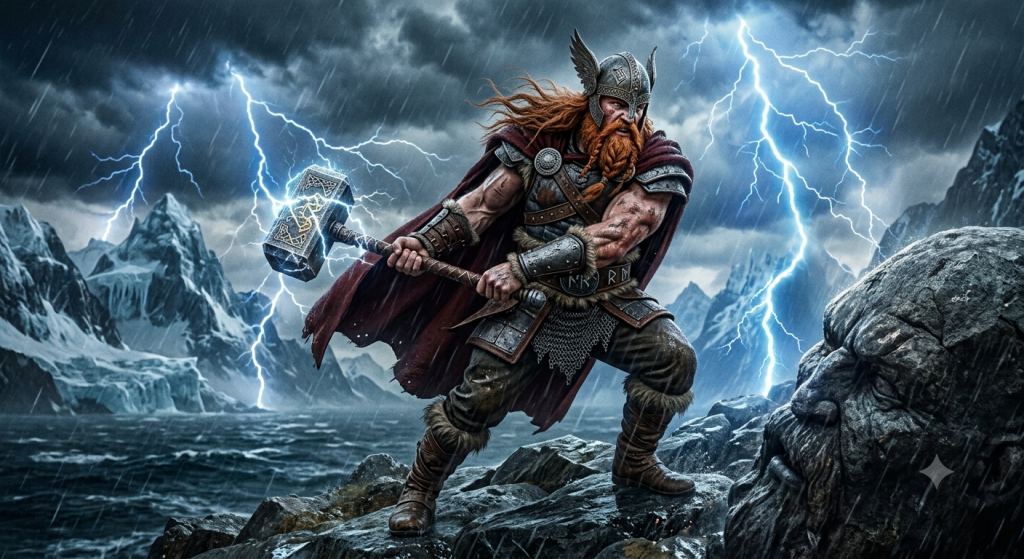
In most popular treatments of Norse mythology, Odin is the chief god and Thor is his notable son, the strong one, the hammer-wielder, the fighter. This hierarchy feels natural to anyone familiar with Marvel, and it maps reasonably onto the theological structure of the Aesir pantheon, in which Odin does hold the highest formal position.
What it does not capture is the practical reality of Norse religious life, in which Thor was almost certainly more widely worshipped than Odin across most of Scandinavia. The evidence is in the names. Odin-derived place names cluster in specific regions of Scandinavia, particularly in areas associated with the elite warrior culture and with centres of royal and aristocratic power. Thor-derived place names are everywhere: farms, settlements, hills, and natural features across Norway, Sweden, Denmark, and Iceland bear his name in numbers that dwarf every other deity.
Odin was the god of kings, poets, and warriors seeking an extraordinary fate. Thor was the god of farmers, sailors, and anyone who needed the weather to cooperate and the giants to stay where they belonged. In a society built on agriculture and coastal fishing, that made Thor the deity most people actually had a daily relationship with. The thunder they heard was him fighting giants. The rain that came after was his doing. The hammer pendant around a farmer’s neck was not a fashion choice. It was an appeal to the most practically important supernatural force in the Norse cosmos.
Who He Was
Thor is the son of Odin and Jörð, whose name means Earth in Old Norse. His mother is not a goddess of the Aesir but a personification of the earth itself, which makes Thor literally the son of the sky-father and the earth-mother in the most fundamental possible cosmological sense. This parentage is the foundation of his connection to weather, agriculture, and the physical world, and it distinguishes him from the other Aesir gods who are divine beings operating on the earth rather than beings whose nature is constituted partly by the earth itself.
He is described consistently in the sources as enormous, red-haired, and red-bearded, with a strength that exceeds every other being in the nine realms when he wears his belt Megingjörð, which doubles his already extraordinary power. He requires iron gauntlets, Járngreipr, to handle Mjolnir safely. He eats and drinks in quantities that the tradition treats as both impressive and slightly comic: in several stories his appetite becomes a plot point that other characters have to manage around.
He is not subtle. He is not mysterious. He does not travel in disguise the way Odin does or manipulate events from a distance. When Thor encounters a problem, his preferred solution is to hit it with the hammer, and the tradition presents this with more affection than criticism because the problems Thor encounters are generally the kind that respond well to being hit with the hammer.
Mjolnir: The Flawed Weapon
Mjolnir is the most famous weapon in Norse mythology and possibly the most recognisable religious symbol from the pre-Christian Northern European tradition. Viking-Age Mjolnir pendants have been found across Scandinavia and the Norse diaspora in numbers that demonstrate genuine widespread religious use rather than simply decorative fashion. Men and women alike wore them. They were used in blessing ceremonies at marriages, births, and funerals, and at the consecration of land. The hammer that kills giants also sanctifies the most important moments of human life.
What most people do not know about Mjolnir is that it has a short handle. The greatest weapon in the cosmos, the hammer that can level mountains and that returns to Thor’s hand when thrown, has a handle that is too short to be wielded with both hands. Thor holds it one-handed. The flaw is permanent and cannot be corrected.
The short handle is Loki’s fault. During the forging contest in which the dwarves Sindri and Brokkr were competing to produce the finest treasures for the gods, Loki transformed himself into a fly and bit Brokkr on the eyelid while he was working the bellows that kept the forge fire burning. The momentary interruption was enough to shorten the handle irreparably. Despite this, the gods judged Mjolnir the greatest of all the treasures produced, which says something interesting about how the tradition understood the relationship between power and perfection: the most powerful weapon in existence is imperfect, and the imperfection does not diminish the power.
The name Mjolnir likely derives from a Proto-Germanic root meaning to crush or lightning, which connects it linguistically to the thunder and lightning that Thor controls. After Ragnarök, in one of the Eddic poems, the hammer is inherited by Thor’s sons Magni and Módi rather than being destroyed with its owner, which makes it the only treasure specifically mentioned as surviving the end of the world. Even in the aftermath of everything, the hammer persists.
The Giants and What They Actually Are
Thor’s defining activity in the mythology is fighting giants, and understanding what the giants actually are in the Norse tradition is essential to understanding why this activity matters beyond simple monster-slaying.
The jötnar, usually translated as giants, are not simply large hostile beings in the Norse tradition. They are primordial forces, older than the Aesir gods, representing the wild and untamed aspects of the cosmos that the divine order exists to contain. They are not purely evil in any simple sense: several of the Aesir gods have giant ancestry, Odin’s mother was a giantess, and some of Thor’s own most significant encounters with giants involve wisdom contests rather than combat. But they represent a principle of chaos and dissolution that is permanently in tension with the order that the gods maintain, and that tension is structural rather than contingent: it does not resolve because it cannot resolve, because the cosmos requires both the order the gods represent and the chaos the giants embody.
Thor’s role in this tension is to be the boundary. He patrols the edges of the ordered cosmos, confronting the forces that would overwhelm it, and his hammer is the mechanism by which that patrol is conducted. When the thunder rolls across a Norse landscape, it is Thor somewhere in the vicinity of Midgard, dealing with whatever needs dealing with. The reassurance that provided to farming communities living at the edge of wilderness, in a landscape where winter was genuinely threatening and storms could destroy a year’s harvest, was not metaphorical. It was practical and immediate.
The Journey to Utgard: Humility and Illusion
The most philosophically interesting Thor story in the Eddic tradition is the journey to Utgard-Loki’s hall, told in the Prose Edda, in which Thor and his companions are comprehensively outwitted by illusions they cannot see through until the host explains them afterward.
Thor and Loki, travelling through Jotunheim, come to a hall so vast that they sleep inside what turns out to be the thumb of a giant’s glove without realising it. They reach the court of Utgard-Loki, a giant king who challenges them to competitions. Loki loses an eating contest against something called Logi. Thor’s servant Thjalfi loses a running race against someone called Hugi. Thor himself fails to drain a drinking horn, fails to lift a cat off the ground, and loses a wrestling match with an old woman named Elli.
When Utgard-Loki escorts them out the following morning, he reveals the truth. Logi was fire itself, which is why he consumed food faster than Loki could. Hugi was thought, which is why he ran faster than any physical being. The drinking horn was connected to the ocean, which is why Thor could not drain it, though he drank enough to visibly lower the sea level. The cat was Jörmungandr the World Serpent in disguise, and lifting even one of its paws off the ground caused terror among the watching giants. Elli was old age itself, and no one can beat old age in a wrestling match.
Thor, humiliated by the revelation that he was manipulated, raises his hammer to destroy Utgard-Loki’s hall, but the king and the hall vanish. He finds only open plain.
The story shows Thor losing comprehensively to concepts rather than beings, which is not something the tradition would do with Odin, who deals in concepts as his primary domain. Thor operates in the physical world where strength and directness are the right tools, and when those tools are made useless by an opponent who operates through illusion rather than force, he has no alternative approach. The loss is not permanent: he goes on to kill Jörmungandr at Ragnarök, and his strength remains what it is. But the story establishes that even the most powerful physical force in the cosmos cannot fight ideas directly, which is a genuinely interesting theological observation dressed as an adventure story.
Mjolnir Pendants and the Conversion Period
The archaeological evidence for Mjolnir’s religious significance is substantial and illuminating. Hundreds of hammer pendants have been found across Scandinavia and in Norse settlements throughout the British Isles, dating primarily from the 9th to 11th centuries. They appear in graves alongside Christian crosses, in the same deposits, sometimes on the same individuals, which suggests that during the conversion period the hammer and the cross were understood as performing analogous functions: protective symbols invoking divine power in the face of danger.
One remarkable find from Jutland in Denmark is a mould capable of producing both Mjolnir pendants and Christian crosses simultaneously, which suggests that a craftsperson was supplying both religious communities from the same workshop and that the practical market for protective symbols did not particularly care which tradition they came from. The transition from Norse paganism to Christianity in Scandinavia was gradual enough that the hammer and the cross overlapped for generations, and the hammer’s function as a blessing instrument at births, marriages, and funerals made the transition to Christian blessing ceremonies relatively smooth in terms of the underlying social need being met.
The persistence of Mjolnir as a symbol into the modern period, through the 19th century Norse revival, through the adoption of the hammer pendant by modern Norse pagans, and through its global recognition via Marvel, is a continuous thread from the Viking Age religious practice rather than a modern invention. The symbol has accumulated new meanings at each stage without losing its connection to what it was originally.
Ragnarök and the Serpent
Thor’s death at Ragnarök is as precisely defined as Odin’s. He fights Jörmungandr, the World Serpent that encircles Midgard and that is, like Fenrir, one of Loki’s children. They are ancient enemies: Thor has attempted to kill the serpent on multiple occasions before the final battle, and Jörmungandr has come close to killing Thor in return. At Ragnarök they meet for the last time.
Thor kills the serpent. He then takes nine steps and falls dead from its venom, which has entered him during the fight. Nine steps, the same number of days Odin hung from Yggdrasil, the same number that appears throughout the Norse tradition as a number of completion and cosmic significance. Thor dies having completed his purpose: the serpent that encircled the world is dead, killed by the god whose purpose was to kill the things that threatened the world’s existence.
His sons Magni and Módi survive Ragnarök and inherit Mjolnir, which is the only one of the Aesir’s great treasures specifically mentioned as persisting into the new world that rises after the destruction. The hammer that was always the most practically important divine object in the Norse tradition, the one with the widest religious use, the one worn by farmers and sailors and ordinary people alongside kings and warriors, is the one that makes it through.
Further Reading
If this article sparked your interest, these are the books worth reading next.
Norse Mythology
by Neil Gaiman — the most accessible modern retelling of the Norse myths, written with genuine respect for the source material.
The Prose Edda (Penguin Classics)
by Snorri Sturluson — the thirteenth century Icelandic text that is the primary source for almost everything we know about Norse mythology.
The Viking Spirit
by Daniel McCoy — the best modern scholarly introduction to Norse mythology, written for general readers without being dumbed down.
For more on the Norse tradition, the Odin article covers the Allfather whose position at the top of the divine hierarchy was more complicated in practice than in theory. The Loki article covers the figure whose interference during Mjolnir’s forging gave the most powerful weapon in the cosmos its defining flaw. The Wild Hunt article covers the spectral procession connected to the Norse tradition in its British and Irish manifestations.
Never miss a myth
Thank you for being here. The site is brand new and every subscriber genuinely means something to me. If you're here, you care about this stuff as much as I do - and that's all the reason I need to keep going. New stories, videos and dark folklore from around the world, straight to your inbox. No algorithm. Just the stories, when they're ready.

