
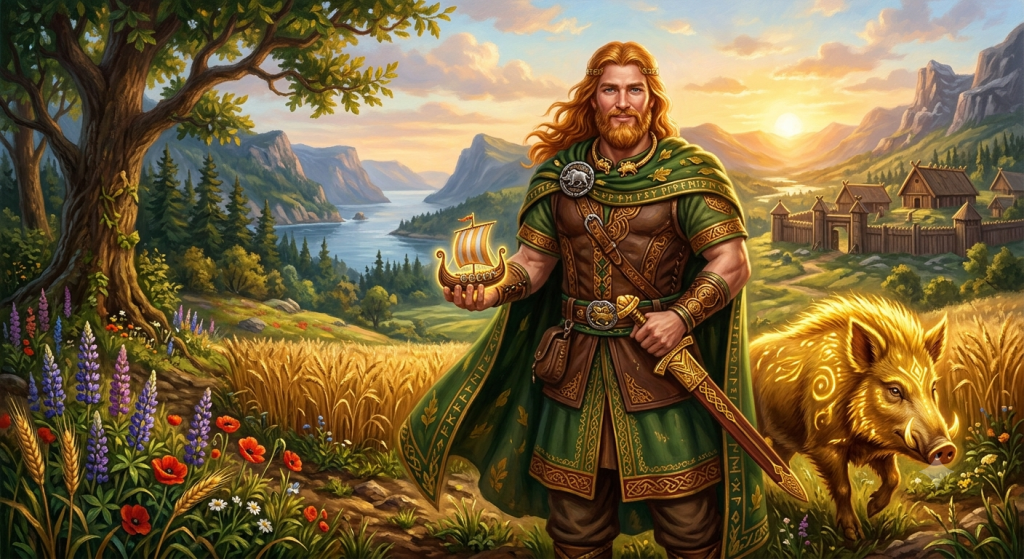
Freyr’s sword fights by itself. Without anyone holding it, without anyone directing it, the sword swings against giants and all enemies, operating according to its own will in the service of whoever possesses it. It is one of the most powerful weapons in the Norse cosmos, and Freyr gives it away for love.
He gives it to his servant Skírnir as payment for wooing the giantess Gerðr on his behalf. He understands what he is giving. The tradition is explicit that he knows the sword’s value and gives it anyway, because what he wants is worth more to him than the sword. He gets Gerðr. He loses the sword. And at Ragnarök, when Freyr faces Surtr the fire giant whose own blade burns with the heat of the sun, the Prose Edda notes directly that Freyr will find the struggle hard because he lacks the good sword he gave to Skírnir.
He dies. Surtr kills him. The fire giant who burns the world at Ragnarök kills the god of fertility and sunlight because the god of fertility and sunlight gave away the only weapon that could have stopped him, for love of a woman who lives in the realm of his enemies.
The Norse tradition does not present this as a moral lesson. It does not suggest Freyr was foolish or that desire is dangerous or that the sword mattered more than Gerðr. It presents a consequence: Freyr made a choice, the choice cost him something irreplaceable, and the cost was waiting for him at the end of the world. That is all. The tradition is honest about what things cost and does not soften it into wisdom.
The Vanir and the Aesir
Freyr is not an Aesir god. He is a Vanir, and the distinction matters more than most popular treatments of Norse mythology acknowledge.
The Norse tradition preserves a memory of two separate groups of divine beings: the Aesir, the gods most prominently featured in the Eddas, including Odin, Thor, Tyr, and Baldr; and the Vanir, an older or parallel group of deities associated primarily with fertility, prosperity, the sea, and the natural abundance of the earth. The relationship between the two groups begins with war.
The Aesir-Vanir War is one of the most significant events in Norse mythological history and one of the least fully documented. The sources indicate that the two groups fought, that neither side won decisively, and that the conflict ended with a peace agreement sealed by an exchange of hostages: prominent members of each group went to live with the other as guarantees of the peace. From the Vanir, Njörðr and his children Freyr and Freyja went to Asgard. From the Aesir, Hœnir and the wise Mímir went to Vanaheim.
The exchange did not go well on the Vanir side: the Vanir eventually decapitated Mímir, feeling they had been deceived in the exchange, and sent his head back to Odin, who preserved it with herbs and used it as a source of counsel thereafter. The Aesir side went considerably better: Njörðr, Freyr, and Freyja became full members of the Aesir community and are listed among the Aesir gods in the sources despite their Vanir origin.
Freyr’s Vanir nature is the foundation of his character and his domains. The Aesir gods are primarily associated with war, governance, fate, and wisdom. The Vanir are associated with the earth, with growing things, with rain and sunlight and the fertility of the land and sea. Freyr is the most thoroughly agricultural and natural of the major Norse deities, the god whose domain is the relationship between the sky and the earth that produces the harvest, and his Vanir origin is the explanation for why a god of fertility and prosperity exists in a pantheon otherwise dominated by figures associated with warfare and cosmic governance.
Alfheim and the Tooth Gift
Among the details the tradition records about Freyr, one of the strangest and most charming is the reason he rules Alfheim, the realm of the light elves. The Grímnismál, one of the poems in the Poetic Edda, records that Alfheim was given to Freyr by the Aesir as a tooth gift, a present given to a child when their first tooth comes through.
This means that one of the nine worlds of Norse cosmology, an entire realm inhabited by the light elves, was given to a Vanir god as a baby gift. The tradition offers no further explanation. Freyr simply received Alfheim as a gift when he was an infant, which makes him the ruler of the elves’ world on the basis of having been given it before he was old enough to understand what he was receiving. The detail is not developed further in the sources, and the elves of Alfheim do not appear prominently in the mythology, but the tooth gift is the kind of specific, slightly absurd detail that the Norse tradition includes without comment in a way that feels genuinely old rather than invented.
The Skírnismál: A Courtship Built on Threats
The most extensively developed myth about Freyr is his courtship of the giantess Gerðr, told in the Skírnismál, one of the poems in the Poetic Edda. The story begins when Freyr commits an act that the tradition presents as a significant transgression: he sits on Odin’s throne Hliðskjálf without permission. The throne allows its occupant to see across all nine worlds, and from it Freyr sees Gerðr walking in Jötunheim, the realm of the giants. Her beauty is described in extraordinary terms: when she raised her hands and opened the door before her, the brightness from her hands illuminated the sky and the sea and all the worlds.
Freyr falls immediately and completely in love and immediately and completely despondent, because Gerðr is a giantess living in the realm of the gods’ enemies, and there is no obvious path between his desire and its fulfilment. He stops eating. He stops sleeping. He does not speak. His father Njörðr eventually asks his servant Skírnir to find out what is wrong.
Freyr tells Skírnir about Gerðr and asks him to go to Jötunheim to woo her on his behalf. Skírnir agrees on one condition: Freyr’s magical sword that fights by itself. Freyr gives it without apparent hesitation.
Skírnir’s courtship in Jötunheim is not what the word courtship conventionally implies. He offers Gerðr eleven golden apples if she will agree to meet Freyr. She refuses. He offers her the ring Draupnir, the ring that produces eight equal rings every nine nights. She refuses. He then produces a carved staff covered in runes and begins threatening her. The threats are specific and escalating: he will cut off her head with his sword if she refuses. He will curse her to be invisible and unwanted at the edges of the world. He will curse her to exist in permanent misery, observed by all but desirable to none, until she agrees to what he is asking.
Gerðr agrees to meet Freyr in a grove called Barri after nine nights. Skírnir returns with the news. Freyr’s response to hearing that he must wait nine nights is one of the most human moments in Norse mythology: nine nights is long when desire has you, and each night that passes before the day I expect feels like a month.
The Skírnismál is not a comfortable story by any modern reading. The courtship works through coercion rather than consent, and the tradition presents its outcome as successful without noting the ethical problem. What it does do, and what makes it one of the most distinctive poems in the Eddic tradition, is present Freyr’s desire as genuinely overwhelming in a way that explains if it does not excuse the means used to satisfy it. The god who cannot eat or sleep or speak because of what he has seen from Odin’s throne is not simply infatuated. He is shown as genuinely transformed by what he saw, and the transformation is the starting point for everything that follows, including the sword.
His Possessions and What He Gave Away
Freyr possesses three treasures, all made by the dwarves of Svartalfheim, and the three together represent different aspects of his domain as a god of fertility, prosperity, and natural abundance.
Skíðblaðnir is the greatest of all ships, constructed to always find a favourable wind the moment its sail is raised and capable of being folded up like cloth and placed in a pocket when not needed. A ship that always has the right wind is the most useful possible vessel for a people whose economy and culture depended on sea travel, and Skíðblaðnir represents exactly the kind of supernatural favour that a god of prosperity might provide: not absolute power over the sea, but the removal of its most frustrating and costly unpredictability.
Gullinbursti is a golden boar whose bristles shine so brightly that they illuminate the darkest night as it runs across land or sea. The boar is sacred to the Vanir tradition generally, and Freyr’s association with it connects him to an older layer of divine boar symbolism in the Germanic tradition that predates the Eddic sources.
The sword that fights by itself is the third and most consequential of the three. Its name is not consistently given in the sources. Its function is clear: it operates autonomously in the service of its possessor, fighting giants without requiring direction, which makes it exactly the kind of weapon a god who rules through fertility and prosperity rather than through personal martial prowess would need. Freyr is not described as a great warrior in the tradition. He is a god of the earth and of abundance. The sword compensates for what he is not.
He gives away the sword. He gives away the horse too, the magical horse that can pass through fire, as part of the same transaction with Skírnir. At Ragnarök he fights Surtr on foot, without his sword, and he dies.
The Archaeological Evidence: How Widely He Was Worshipped
Outside the narrative myths, the evidence for Freyr’s importance in the actual religious practice of the Norse world is substantial. Place names containing his name appear across Scandinavia, and the concentration of Freyr-derived place names in Sweden is particularly significant. The Ynglinga Saga, Snorri’s euhemerised account of the Norse gods as human rulers, places Freyr as the progenitor of the Yngling dynasty, the royal line of Sweden, and gives him the alternative name Yngvi or Yngvi-Freyr. This connection to Swedish royal lineage suggests that Freyr’s cult was not simply agricultural but had political dimensions, with the fertility of the land being understood as connected to the legitimacy and virtue of the king who ruled it.
Cult statues of Freyr are described in the sagas, and at least one such statue at Uppsala in Sweden, the great cult centre of pre-Christian Scandinavia, appears to have depicted him ithyphallically, with an erect phallus, which is consistent with his role as a fertility deity and with similar depictions of fertility gods across multiple ancient traditions. The Uppsala temple complex, described in detail by Adam of Bremen writing in the 11th century, housed statues of Odin, Thor, and Freyr, and the description suggests that all three were considered equally important objects of worship at the primary cult site of Swedish paganism.
Freyr was also worshipped in connection with the cycles of the agricultural year. Blót sacrifices made to him at specific times of year were intended to secure good harvests, calm seas, and peaceful conditions, which reflects his domain across all three aspects of the prosperity that Norse communities depended on. The marriage of Freyr and Gerðr, the Vanir sky god and the giantess of the earth, has been interpreted by scholars as a mythological encoding of the sacred marriage between sky and earth that produces fertility, the same hieros gamos that appears in agricultural mythologies across the ancient world.
What His Death Means
Freyr is the only Vanir god specifically named in the Ragnarök sources. The Völuspá describes Surtr advancing from the south with his destroying flame, and it is Freyr who faces him. The Prose Edda notes the absence of the sword. He kills Beli, a giant he encounters before the final battle, with an antler rather than a blade, which is the tradition’s way of showing that he has already been stripped of what he needs before the decisive encounter.
The death of the god of fertility and prosperity in the fire that destroys the world is the most symbolically complete ending available to a deity with his domain. Freyr is the god of growing things, of rain and sunlight and the abundance that comes from the earth. Surtr is fire that consumes everything, the primordial heat of Muspelheim that will burn the nine worlds to nothing. Their encounter at Ragnarök is the confrontation between the principle of natural fertility and the principle of absolute destruction, and the tradition knows which one wins at the end of the world.
What it preserves alongside that knowledge is the decision that made Freyr’s death the way it was: the moment at which he held the sword in his hand and gave it to Skírnir and knew what he was giving. The tradition does not say he regretted it. It says he died without it. Whether the love was worth the sword is a question the Skírnismál raises and deliberately does not answer.
Further Reading
If this article sparked your interest, these are the books worth reading next.
Norse Mythology
by Neil Gaiman — the most accessible modern retelling of the Norse myths, written with genuine respect for the source material.
The Prose Edda (Penguin Classics)
by Snorri Sturluson — the thirteenth century Icelandic text that is the primary source for almost everything we know about Norse mythology.
The Viking Spirit
by Daniel McCoy — the best modern scholarly introduction to Norse mythology, written for general readers without being dumbed down.
For more on the Norse tradition, the Odin article covers the Allfather whose throne Freyr sat on without permission and whose high seat gave him his first sight of Gerðr. The Ragnarök article covers the battle in which Freyr’s absence of a sword determines how he dies. The Loki article covers the god who taunts Freyr in the Lokasenna about the price he paid for Gerðr and the sword he no longer has.
Never miss a myth
Thank you for being here. The site is brand new and every subscriber genuinely means something to me. If you're here, you care about this stuff as much as I do - and that's all the reason I need to keep going. New stories, videos and dark folklore from around the world, straight to your inbox. No algorithm. Just the stories, when they're ready.

