
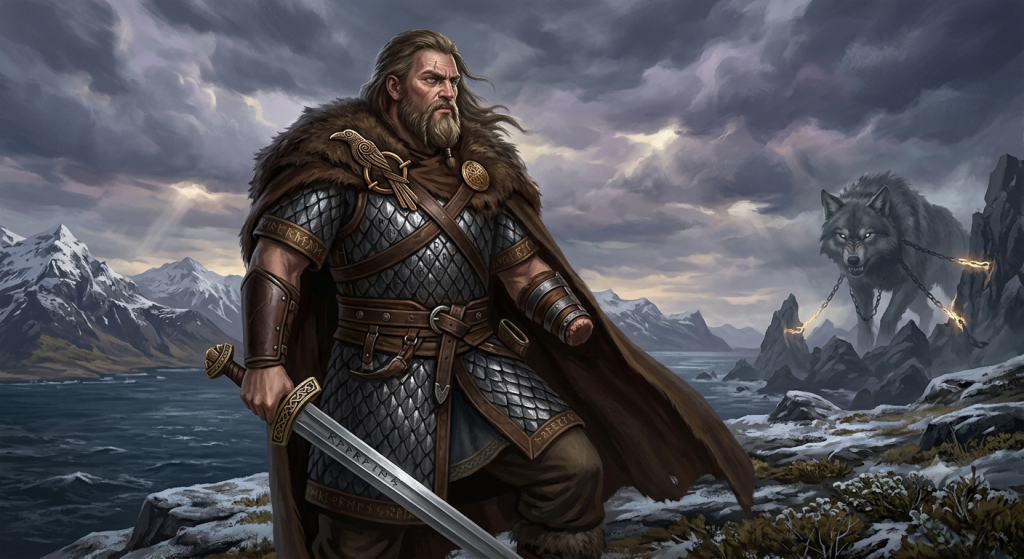
Tuesday is named after Tyr. Not after Odin, who gives Wednesday its name. Not after Thor, who gives Thursday. Tyr, whose name in Old English was Tiw and from whose name Tiw’s Day became Tuesday. He is one of only four Norse deities whose names became permanently embedded in the days of the Western week, alongside Odin, Thor, and Freya, which places him in extraordinary company for a god whose surviving mythology consists essentially of one story.
That single story is the binding of Fenrir, covered in depth in the Fenrir article on this site from the wolf’s perspective. From Tyr’s perspective, the story is about something different: it is about the god of justice voluntarily placing his hand in the mouth of a being he knows will bite it off, because someone has to pay the cost of what the gods are doing, and he is the one who steps forward.
The disproportion between Tyr’s evident importance, embedded in the calendar, in the law traditions of the Germanic world, in the comparative linguistics of Indo-European religion, and his thin presence in the surviving Norse sources is the most interesting thing about him. He is a god whose full stature has been mostly lost, who appears in the Eddas as a respected but secondary figure, and who can be partially reconstructed from the traces he left in language, place names, and comparative mythology.
What the Name Reveals: An Ancient Chief God
Tyr’s name is the most linguistically significant of any Norse deity. The Old Norse Tyr, Old English Tiw, Old High German Ziu, and Gothic Teiws all derive from the Proto-Germanic Tiwaz, which itself derives from the Proto-Indo-European root dyeus, meaning sky or to shine. This root also produces the Latin deus, meaning god, the Greek Zeus, the Latin Jupiter whose name contains the same root in its first syllable, and the Sanskrit Dyaus Pita, the sky father of the Vedic tradition.
Tiwaz is therefore cognate with Zeus and Jupiter and Dyaus Pita. He shares a name root with the chief sky gods of the Greek, Roman, and Vedic traditions. In the earliest layers of the Germanic religious tradition, before the Viking Age, before the composition of the Eddas, before Odin became the dominant figure of the Norse pantheon, the evidence of comparative linguistics suggests that Tiwaz was the chief deity of the Germanic peoples: the sky father, the law-giver, the supreme divine authority.
By the time the Eddas were composed in 13th century Iceland, that position had been occupied by Odin for centuries. Tyr in the Eddas is a respected member of the Aesir, brave and just, but clearly not the chief god. He is the boldest and most courageous of the gods, according to Snorri’s account, and men invoke him for victory in battle and for wisdom in judgment, but the cosmic authority that his name’s etymology implies is almost entirely absent from the sources.
What happened between the early Germanic Tiwaz and the Viking Age Tyr is a question historical linguistics can identify but not fully explain. The most plausible reconstruction is that Odin’s cult expanded dramatically during the migration period and the early Viking Age, absorbing functions and authority that had previously belonged to other deities including Tyr. The war god who governed the formalities of conflict, treaties, and legal oaths was gradually supplemented and eventually partially displaced by the more complex war god who governed fate, death, and the deeper mysteries of battle.
What Tyr retained was the specific domain of law and justice: not the chaos of combat but its governance, not victory but the conditions under which victory is legitimate. The god of the Thing, the public assembly where laws were made and disputes settled, the god invoked over weapons to legitimise their use, the god whose name was carved in runes on sword hilts to consecrate them: this is the Tyr the Viking Age knew, stripped of cosmic dominance but elevated in moral precision.
The Thing and the Law
The Thing, from the Old Norse þing, was the primary institution of Norse and Germanic governance: a public assembly at which free men came together to make laws, settle disputes, hear legal cases, and reach collective decisions. It was the closest equivalent the Norse world had to a parliament, and it was understood as a sacred institution as much as a political one. Oaths sworn at the Thing were oaths before the gods, and breaking them carried supernatural as well as social consequences.
Tyr was the divine patron of the Thing. His association with law and oath-keeping made him the appropriate divine presence at assemblies where laws were decided and oaths were sworn. The day designated for legal assemblies in some Norse communities was Tuesday, Tyr’s day, which is consistent with his role as the god of legal proceedings and with the Roman identification of Tyr with Mars as the deity associated with formal organised human conflict rather than with chaos.
The Roman identification is itself significant. When Romans encountered Germanic peoples during the early centuries of the common era, they practised interpretatio romana: identifying foreign deities with their closest Roman equivalents. They identified Tyr with Mars, the Roman god of war, which confirms that the Germanic Tiwaz was understood as a war god in a specific and formal sense rather than a chaos deity. Mars in Roman religion is not simply the god of fighting. He is the god of the Roman military institution, of disciplined organised warfare, of the formal conditions under which fighting is legitimate and sanctioned. Tyr as the Germanic Mars is a god of warfare understood as a regulated institution rather than as pure violence, which is consistent with his role as the god of the Thing and of oath-keeping.
The Fenrir Binding: From Tyr’s Perspective
The binding of Fenrir is covered in the Fenrir article from the wolf’s perspective. From Tyr’s perspective, the story has a different centre of gravity.
The Prose Edda’s account of the binding is specific: when the gods asked Fenrir to allow himself to be bound by Gleipnir, and Fenrir demanded that one of the gods place a hand in his mouth as a pledge of good faith, all the gods looked at each other. They knew that the pledge was a deception. They knew that whoever placed their hand in Fenrir’s mouth was going to lose it. And they all looked at each other.
Tyr put his hand in.
The Prose Edda says that he alone among all the Aesir dared to do it. The other gods did not. Whether this was because they were afraid of losing a hand or because they understood the moral weight of what they were doing and were not willing to carry it personally is not explained. What is clear is that the god of justice, the god of oaths and law, was the one who volunteered to be personally complicit in the gods’ deception, to put his body in as the guarantee of a promise they knew they were going to break.
When Fenrir found he could not escape, he bit off the hand at the wrist. The gods cheered. Tyr did not. He had known what was coming and he had done it anyway, and the loss was his alone to carry. He does not appear to have sought revenge for the loss or to have complained about it. The tradition does not record him doing either of those things. He placed his hand in, he lost it, and the wolf was bound.
This is the single act for which Tyr is primarily remembered in the Norse tradition, and it contains a genuine moral paradox that the tradition does not try to resolve. The god of justice participated in an injustice. He did so knowingly. He paid a personal cost for doing so, which mitigates but does not eliminate the injustice. The gods bound an innocent being through deception, and the god of justice was the one who made the deception possible by providing the pledge they needed.
The tradition appears to have understood this as the correct price rather than as a further wrong. Tyr paid personally for what the gods did collectively. His missing hand is not a wound that needs to be avenged. It is a debt that has been settled. The justice god carries justice’s cost in his body for the rest of the mythology.
Tuesday
The persistence of Tyr’s name in the days of the week is the most remarkable testament to his importance in the early Germanic tradition. The seven-day week as used across the Western world was adopted from Roman practice, but the Germanic peoples who encountered it renamed four of its days after their own deities: Sunday and Monday retained their luminaries, but dies Martis, the Day of Mars, became Tiw’s Day, dies Mercurii, the Day of Mercury, became Woden’s Day, dies Iovis, the Day of Jupiter, became Thor’s Day, and dies Veneris, the Day of Venus, became Frigg’s Day or Freya’s Day.
The identification of Tyr with Mars for the purpose of this renaming is the same interpretatio romana that the Romans used to identify the Germanic Tiwaz with their war god. It places Tyr alongside Odin identified with Mercury, Thor identified with Jupiter, and Freya identified with Venus, in a translation of Roman divine categories into Germanic ones that has persisted for fifteen centuries.
Every time anyone in an English-speaking country refers to the second day of the working week, they are using the name of a Norse god whose surviving mythology consists of one story and whose hand was bitten off by a wolf as payment for an injustice he made possible. The longevity of the name is out of all proportion to the surviving mythology. It is the trace of a much larger religious presence that the sources do not fully preserve.
Ragnarök and Garm
At Ragnarök, Tyr fights Garm, the hound of Hel who guards the entrance to the realm of the dead. The sources are brief about this encounter. Both Tyr and Garm die. The tradition gives the combat no elaboration, no extended description, no particular dramatic weight beyond the fact of the mutual killing. Tyr meets a dog and they kill each other and that is the end of Tyr’s involvement in the Norse cosmos.
The brevity is itself significant. The binding of Fenrir, Tyr’s only extensively developed myth, was the single story the tradition kept for him. At Ragnarök, he is given a combat rather than a narrative. He kills a dog and is killed by it, and then the world burns. There is no resolution of the Fenrir story, no return of the hand, no reckoning with the wolf who bit it off. Fenrir swallows Odin. Víðarr kills Fenrir. Tyr fights Garm. The threads do not converge for him the way they do for the central figures of the Ragnarök narrative.
The missing resolution is consistent with what the tradition preserved of Tyr more broadly: a god whose full stature is visible in etymology and in the calendar and in the institutional role he played in Germanic legal culture, but whose mythology was not transmitted with the same completeness as that of Odin or Thor or even Freyr. What remains is one hand, one act, one day of the week, and the certain knowledge that someone was brave enough to put their hand in the wolf’s mouth when everyone else looked at each other and waited.
Further Reading
If this article sparked your interest, these are the books worth reading next.
Norse Mythology
by Neil Gaiman — the most accessible modern retelling of the Norse myths, written with genuine respect for the source material.
The Prose Edda (Penguin Classics)
by Snorri Sturluson — the thirteenth century Icelandic text that is the primary source for almost everything we know about Norse mythology.
The Viking Spirit
by Daniel McCoy — the best modern scholarly introduction to Norse mythology, written for general readers without being dumbed down.
For more on the Norse tradition, the Fenrir article covers the binding from the wolf’s perspective and examines the full moral complexity of what the gods did. The Odin article covers the god who displaced Tiwaz as the Germanic sky father and whose cult expansion may explain why so little of Tyr’s mythology survived. The Ragnarök article covers the end in which Tyr’s final combat takes place.
Never miss a myth
Thank you for being here. The site is brand new and every subscriber genuinely means something to me. If you're here, you care about this stuff as much as I do - and that's all the reason I need to keep going. New stories, videos and dark folklore from around the world, straight to your inbox. No algorithm. Just the stories, when they're ready.

