
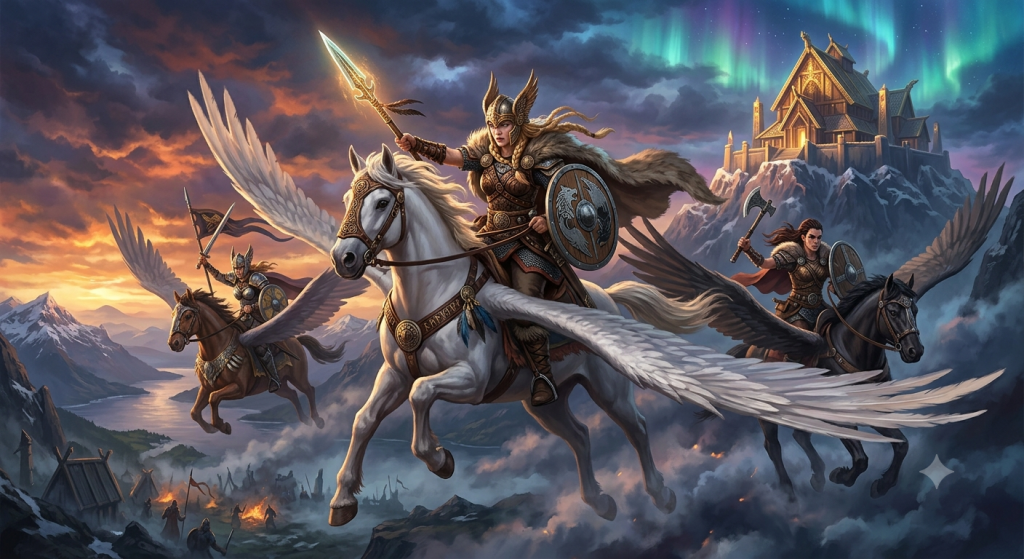
The Valkyrie most people picture is a woman in a horned helmet on a winged horse, riding through the sky over a battlefield. This image has been so thoroughly embedded in popular culture, through Wagner’s operas, through countless paintings, through fantasy gaming and film, that it feels like the original.
Almost none of it comes from the Norse sources.
The horned helmet is a misconception: Norse warriors did not wear horned helmets in battle, and neither did the Valkyries in the primary sources. The winged horse does not appear anywhere in the Norse mythological tradition. Winged horses are a Greek concept, Pegasus and his descendants, and they have no place in the Norse cosmos as the Eddas describe it. In the earliest sources, the Valkyries are associated not with horses at all but with wolves and ravens, the animals that feed on the battlefield dead.
What the sources actually describe is both stranger and more interesting than the Romantic-era image that replaced it: supernatural women who determine which warriors die before battles begin, who weave the fate of armies on looms made of intestines, who serve mead in Valhalla to the dead they have chosen, and who occasionally defy Odin himself and pay the consequences.
What the Name Means and What They Actually Did
Valkyrja in Old Norse means chooser of the slain, from valr, the slain, and the verb velja, to choose. The name is a precise description of their function: they choose who among the warriors in a given battle will die. This choice is made before the battle begins, which means the Valkyries are not simply collecting the already dead but determining who the dead will be. They are agents of fate operating within the battlefield context, and the warriors who fall do so because the Valkyries have decided they will fall rather than simply because the mechanics of combat have produced that outcome.
The Prose Edda specifies that Odin takes half the slain for Valhalla and the goddess Freyja takes the other half for her own realm Fólkvangr. The Valkyries serve as agents of Odin’s half of this arrangement: they identify the warriors designated for Valhalla, ensure their deaths occur as determined, and escort them to the hall of the slain. In Valhalla they continue their service by carrying mead to the Einherjar, the warriors who feast and train there in preparation for Ragnarök.
This double function, as agents of death on the battlefield and servants in the hall of the dead, places the Valkyries at both ends of the warrior’s final transition: they are the last supernatural beings a warrior encounters on the battlefield and the first he encounters on arrival in Valhalla. The continuity of care this implies is not incidental. The tradition is describing a relationship between the Valkyries and the warriors they choose that begins at the moment of death and continues indefinitely in the afterlife.
The Earliest Sources: Wolves and Ravens, Not Horses
In the earliest Norse poetic sources, before the tradition had been fully developed in the form preserved in the Eddas, the Valkyries appear in a different register from the later sources. They are associated with the wolf and the raven, the two animals most closely connected to battlefield death in Norse culture, rather than with horses. The raven feasts on the dead. The wolf tears at corpses. The Valkyrie chooses them.
This earlier association presents a considerably less aestheticised version of the Valkyrie function. The beings who decide who dies and strip the battlefield of its chosen dead are connected to the animals that clean battlefields of their remains. The Valkyrie in this register is not a noble escort but something closer to a death goddess in the most direct sense: present at the moment of killing, associated with what comes after the killing, part of the natural and supernatural economy of warfare rather than a figure standing apart from it in noble disengagement.
Horses appear in the tradition but without wings. The Valkyries ride across the sky in the Grimnismal and other sources, but the sky-riding is presented as simply what they do rather than as requiring an explanation in terms of the horse’s capabilities. How horses carry Valkyries through the sky is not a question the tradition asks, because the Valkyries are supernatural beings operating in the supernatural register where such things simply happen rather than requiring aerodynamic explanation.
The Darraðarljóð: The Loom of Battle
The most disturbing Valkyrie text in the Norse corpus is not in the Eddas but in a poem called the Darraðarljóð, preserved in Njál’s Saga and set before the historical Battle of Clontarf in Ireland in 1014. A man named Dörruðr watches through a window as twelve women work at a loom and chant their work aloud.
The loom is made of human intestines. The weights that keep the warp threads taut are human heads. The shuttle is a spear. The weavers are Valkyries, and what they are weaving is the fate of the warriors who will die at Clontarf. As they work they name the men who will fall, describe the blood that will flow, and express what reads as genuine enthusiasm for the carnage their weaving is producing. When the weaving is done they tear it apart and each takes a piece, then mount their horses and ride in different directions, some toward the south and some toward the north.
The poem is one of the most visceral pieces of writing in the Norse tradition and it has attracted sustained scholarly attention because it encodes something specific about the Valkyrie’s function that the more aestheticised later tradition tends to obscure. The Valkyries are not simply choosing among the already dying. They are actively producing the death. The weaving of fate is not a metaphor for passive foreknowledge: it is a description of causation. The warriors will die because the Valkyries have woven them dying, not because they happened to be in the wrong place. The loom is a weapon as much as it is a record.
The specific materials of the loom, intestines, severed heads, a spear for a shuttle, connect the weaving activity directly to the physical reality of battlefield death in a way that makes the aesthetic distance of the later tradition visible by contrast. The Romantic period’s winged horses and shining armour were a very deliberate departure from what the sources actually contain.
Individual Valkyries and Their Names
The sources identify as many as 39 individual Valkyrie names across the Poetic and Prose Edda and skaldic poetry, though not all appear consistently across multiple sources. Several of the names are descriptive of battlefield violence or death: Göndul, the wand-wielder; Göndul also appears as a pole or staff, possibly a staff of death; Skögul, the shaker; Hildr, battle; Herfjötur, host-fetter; Geirönul, the one rushing forth with a spear. The names describe functions and aspects of the Valkyrie role rather than individual personalities in most cases, which suggests that the named Valkyries are partially a taxonomy of battle-death types rather than fully individualised characters.
A few individual Valkyries are developed as genuine characters in the tradition rather than simply named as members of a collective. Sigrún in the Helgakviða poems is a shield-maiden who rides in armour, falls in love with the hero Helgi, and whose story involves reincarnation and tragic separation. Göndul and Skögul appear in Hákonarmál guiding the Norwegian king Hákon to Valhalla after his death in battle, in one of the few passages where a Valkyrie speaks directly to the hero being escorted.
But the most fully developed individual Valkyrie in the entire tradition is Brynhild, whose story is the most important in Norse heroic poetry and the one that most directly addresses what it means for a Valkyrie to have her own judgment and act on it.
Brynhild: The Valkyrie Who Defied Odin
Brynhild, sometimes spelled Brynhildr, was a Valkyrie who disobeyed Odin. He had designated a specific king to win a particular battle. Brynhild gave victory to the other king instead, acting according to her own assessment of who deserved to win rather than according to Odin’s directive. Her reasons are presented as honorable: the king Odin favoured was, by her judgment, the lesser man.
Odin’s response was to strip her of her Valkyrie status, prick her with a sleep thorn, and surround her with a ring of fire on a mountain or a rock, declaring that she would sleep until a man brave enough to ride through the flames woke her, whereupon she would marry and live a mortal life rather than continuing as one of his supernatural agents.
The hero Sigurd rides through the fire. He wakes Brynhild. She teaches him runes and wisdom in the Sigrdrifumal, one of the Eddic poems, in a passage that presents her as one of the most knowledgeable beings in the tradition. They swear oaths of love. Then a magic potion administered by the scheming queen Grimhild causes Sigurd to forget Brynhild entirely, and he marries another woman instead. The subsequent tangle of false marriages, betrayals, and competing oaths produces a catastrophe that kills both Sigurd and Brynhild and destroys the Volsung dynasty whose story they are embedded in.
Brynhild’s story is the foundation of Wagner’s Ring Cycle, and the influence of the Ring on the 19th and 20th century imagination has made her version of the Valkyrie, tragic, powerful, defiant, eternally punished for having genuine judgment, the template through which most people understand what a Valkyrie is. She is not a typical Valkyrie in the tradition’s terms. She is a Valkyrie who stopped being one, who was punished for exercising exactly the qualities the tradition otherwise presents as the Valkyrie’s defining characteristics. The punishment for choosing wrong is to no longer be a chooser.
Swan Maidens
A separate strand of Valkyrie mythology in the sources presents them as swan maidens: supernatural women who transform into swans by wearing feathered cloaks. The Völundarkviða, one of the poems in the Poetic Edda, describes three Valkyries resting beside a lake in the form of swans, their feather cloaks set aside on the shore. Three men find the cloaks and keep them, which prevents the Valkyries from flying away, trapping them in human form. The Valkyries live with the men for years, and then one day the men go out and when they return the cloaks are gone and so are the women.
The swan maiden tradition connects the Valkyries to a much broader pan-European and Central Asian tradition of supernatural women who take bird form, whose power resides in the feathered cloak, and who can be temporarily captured by someone who seizes the cloak but will always eventually reclaim it and depart. The connection between the Valkyrie tradition and this older, more widely distributed pattern suggests that the Valkyries absorbed elements from multiple earlier supernatural female figures rather than developing from a single source.
What They Tell Us About Norse Attitudes to Death in Battle
The Valkyrie tradition is the Norse mythological system’s most direct address to the question of why warriors die when they die. In a world without germ theory, without modern medical understanding, where the outcome of battles was genuinely unpredictable and where a warrior who survived one engagement might die in the next for reasons that had nothing to do with his skill or courage, the need to make sense of who died and why was both urgent and unanswerable by conventional means.
The Valkyrie tradition answers it by attributing the choice to supernatural agents acting under divine direction. Warriors do not die randomly. They die because they have been chosen, because Odin needs them in Valhalla, because their death serves the preparation for Ragnarök. The chaos of battlefield death is reframed as purposeful selection, and the quality being selected for is the kind of death that earns a place among the Einherjar: dying with courage, in battle, in a way that demonstrates the values the tradition prizes.
This reframing does not eliminate the grief of death. The Hákonarmál, the poem in which Valkyries escort King Hákon to Valhalla, acknowledges directly that his death is a loss to the living world even as it is a gain for the divine one. What it does is give the death a meaning that purely natural death does not have, which is perhaps the most fundamental thing a religious tradition can do with mortality.
Further Reading
If this article sparked your interest, these are the books worth reading next.
Norse Mythology
by Neil Gaiman — the most accessible modern retelling of the Norse myths, written with genuine respect for the source material.
The Prose Edda (Penguin Classics)
by Snorri Sturluson — the thirteenth century Icelandic text that is the primary source for almost everything we know about Norse mythology.
The Viking Spirit
by Daniel McCoy — the best modern scholarly introduction to Norse mythology, written for general readers without being dumbed down.
For more on the Norse tradition, the Odin article covers the Allfather who directs the Valkyries and whose preparation for Ragnarök is the purpose their selections serve. The Fenrir article covers the wolf whose killing of Odin is what the entire Einherjar apparatus is preparing to avenge. The Ancient Mythology section has more on the Norse tradition and the world’s other major mythologies.
Never miss a myth
Thank you for being here. The site is brand new and every subscriber genuinely means something to me. If you're here, you care about this stuff as much as I do - and that's all the reason I need to keep going. New stories, videos and dark folklore from around the world, straight to your inbox. No algorithm. Just the stories, when they're ready.

