
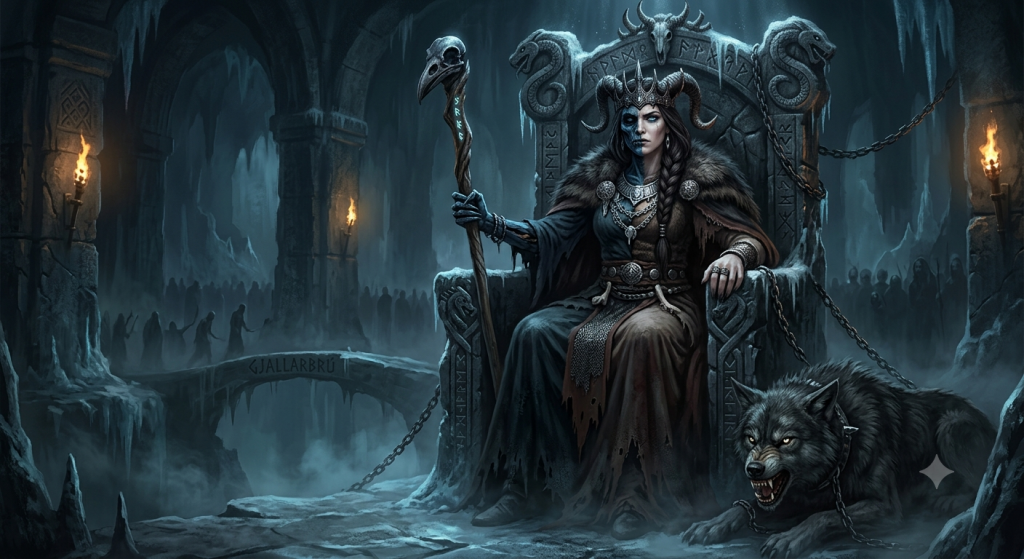
When Hermod rode Sleipnir down through the darkness to the realm of the dead to beg for Baldr’s return, he found Hel on her throne. He told her why he had come. He told her of the grief in Asgard, of Frigg’s weeping, of the universal loss that Baldr’s death had caused. He asked her to release Baldr back to the living.
Hel listened. Then she set a condition: if every being and every thing in the nine worlds truly mourned Baldr, if the grief was as universal as Hermod claimed, then she would release him. Let everything weep for him, and she would let him go.
Messengers were sent across all the worlds. Everything wept. Gods, humans, animals, plants, stones, metals. Then the messengers found a giantess named Þökk sitting alone in a cave who refused. Hel kept Baldr.
The condition she set was not designed to fail. It was a fair test of the claim Hermod had made. If everything genuinely mourned Baldr, as he said, then the condition should have been easy to meet. The condition failed because one being, almost certainly Loki in disguise, chose not to mourn. Hel did not refuse Odin’s request. She set terms. The terms were not met. She kept what was hers. There is no malice in this account and no unreasonableness. There is only a ruler of the dead who applies her own laws consistently regardless of who is asking.
Who She Was and Where She Came From
Hel is the daughter of Loki and the giantess Angrboða, and the sister of Fenrir and Jörmungandr. Like her brothers, she was taken from her mother’s hall by the gods when prophecy revealed what she and her siblings would become. Unlike her brothers, who were bound or cast into the sea, she was given a job.
Odin appointed her to rule the realm of the dead in Niflheim, giving her authority over all nine worlds to apportion dwellings to those sent to her. This appointment is one of the most consequential decisions Odin makes in the mythology, and one he would have cause to regret. He placed Loki’s daughter in charge of the realm where the vast majority of Norse humanity expected to end up. When he later needed to negotiate the return of his most beloved son from that realm, the person he was negotiating with was Loki’s daughter, who owed him nothing and was under no obligation to grant what he asked except on her own terms.
Her name in Old Norse means hidden or concealed, from the same root that gives us the modern English word hell. The name refers to the dead who are buried or cremated, whose bodies are hidden from the living world, rather than to any concept of punishment or damnation. The Norse Hel is not the Christian Hell and the connection between them is etymological rather than theological. They share a word but not a function.
What She Looked Like
The Prose Edda’s description of Hel is one of the most precisely rendered physical descriptions in Norse mythology and one of the most genuinely unsettling. She is half flesh-coloured and half blue-black or black, with one side of her body appearing as a living woman and the other appearing as a corpse. Her expression is downcast and fierce simultaneously.
The half-living, half-dead appearance is the most direct possible visual statement of what Hel is: a being who exists at the boundary between the living world and the dead one, who partakes of both states without belonging fully to either. She is not a ghost and she is not a living person. She is the threshold itself given a body and set on a throne.
The description appears primarily in Snorri’s Prose Edda, and some scholars have argued that it reflects Snorri’s Christian sensibility imposing a more dramatic visual character on a figure who was less well-defined in the earlier tradition. Whether or not this is true, the image he created is the one that has been transmitted through the subsequent tradition, and it is precise enough and original enough to have earned its place regardless of its origin.
Helheim: What the Realm Was Actually Like
The popular image of Hel’s realm as a place of suffering and darkness owes more to Christianity than to the Norse sources, and the distinction matters for understanding what the Norse tradition actually believed about where most people went after death.
Snorri’s Prose Edda presents Hel’s realm with a gothically grim character: her hall Éljúðnir, Home of the Dead, has a dish called Hunger and a knife called Famine, a threshold called Stumbling Block and a bed called Sick Bed. The catalogue of grim names reads like an attempt to make the place as unappealing as possible, and scholars have noted that it has the quality of Snorri deliberately constructing an unpleasant afterlife to contrast with the heroic afterlife of Valhalla, possibly influenced by his Christian understanding of the distinction between heaven and hell.
The older and more reliable evidence suggests a rather different picture. The Poetic Edda and the saga literature present Hel’s realm as the destination of those who die of old age, sickness, and accident: the vast majority of the human population across every generation. It is a realm of the dead rather than a realm of punishment. The dead continue to exist there, to feast, to have social structures, to occupy their proper status. When Hermod arrives to find Baldr, he finds him seated in the place of honour at Hel’s table. The most beloved of the gods is not suffering. He is simply dead, and being dead means being in Hel’s hall at her feasts.
This is the most important thing to understand about Hel’s realm in the Norse tradition: it was not a terrible fate. It was simply fate. The Norse afterlife was not primarily divided between reward and punishment but between types of death: dying in battle might earn you Valhalla or Fólkvangr, dying at sea might mean being taken by the goddess Rán, dying of illness or old age meant going to Hel. The manner of death determined the destination, not the moral quality of the life lived. Hel received the overwhelming majority of the human dead not because they had been wicked but because they had simply died in the ordinary way.
Her Staff: The Servants Who Move Slowly
Hel’s hall is served by two attendants whose names are among the most darkly comic details in all of Norse mythology. Her manservant is Ganglati and her maidservant is Ganglöt, and both names mean tardy, slow-moving, or one who shuffles. They move slowly because they are servants in the realm of the dead, where slowness is appropriate and where urgency has no particular meaning.
The names are the tradition’s most direct acknowledgement that the realm of the dead operates at a different pace from the living world. Time in Hel’s hall is not experienced with the urgency of the living. Things happen slowly there because there is no reason for them to happen quickly. The dead have nowhere to be and nothing that cannot wait. The shuffling servants who attend the half-living ruler of the dead are the clearest possible image of a realm where the ordinary temporal pressures of existence have ceased to apply.
The detail is so specific and so precisely observed that it feels genuinely old, the kind of concrete mythological detail that survives because it captures something true about how the tradition understood the experience of death rather than because anyone invented it for narrative purposes.
The Scholarly Problem: Did She Exist Before Snorri?
The World History Encyclopedia and several serious scholars have raised a genuinely important question about Hel as a personified being: whether she existed as a distinct deity in pre-Christian Norse belief or whether she is primarily Snorri’s creation, a personification of the place that he constructed from the tradition’s association of the word hel with the realm of the dead.
The case for this scepticism is not trivial. The older Poetic Edda references to Hel are often ambiguous between the place and the person. The most developed characterisation of Hel as a ruler with a hall, servants, and a specific physical appearance comes primarily from Snorri. The place called Hel clearly predates Snorri, but whether the person called Hel does is less certain.
The counter-argument is that the Poetic Edda does contain references that seem to treat Hel as a being rather than simply a place, and that the Baldr episode in which conditions are set and Hermod negotiates implies a ruler with agency rather than simply a location. A place cannot set a condition. Whatever is on the throne in Hel’s hall when Hermod arrives is a being capable of making decisions, whatever Snorri may or may not have added to the description of what that being looks like.
The honest position is that Hel as a fully characterised being is substantially Snorri’s construction, but that some tradition of the dead having a ruler in their realm probably predates him, and that the connection to Loki’s family is genuine enough in multiple sources to represent something older than the 13th century.
Ragnarök and What She Sends
At Ragnarök, the ship Naglfar, made from the fingernails and toenails of the dead, comes from Hel. The army of the dead that sails on it to join the forces of chaos against the gods is Hel’s contribution to the final battle, and it represents the reversal of the function she has served throughout the pre-Ragnarök cosmos: where she has spent the entire mythology receiving the dead and keeping them, at Ragnarök she releases them into the world that had deposited them with her.
The tradition does not describe what happens to Hel herself at Ragnarök. She is not listed among the gods who die in specific combats. She is not listed among the survivors who inhabit the new world. She is simply the source of the dead army and then, like the realm she rules, she is not discussed further in the context of what comes after.
Whether the new world that rises from the water after Ragnarök has its own Hel, its own ruler of the ordinary dead, its own slow-shuffling servants and half-living threshold guardian on a throne, is a question the tradition declines to answer. The new world is described in terms of what it gains: the survivors, the golden playing pieces in the grass, the fields that grow without sowing. What it inherits from the old world’s structure of death is left open.
Further Reading
If this article sparked your interest, these are the books worth reading next.
Norse Mythology
by Neil Gaiman — the most accessible modern retelling of the Norse myths, written with genuine respect for the source material.
The Prose Edda (Penguin Classics)
by Snorri Sturluson — the thirteenth century Icelandic text that is the primary source for almost everything we know about Norse mythology.
The Viking Spirit
by Daniel McCoy — the best modern scholarly introduction to Norse mythology, written for general readers without being dumbed down.
For more on the Norse tradition, the Baldr article covers the death that sent the most beloved god to Hel’s hall and the condition she set for his return. The Loki article covers her father, whose trickery killed Baldr and whose disguise as Þökk ensured the condition could not be met. The Ragnarök article covers the end from which Hel releases her dead to sail on Naglfar.
Never miss a myth
Thank you for being here. The site is brand new and every subscriber genuinely means something to me. If you're here, you care about this stuff as much as I do - and that's all the reason I need to keep going. New stories, videos and dark folklore from around the world, straight to your inbox. No algorithm. Just the stories, when they're ready.

