
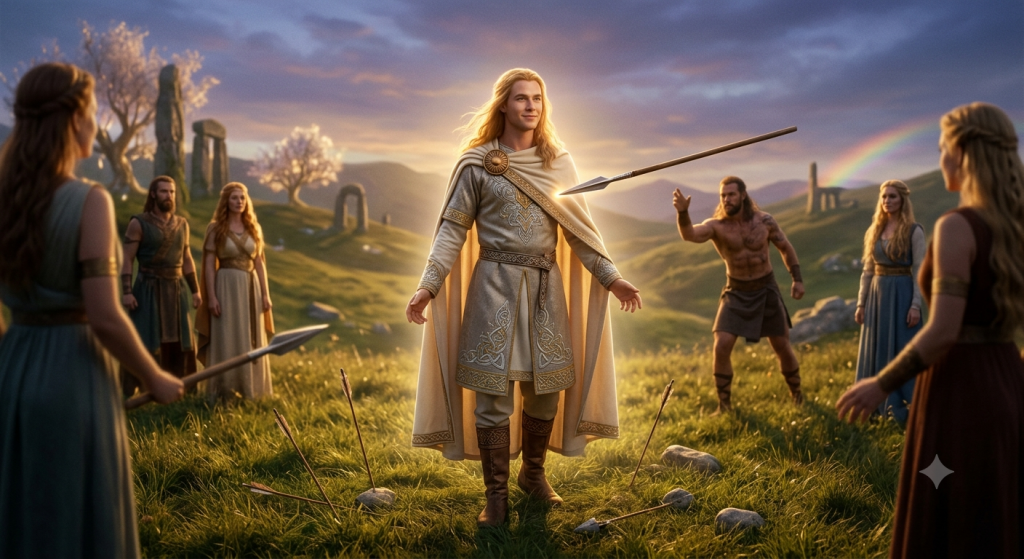
When Baldr fell dead, the Prose Edda says that the gods were so stunned that none of them could speak. Then they wept. Every god in Asgard wept at what had happened, which is the tradition’s way of establishing that Baldr was unlike any other deity: the one whose death produced universal grief rather than the anger or strategic calculation that most divine deaths in the Norse tradition produce.
His father Odin bent over the body on the funeral pyre and whispered something in his son’s ear. What he said has been one of the most discussed unsolved mysteries in Norse scholarship for centuries. The tradition records the whisper but not its content. Odin alone knew what he said, and the sources do not tell us, and the secret has never been recovered.
The death of Baldr is the pivotal moment in the Norse mythological tradition, the event that sets Ragnarök in motion and that represents the loss of the best thing in the cosmos. Everything before it is preparation and everything after it is consequence. Understanding it properly requires being honest about something most popular accounts avoid: the version of the story that everyone knows comes primarily from a 13th century Christian scholar, and the older sources tell a significantly different story.
The Two Versions
Snorri Sturluson’s Prose Edda, written around 1220 in Christian Iceland, contains the most complete and most familiar account of Baldr’s death: the dreams, Frigg’s oaths, the game of throwing things, Loki’s discovery of the mistletoe exception, the dart guided by Höðr’s blind hand, the death, the funeral pyre, Hermod’s ride to Hel, the condition of universal weeping, and the single refusal that keeps Baldr in the realm of the dead. This is the version that has dominated popular understanding of the myth for centuries.
The Poetic Edda, which preserves older material in verse form, gives a much thinner account. The Völuspá mentions Baldr’s death but does not describe the mechanism in detail. The Baldrs Draumar, Baldr’s Dreams, is a short poem in which Odin rides to Hel and raises a dead völva to ask about the meaning of Baldr’s prophetic dreams. It confirms the death is coming but does not fully describe how.
Saxo Grammaticus, the Danish historian writing in the Gesta Danorum around 1200, gives an almost entirely different account. In Saxo’s version, Balderus is not a gentle beloved god but a warlike demigod, and his death comes not from a mistletoe dart but from a rival called Høtherus in a battle over a woman both of them love. This version has no Loki, no Frigg’s oaths, no invulnerability game, no Hel, no weeping condition. It reads like a heroic saga rather than a mythological tale, and scholars have long debated which version is closer to whatever original tradition underlies both.
The most honest position is that Snorri’s version, as detailed and coherent as it is, may include substantial elaboration or even invention on his part. He was a 13th century Christian writing about a pagan tradition from a distance, and the beautiful structure of his Baldr account, the elegance of the mistletoe exception, the tragic completeness of the universal weeping condition undone by a single refusal, has the quality of a literary construction rather than a rough oral tradition. This does not make it untrue in the sense that matters for mythology. It makes it a 13th century telling of an older story whose original form we cannot fully recover.
Baldr Himself
The Prose Edda describes Baldr in terms that border on hyperbole. He is the wisest of the gods and the most eloquent. He is the most beautiful, and from his body light shines. He lives in a hall called Breiðablik, the broad gleam, where nothing unclean can exist. Everything about him is described as the best possible version of its category.
His wife is Nanna, whose grief at his death is so complete that she dies of it on the funeral pyre and is burned beside him. His son is Forseti, the god of justice and reconciliation, who sits in his hall Glitnir and settles all disputes. The family is presented as the most purely good in the divine community, which is part of why Baldr’s death registers as the worst possible loss rather than simply as one god’s death among many.
He is also the only major Aesir god who is primarily defined by what happens to him rather than by what he does. Odin seeks wisdom. Thor fights giants. Freyr loves Gerðr. Tyr puts his hand in the wolf’s mouth. Baldr has prophetic dreams, is made invulnerable, and is killed. His agency in the tradition is minimal, and his value is primarily as the thing that is lost rather than as an agent who makes choices. This is consistent with his function in the mythology: he is not a character who acts but a quality that exists, and the loss of that quality is what his death actually represents.
The Oaths and the Exception
Frigg’s campaign to extract oaths from every substance and creature in the nine worlds is one of the most logistically extraordinary acts in Norse mythology. She goes to fire, water, iron and all metals, stones, earth, trees, diseases, beasts, birds, poisons, and serpents. Every one of them swears not to harm Baldr. The comprehensive scope of the oath-taking is what makes the game of throwing things at Baldr possible and what makes the mistletoe exception so consequential.
The mistletoe she did not approach. The sources give different reasons: it was too young, it seemed too small and harmless, she did not think it worth the trouble. Whatever the reason, the oversight is presented not as foolishness but as the kind of gap that fate always finds in even the most comprehensive protection. The tradition is suggesting something about the nature of invulnerability: it cannot be total, and the thing that breaks it is always the thing that seemed too insignificant to matter.
Loki, in the disguise of a woman, visits Frigg and asks what the gods are doing. Frigg tells him about the game and then, apparently without suspecting the visitor’s motives, mentions the mistletoe exception. What follows from that disclosure is entirely Loki’s responsibility: he finds the mistletoe, fashions it into a dart or a spear depending on the source, approaches Höðr who is standing apart from the game because his blindness means he cannot aim, and guides his hand to throw it at Baldr.
Baldr falls dead. The tradition emphasises that Höðr did not know what he was throwing. The guilt in the tradition is not his but Loki’s, and the punishment eventually falls on Loki rather than on Höðr, though Odin also begets a son specifically to avenge Baldr’s death, and that son kills Höðr as the instrument of the killing even if not its instigator.
The Funeral: What Odin Whispered
Baldr’s funeral is the most elaborate in Norse mythology. His body is carried to his ship Hringhorni, the greatest of all ships, and placed on a pyre there. The ship is so large that the gods cannot launch it from the shore without help. A giantess named Hyrrokkin arrives riding a wolf with serpents for reins, and she launches the ship with a single push, so hard that the rollers it rested on burst into flame and the earth shook.
Thor hallows the pyre with Mjolnir. A dwarf named Litr runs in front of his feet and Thor kicks him into the fire, which appears to be a comic detail the tradition includes without comment. Odin places the ring Draupnir on the pyre. Nanna dies of grief and is laid on the pyre beside her husband. Baldr’s horse is led onto the pyre fully equipped.
And Odin bends down and whispers something in Baldr’s ear before the pyre is lit.
The tradition never reveals what he said. The poem Vafþrúðnismál frames this secret as a riddle: Odin, disguised as a traveller, challenges the giant Vafþrúðnir to a wisdom contest and eventually asks what Odin whispered in Baldr’s ear at the funeral. The giant correctly identifies this as something only Odin himself could know, which is the point of the riddle rather than an answer to it. The whisper is the one piece of knowledge in the Norse cosmos that has no answer in the tradition. It is the thing that Odin knows and that the sources acknowledge they cannot tell us.
Scholarly speculation has produced various theories. Odin told Baldr that he would return after Ragnarök. Odin told Baldr something about the nature of death. Odin confided something about Ragnarök itself. None of these can be verified and the tradition gives no support to any of them specifically. The whisper is simply a secret, preserved as a secret, and the preservation of the secret is itself the point: even in a tradition committed to recording what the gods knew, there are things that remain unknown.
Hermod’s Ride and the Single Refusal
Frigg asks for a volunteer to ride to Hel and ask for Baldr’s return. Hermod, one of Odin’s sons, takes Sleipnir and rides for nine days and nine nights through valleys so deep and dark that he can see nothing. He crosses the river Gjöll on the Gjöllarbru bridge, whose guardian Módguðr tells him that five battalions of dead men have recently crossed and that even all of them together did not make as much noise as Hermod alone on his horse.
He reaches Hel’s hall. He finds Baldr seated in the place of honour at the table, which is the tradition’s way of showing that even in death Baldr retains his status. He asks Hel to release Baldr. Hel’s condition is that every being in the nine worlds must weep for Baldr, demonstrating that his loss is genuinely universal. If every being mourns him, she will let him return.
Messengers are sent across all the worlds. Everything weeps: gods, humans, animals, plants, stones, metals. Then the messengers come to a cave where a giantess named Þökk sits alone. They ask her to weep for Baldr. She refuses. She says that Baldr never did anything for her and that Hel can keep him. The messengers return with the news. Baldr stays in Hel.
The tradition is almost certainly that Þökk is Loki in disguise. Loki causes the death and then, in the form of the one being who refuses to weep, ensures that the condition for the return cannot be met. He blocks Baldr twice, once at either end of the myth, and the second blocking is the one that determines that Ragnarök will happen: if Baldr had returned from Hel, the chain of events leading to the end of the world would have been interrupted. The single refusal of one disguised figure is what ensures that Ragnarök proceeds as the Norns have woven.
Baldr After Ragnarök
The Völuspá contains one of the most quietly moving passages in Norse mythology, the description of the new world that rises after Ragnarök. Among the things it describes are Baldr and Höðr reconciled, returning together from Hel and the land of the dead to take their place in the new world.
The god who died before Ragnarök and the blind god who was tricked into killing him come back together into a world where what was broken by Loki’s interference can be mended. The tradition that presents fate as unalterable and the cosmos as doomed also preserves, in the new world that follows the destruction, the possibility of reconciliation between two brothers whose tragedy was engineered by someone else entirely.
They find the golden playing pieces in the grass, the same pieces the gods used in the age before everything ended. The game was interrupted by what happened to Baldr. In the new world, the pieces are still there, and the players have returned.
Further Reading
If this article sparked your interest, these are the books worth reading next.
Norse Mythology
by Neil Gaiman — the most accessible modern retelling of the Norse myths, written with genuine respect for the source material.
The Prose Edda (Penguin Classics)
by Snorri Sturluson — the thirteenth century Icelandic text that is the primary source for almost everything we know about Norse mythology.
The Viking Spirit
by Daniel McCoy — the best modern scholarly introduction to Norse mythology, written for general readers without being dumbed down.
For more on the Norse tradition, the Loki article covers the figure who causes Baldr’s death and then prevents his return, examining the question of whether his motives in the tradition are malice, fate, or something harder to name. The Ragnarök article covers the end that Baldr’s death makes inevitable and the new world in which he returns. The Odin article covers the father who whispered something at his son’s funeral that the tradition has never revealed.
Never miss a myth
Thank you for being here. The site is brand new and every subscriber genuinely means something to me. If you're here, you care about this stuff as much as I do - and that's all the reason I need to keep going. New stories, videos and dark folklore from around the world, straight to your inbox. No algorithm. Just the stories, when they're ready.

