
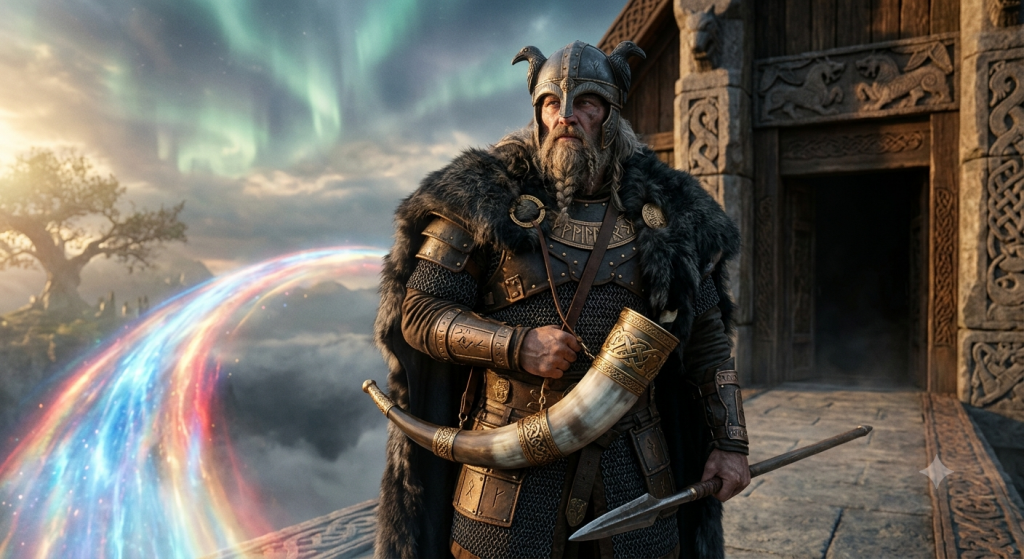
Heimdall requires less sleep than a bird. He can see for a hundred leagues in every direction, equally well by day and by night. He can hear grass growing in the meadows and wool growing on the backs of sheep. He stands at the point where the Bifröst bridge meets Asgard and watches everything that approaches from every direction simultaneously, and when what approaches is the army of chaos at Ragnarök, he will blow the Gjallarhorn and the sound will be heard across all nine worlds.
These are the specific sensory abilities the sources attribute to Heimdall, and their specificity is worth dwelling on before explaining any of the mythology around them. Hearing wool growing on sheep is not a generalised description of supernatural hearing. It is a precise claim about a particular sensitivity to a particular kind of growth: slow, biological, continuous, inaudible to any ordinary ear. The tradition is describing a being whose perceptual threshold is so fine that the normal background noise of the world is to him a continuous and detailed source of information.
This kind of watchfulness is the defining quality of the Norse pantheon’s most enigmatic major deity, and it makes him the perfect structural opposite of Loki: where Loki moves through every boundary, Heimdall guards the most important one. Their mutual killing at Ragnarök is the most precisely symmetrical death in the mythology.
The Nine Mothers
Heimdall’s birth is one of the strangest events in Norse cosmology, and the tradition provides almost no explanation for it. He was born of nine mothers simultaneously. The nine mothers are most commonly identified as the nine daughters of Ægir and Rán, the sea god and his wife, which would make them nine wave maidens. A fragment of a lost poem called Heimdalargaldr, preserved in a quotation by Snorri, has Heimdall himself declare: nine mothers’ son am I, nine sisters’ son am I.
How a single being can be born of nine mothers at once is a question the tradition does not answer. Various interpretations have been proposed: the nine mothers are nine waves that together constitute the sea, making Heimdall in some sense a child of the ocean; the nine mothers represent nine aspects of a single divine female principle; the nine mothers are a mythological encoding of something from a much older tradition that the Eddic sources preserve without fully understanding.
None of these interpretations is established as correct by the sources, which simply assert the nine mothers without explaining them. The assertion itself is consistent with Heimdall’s character as the tradition develops it: he is a being whose origins are more ancient and more fundamental than most of the Aesir gods, whose connection to the primordial sea gives him a different quality of being from the gods who were born in the conventional divine genealogies.
He is called the whitest of the gods, the shining god, the white As, all epithets that associate him with light and clarity rather than with the war and wisdom domains of the most prominent Aesir. His hall Himinbjörg, the heaven mountains or sky cliffs, sits at the end of Bifröst where the bridge meets Asgard, and it is there that he stands and watches and waits and hears the wool growing on the sheep of Midgard.
The Bifröst and What He Is Guarding Against
The Bifröst is described in the sources as a bridge of three colours, burning with fire, and it connects Midgard, the human world, to Asgard. The red in the rainbow bridge is described as actual fire, which prevents frost giants from crossing it into the divine realm. Heimdall guards the Asgard end of the bridge, which means he guards the point at which the human world and the divine world are connected: the most important threshold in the Norse cosmos.
His function as guardian is specific: he watches for giants. The giants are the primordial forces of chaos that the divine order exists to contain, and the Bifröst is the path by which any unauthorised crossing between worlds would most naturally occur. Heimdall’s vigil is continuous because the threat is continuous. The giants do not attempt a single dramatic assault. They are simply always there, on the other side of the boundary, and Heimdall is always watching.
The sensory abilities the tradition attributes to him are calibrated to this function. He does not need to see an army to know it is coming. He can hear individual biological processes at great distances. An army of giants moving toward Bifröst would be detectable to him far earlier than it would be visible to any ordinary observer, which gives the gods the warning time they need to arm and assemble before the battle begins.
This is what the Gjallarhorn is for: not simply a loud horn, but the instrument that converts Heimdall’s detection into a warning that reaches all nine worlds simultaneously. When he sounds it at Ragnarök, every being in every realm hears it, which means every being in every realm knows simultaneously that the end has begun.
The Gjallarhorn and Mímir’s Well
The Gjallarhorn, whose name means yelling horn or resounding horn, is Heimdall’s defining object in the tradition and the thing he is most consistently depicted with. Its final use, the sounding at Ragnarök, is familiar. What is less widely known is where the horn is kept between uses.
The Völuspá mentions that the Gjallarhorn is hidden under the tree, specifically under Yggdrasil, at Mímir’s well. The same well where Odin sacrificed his eye for cosmic wisdom. The well whose waters contain the deepest knowledge available in the Norse cosmos. Heimdall’s horn is stored at the source of cosmic wisdom when it is not at Heimdall’s lips.
This detail connects the horn’s function to something more fundamental than a simple alarm system. The Gjallarhorn sounding at Ragnarök is not just a notification that enemies have arrived. It is a cosmic event, a sound drawn from the same source as the wisdom Odin paid an eye to access, capable of being heard across all nine worlds simultaneously. The horn stored in Mímir’s well is a horn whose sound participates in the deep structure of the cosmos rather than simply travelling across it.
Some scholars have read this as suggesting that Heimdall and Odin are in some sense paired at the two ends of a cosmic axis: Odin’s eye at Mímir’s well giving him visual access to cosmic knowledge, Heimdall’s horn at Mímir’s well giving his warnings cosmic reach. Both sacrifices are at the same location. Both establish a connection between a specific divine object and the source of deepest knowledge. The parallel is precise enough to be deliberate.
Rígr and the Origin of Human Social Classes
The most extensive myth about Heimdall in the Eddic tradition is the one most popular accounts barely mention, possibly because its content is unfamiliar and its implications are uncomfortable. The poem Rígsþula, the Lay of Rígr, describes Heimdall travelling through Midgard under the name Rígr and visiting three human households in succession.
At each household he stays for three nights, sleeps between the husband and wife, and departs. Nine months later, a child is born at each household. The first couple are old and poor: their child, named Þræll, is dark, ugly, thick-fingered, and strong-backed, and becomes the ancestor of the thralls, the unfree labourers. The second couple are prosperous farmers: their child, named Karl, is red-faced, bright-eyed, and capable, and becomes the ancestor of the free farmers and craftspeople. The third couple are aristocratic: their child, named Jarl, is blond, keen-eyed, and destined for greatness, and Rígr returns to teach him runes personally and acknowledge him as his son. Jarl becomes the ancestor of the nobility and kings.
The poem is a mythological origin story for the three-class structure of Norse society: thralls, free farmers, and nobles, each descended from a different encounter between Heimdall and a different household. The god who guards the boundary between worlds is also the ancestor of all humans, which connects his boundary-guarding role to something more intimate: he did not simply watch over humanity from a distance but participated in human history at the most fundamental biological level.
The theological and social implications of the poem are significant and were presumably not uncontroversial even when the tradition was live. The poem attributes the hereditary inequality of Norse society to divine origin: the thralls are the way they are because of who their ancestor was, and that ancestor was shaped by Heimdall’s visit to a specific household. Whether this was understood as legitimising social hierarchy or simply as explaining it the tradition does not make explicit.
The Seal Fight With Loki
The rivalry between Heimdall and Loki is one of the most important structural relationships in Norse mythology and one of the least documented in surviving sources. The tradition is clear that they are ancient enemies, that they will kill each other at Ragnarök, and that the enmity between them represents the opposition between the guardian of order and the agent of chaos. What the tradition is less forthcoming about is what specifically happened between them before Ragnarök to establish and maintain the enmity.
One documented episode survives. In a poem called Húsdrápa, preserved only in fragments cited by Snorri, Heimdall and Loki fight over the Brísingamen, the necklace of the goddess Freyja. Loki has stolen it. Heimdall pursues him. Both transform into seals for the combat, which takes place somewhere in the sea or at a rock in the sea depending on the interpretation of the fragmentary source. Heimdall wins and recovers the necklace.
The seal fight is significant for a reason most accounts of it miss: it is the only instance in Norse mythology of someone out-tricking Loki at shapeshifting. Loki’s shapeshifting is his defining ability, the thing that makes him capable of the deceptions that drive the mythology. Heimdall matching him transformation for transformation and winning is the tradition’s way of establishing that the watchman is not simply a passive defender but an active opponent capable of meeting the trickster in his own domain.
One source notes that Heimdall and Loki had fought in the form of seals at a place called Singasteinn in earlier times, suggesting the shapeshifting combat was a recurring feature of their relationship rather than a single incident. The enmity runs deep and old, older than what the surviving sources can fully document.
Why Loki and Heimdall Kill Each Other at Ragnarök
The mutual killing of Heimdall and Loki at Ragnarök is the most symmetrical death in the Norse tradition, and it is worth understanding why the tradition paired these two specifically.
Heimdall is the guardian of boundaries. His function is to stand at the point where one world ends and another begins and ensure that nothing crosses without authorisation. He sleeps less than a bird because the boundary must always be watched. His senses are calibrated to detect the smallest unauthorised movement across the threshold he guards.
Loki is the breaker of every boundary. He crosses between the world of the gods and the world of the giants at will. He takes any form. He moves between categories of being that the cosmos tries to keep separate. He is the principle of boundary violation given divine form.
These two cannot coexist indefinitely. One of them must eventually overwhelm the other. At Ragnarök, when all boundaries collapse simultaneously and the order of the cosmos dissolves into the chaos it was made from, the guardian of the boundary and the breaker of every boundary meet for the last time and destroy each other. The pairing is the tradition’s most precise structural statement about what Ragnarök actually is: not simply a big battle but the final resolution of the tension between order and chaos that has run through the entire mythology.
Heimdall sounds the horn. The gods assemble. The battle is fought. And Heimdall and Loki kill each other, which is both the end of the watchman’s vigil and the cancellation of the trickster’s disruption. Both end together because neither can exist after the other is gone.
Further Reading
If this article sparked your interest, these are the books worth reading next.
Norse Mythology
by Neil Gaiman — the most accessible modern retelling of the Norse myths, written with genuine respect for the source material.
The Prose Edda (Penguin Classics)
by Snorri Sturluson — the thirteenth century Icelandic text that is the primary source for almost everything we know about Norse mythology.
The Viking Spirit
by Daniel McCoy — the best modern scholarly introduction to Norse mythology, written for general readers without being dumbed down.
For more on the Norse tradition, the Loki article covers Heimdall’s ancient enemy from the trickster’s own perspective, examining the question of what Loki actually is and why his opposition to the divine order runs so deep. The Ragnarök article covers the end in which Heimdall’s horn sounds and his vigil is finally over. The Yggdrasil article covers the world tree beneath which the Gjallarhorn waits at Mímir’s well.
Never miss a myth
Thank you for being here. The site is brand new and every subscriber genuinely means something to me. If you're here, you care about this stuff as much as I do - and that's all the reason I need to keep going. New stories, videos and dark folklore from around the world, straight to your inbox. No algorithm. Just the stories, when they're ready.

