
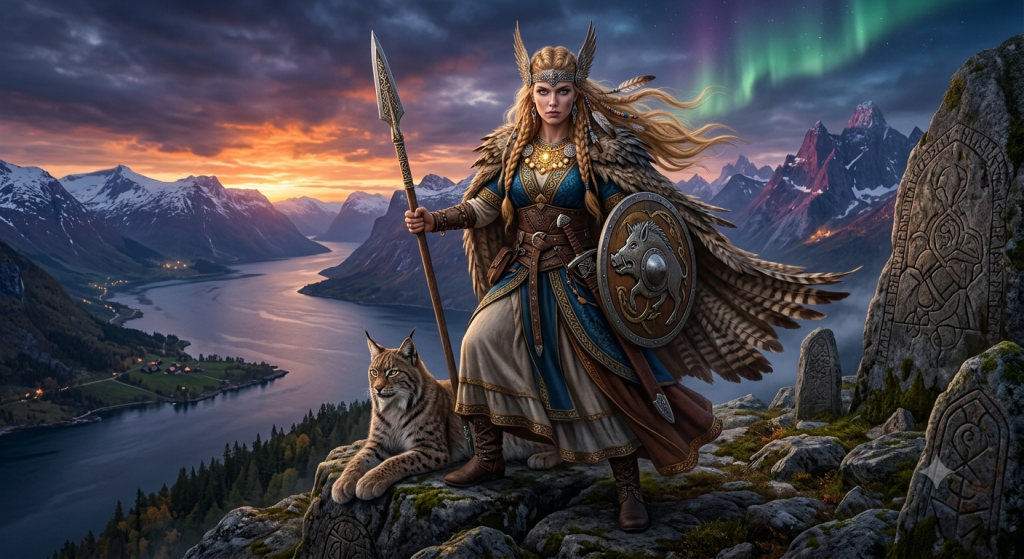
Freyja is consistently described in popular culture as the Norse goddess of love, which is accurate as far as it goes and does not go nearly far enough. She is also the goddess of war and death, the ruler of Fólkvangr where half of all warriors killed in battle spend their afterlife, the mistress of seiðr magic, a shapeshifter, a weeper of gold tears for a wandering husband, and the being who taught Odin the magical practice that gives him most of his power.
The love goddess framing comes from the same impulse that reduces Athena to a goddess of wisdom and Artemis to a goddess of the hunt: taking one domain of a complex deity and presenting it as the whole. Freyja governs love, but love in the Norse tradition is not a soft domain. It is one of the primary forces that drives human behaviour toward conflict, sacrifice, and death, and Freyja governs all of those consequences alongside the desire that produces them.
She is the most powerful goddess in the Norse pantheon, and making the case for that requires examining what the tradition actually says about her rather than what the love goddess shorthand implies.
The Vanir and What That Means
Freyja is Vanir, not Aesir. Her brother is Freyr, her father is Njörðr, and all three came to Asgard as part of the hostage exchange that ended the Aesir-Vanir War. She is therefore a member of the older or parallel divine group associated with fertility, the sea, and natural abundance, living among the Aesir as a permanent member of their community while retaining her Vanir nature and Vanir powers.
Her name in Old Norse means simply the Lady, from the same Proto-Germanic root as the modern English free, which is the female counterpart to Freyr’s the Lord. The names describe positions of authority rather than specific domains, which is consistent with the tradition’s treatment of both siblings as figures of considerable cosmic power rather than deities with narrowly defined functions.
She lives in Fólkvangr, the Field of the People, in a hall called Sessrúmnir whose name means the seat-roomy one or the one with many seats, a name that reflects the function of the hall as a place for the many. Fólkvangr is entirely her own domain, governed by no one else and subordinate to nothing else in the divine hierarchy. She does not share it with Odin. She holds it independently, which says something important about her status.
She Chooses Before Odin
The most significant detail about Freyja’s relationship to the battlefield dead, and the one that most popular accounts either miss or understate, is found in the Grímnismál, one of the poems in the Poetic Edda. Odin speaks the poem, describing the structure of the Norse cosmos, and when he comes to describe the distribution of the battle slain he says that Freyja gets first choice.
The exact phrasing in Old Norse indicates that Freyja selects her half of the slain before Odin takes his. In the most important activity of the Norse afterlife system, the recruitment of warriors for the preparation for Ragnarök, Freyja has priority over the Allfather. She chooses first. He takes what remains.
This is not a minor detail. The Einherjar in Valhalla, the warriors Odin has spent centuries assembling to fight beside the gods at Ragnarök, are the warriors Freyja did not want. The best of the best go to Fólkvangr. The tradition is either unaware of the implication of this or entirely comfortable with it, because Odin himself is the one who states it in the poem. He is not diminished by saying it. It is simply the structure of how the afterlife works.
What Freyja does with the warriors in Fólkvangr is less documented than what Odin does with his in Valhalla. The training, feasting, and preparation for Ragnarök that defines life in Valhalla is not described in comparable detail for Fólkvangr. What the tradition records is that she has them, she chose them, and they are hers.
Seiðr: The Magic She Taught to Odin
Seiðr is the most powerful magical practice in the Norse tradition, associated with fate, prophecy, shapeshifting, and the ability to manipulate the course of events. It was Odin’s most feared power. It is also a Vanir practice that Freyja brought to the Aesir and taught to Odin.
The Ynglinga Saga records this directly: Freyja was the first to teach the Aesir the art of seiðr as it was practised among the Vanir. Odin learned it from her. Every instance of Odin performing seiðr, every prophetic vision he seeks, every manipulation of fate he attempts through magical rather than conventional means, draws on knowledge that came from Freyja.
The tradition also records that seiðr was considered ergi in Norse culture: unmanly, coded as a feminine practice, socially transgressive for a male to perform. Loki mocks Odin for this in the Lokasenna, and Odin does not deny the accusation. He practises a magic that his own culture considers degrading for a man, and he learned it from the most important goddess in the pantheon. His power is partly her gift, and the cost of that gift is the persistent accusation that he has compromised his masculine status by accepting it.
Freyja herself is never accused of compromising anything by practising seiðr. For her it is simply what she does, the most powerful magic in the cosmos wielded without apology by the being who originated it in the divine community.
The Brísingamen
The story of how Freyja acquired the Brísingamen necklace is the most consistently misread myth in the Norse tradition, and the misreading consistently goes in the same direction: treating it as a story about Freyja compromising herself for vanity.
The sources are fragmentary on the details, but the core narrative is consistent: Freyja encountered four dwarves, the Brísings, who were forging a necklace of extraordinary beauty and power. She offered gold and silver for it. They refused. Their price was one night with each of them in succession, four dwarves, four nights. Freyja agreed, spent four nights with them, and received the necklace.
The tradition does not present this as shameful. It presents it as a transaction: something of extraordinary value was offered at an extraordinary price, and Freyja paid it. She is the goddess who governs love and desire and fertility: sexuality in the Norse tradition is part of her domain rather than a vulnerability within it. The transaction is consistent with who she is rather than being a departure from it.
What the story actually demonstrates is Freyja’s willingness to determine what something is worth and pay what is asked for it without apology. She wanted the necklace. She assessed its value. She paid the price. This is the same quality that leads her to take first choice of the battlefield dead and to wield the most powerful magic in the cosmos: she knows what things are worth and she acts accordingly.
The Brísingamen subsequently becomes so central to her identity that when Thor disguises himself as Freyja in the Thrymskviða to retrieve Mjolnir from the giants, the necklace is one of the identifying attributes he wears. The necklace is not simply beautiful jewellery. It is part of what Freyja is.
Óðr and the Gold Tears
Freyja has a husband named Óðr, and almost nothing is known about him except that he wanders. His name is similar to Odin’s to the point where some scholars have argued they are the same figure. The tradition does not confirm this and does not deny it. What it records is that Óðr leaves, he goes far away, and Freyja weeps for him.
She weeps tears of red gold. When Freyja’s tears fall they become gold, which is why gold in the Old Norse kenning tradition is called Freyja’s tears or the tears of the Vanir goddess. The grief of the goddess of love produces the most valuable substance in the human world, which is either a statement about the economic value of love’s consequences or a mythological explanation for why gold has the colour and weight it does.
She travels through unknown worlds searching for Óðr, taking different names in different places as she goes. The wandering search is one of the most poignant details in the Norse tradition: the goddess who receives half of the dead, who knows the magic that governs fate, who chose the best warriors of every generation, travels anonymously through the nine worlds weeping for a husband who wanders without explanation and apparently without concern for the grief he causes.
The daughters she and Óðr have together are named Hnoss and Gersemi, both meaning treasure or jewel. The children of the goddess of love and the wandering husband are called things that are precious and beautiful, which is the tradition’s way of saying something about what love produces when it persists through absence and grief.
The Lokasenna Accusations
In the Lokasenna, Loki’s extended insult of every god and goddess at Ægir’s feast, Freyja receives particular attention. He accuses her of having slept with every god and elf present, including her brother Freyr. The accusation of incest with Freyr appears elsewhere in the tradition in ways that suggest it was a genuine element of the Vanir tradition rather than simply a Lokasenna invention: the Vanir are described in some sources as practising marriage between siblings, which distinguished them from the Aesir and which may reflect a different religious tradition’s understanding of divine genealogy.
The sources that preserve the Lokasenna accusations do so in a context where Loki is specifically trying to cause maximum offence to each deity in the most targeted way possible. His accusations are not random. They are aimed at what he knows will hurt or embarrass each target most precisely. The fact that he accuses Freyja specifically of this suggests either that it was a genuine element of the tradition around her or that it was the most effective accusation available, which itself reflects something about how she was understood.
Freyja’s response in the poem is not denial. She calls him shameless and tells him he would do better to be silent. This is consistent with how several other gods respond to Loki’s accusations in the poem: neither confirming nor denying, but refusing to engage with accusations delivered in bad faith.
Her Animals and What They Mean
Freyja’s companions and vehicles are among the most specifically described divine attributes in Norse mythology. Her chariot is pulled by two cats, which are the only cats in the Norse divine tradition and which connect her to an animal whose independence and unpredictability is consistent with her own character. She owns a cloak of falcon feathers that allows the wearer to take falcon form and fly between worlds: Loki borrows it twice in the mythology, once to retrieve Iðunn and once to retrieve Mjolnir’s location, which reflects both the cloak’s usefulness and Freyja’s willingness to lend it when the cause is sufficient.
Her companion animal is the boar Hildisvíni, the battle swine, which she rides in battle. The boar is sacred to the Vanir tradition generally, appearing with both Freyja and her brother Freyr, and its association with battle as well as with fertility reflects the Vanir tradition’s understanding of natural forces as encompassing destruction as well as growth.
Further Reading
If this article sparked your interest, these are the books worth reading next.
Norse Mythology
by Neil Gaiman — the most accessible modern retelling of the Norse myths, written with genuine respect for the source material.
The Prose Edda (Penguin Classics)
by Snorri Sturluson — the thirteenth century Icelandic text that is the primary source for almost everything we know about Norse mythology.
The Viking Spirit
by Daniel McCoy — the best modern scholarly introduction to Norse mythology, written for general readers without being dumbed down.
For more on the Norse tradition, the Frigg article covers the Aesir goddess with whom Freyja is most consistently compared and with whom she may share a common origin. The Freyr article covers her brother, the other great Vanir deity who came to Asgard in the hostage exchange. The Valkyries article covers the beings whose battlefield function partially overlaps with Freyja’s own role as chooser of the slain.
Never miss a myth
Thank you for being here. The site is brand new and every subscriber genuinely means something to me. If you're here, you care about this stuff as much as I do - and that's all the reason I need to keep going. New stories, videos and dark folklore from around the world, straight to your inbox. No algorithm. Just the stories, when they're ready.

