
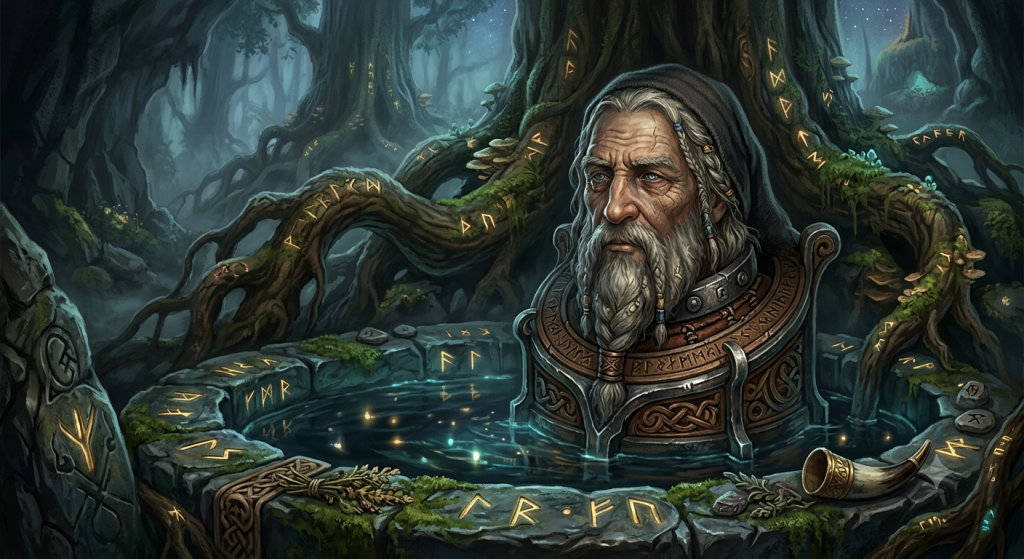
Mímir was the wisest being in the Norse cosmos. He was the guardian of the well beneath Yggdrasil that contained the waters of cosmic wisdom, waters so potent that Odin sacrificed his eye for a single drink of them. He was sent to the Vanir as a hostage of peace after the Aesir-Vanir War, and he was decapitated because the god sent alongside him could not make a decision without him present.
That last detail is worth dwelling on. Mímir was killed not because of anything he did but because his companion Hœnir was impressive-looking but intellectually hollow, and whenever Mímir was not in the room to advise him, Hœnir would respond to questions with some version of let others decide. The Vanir, watching a god who could not think for himself consistently fail to govern, concluded they had been deceived in the hostage exchange. They decapitated Mímir and sent the head back to the Aesir as a statement about the quality of what they had received.
Odin received the severed head of one of the wisest beings in existence and his response was entirely characteristic: he chanted incantations over it, embalmed it with herbs, and kept it. Death had not ended Mímir’s function. It had only changed his form.
Who He Was and Where He Came From
Mímir’s origins are among the most debated questions in Norse mythology scholarship, and the sources are not entirely consistent with each other on what he actually was. The Prose Edda and the Poetic Edda present him in ways that suggest he may represent the convergence of several older mythological traditions rather than a single coherent character.
In some accounts he is presented as one of the Aesir, a member of the divine community who happened to possess exceptional wisdom. In others he is a being of more ambiguous nature, associated with primordial depths and ancient knowledge rather than with the divine hierarchy. Some scholars have proposed that he may be older than the Aesir and Vanir themselves: a being of the earliest layer of the Norse cosmological tradition whose wisdom predates the current divine order because he existed before it.
This possibility is consistent with the nature of Mímisbrunnr, his well. The three wells at the roots of Yggdrasil represent three different kinds of knowledge or cosmic function: the Well of Urðr where the Norns tend the fates of gods and humans, Hvergelmir the spring from which the rivers of the world flow, and Mímisbrunnr the well of cosmic wisdom. Of these three, Mímisbrunnr is the one associated with the deepest understanding of how things are and why: not fate as the Norns govern it, not the physical substance of the world as Hvergelmir provides, but the comprehension of the structure behind everything.
Whoever or whatever Mímir was before his beheading, his name is connected to the Old Norse verb muna, to remember or to think, and to the concept of memory as a form of wisdom. His name encodes his function: he is the one who remembers, which in a tradition where wisdom is accumulated across enormous spans of time is a description of extraordinary power.
The Well
Mímisbrunnr, Mímir’s well, sits beneath the root of Yggdrasil that reaches into the realm of the frost giants. The Völuspá places it in the realm of the jötunn, which connects the deepest source of wisdom in the Norse cosmos to the world of the primordial forces that the divine order was imposed upon. Wisdom in the Norse tradition does not reside in Asgard. It resides at the boundary between the ordered cosmos and the chaos that preceded it.
The waters of the well are described as containing wisdom so profound that they confer understanding of the deep structure of the cosmos on whoever drinks them. Mímir himself drinks from the well daily through the horn Gjallarhorn, which means the same horn Heimdall will blow at the onset of Ragnarök is also the vessel through which the wisest being in existence maintains and replenishes his wisdom. The horn connects the watchman of the boundaries to the guardian of the deepest knowledge in a detail the tradition includes without elaboration.
The well appears at one of the most pivotal moments in the Odin mythology: his sacrifice of an eye to drink from it. Odin came to Mímisbrunnr seeking wisdom beyond what he already possessed, the kind that would help him understand what was working toward Ragnarök. Mímir’s price was an eye. Odin removed it and cast it into the well. He drank. He understood more than he had before, and what he understood did not make things easier. It simply made what was coming clearer.
Odin’s eye sits at the bottom of the well to this day in the tradition’s understanding. The most famous physical sacrifice in Norse mythology is not destroyed or lost. It is preserved in the same water that contains the deepest wisdom available in the cosmos, alongside everything else the well has accumulated across the entire span of time.
The Aesir-Vanir War and the Beheading
The hostage exchange that ended the Aesir-Vanir War sent Mímir and Hœnir to live among the Vanir as guarantors of the peace. Hœnir was tall, impressive, and appeared wise, which made him seem like a valuable hostage. The Vanir made him a chieftain. Then they started consulting him.
The problem emerged gradually. Whenever Mímir was present, Hœnir made sound decisions and spoke with apparent authority. Whenever Mímir was absent, Hœnir’s response to any question of difficulty was consistently some variation of let others decide or this is not a matter for me to determine. The Vanir eventually recognised the pattern: Hœnir was a vessel for Mímir’s judgment, not a thinker in his own right. His apparent wisdom was borrowed from the being standing next to him.
The Vanir concluded, not unreasonably, that they had been deceived. They had been given a god who looked valuable and was useless without his advisor, while the Aesir received Njörðr, Freyr, and Freyja, three of the most genuinely powerful beings in the tradition. The imbalance was clear. Their response was to decapitate Mímir and send the head back to the Aesir as a demonstration that the exchange had not been conducted in good faith.
The injustice of Mímir’s death is characteristic of the Norse tradition’s relationship to fairness: he was killed for someone else’s inadequacy, in a conflict he had no part in creating, as a consequence of a diplomatic decision made by others. The tradition records this without apparent moral comment. Mímir was killed. Odin received the head. The situation was managed.
The Preserved Head
Odin’s response to Mímir’s severed head arriving in Asgard is the detail that most distinguishes this mythology from the kinds of story that treat death as an ending. He did not mourn, or at least the tradition does not record him mourning. He embalmed the head with herbs, chanted galdrar, magical incantations, over it, and animated it back into a speaking, thinking, advising presence.
From that point forward, Mímir’s head functioned as Odin’s personal oracle. It continued to dispense wisdom. It continued to understand the deep structure of things. It could be consulted in times of particular need, and Odin consulted it at the most significant moments in the mythology.
The Völuspá records that at the onset of Ragnarök, when the signs have begun and the end is clearly approaching, Odin rides to consult Mímir for the last time. The Allfather, who has prepared for Ragnarök across centuries, who has gathered warriors and sought every possible piece of knowledge about what is coming, still goes to the head that lives at the root of the world tree to ask one final time whether there is anything he has missed. The tradition does not record what the head tells him. It records only that he asked.
The head’s preservation is one of the Norse tradition’s most precise statements about what wisdom actually is. Mímir’s wisdom was not in his body. It was in his accumulated understanding of how things are, and that understanding survived the removal of the body that had housed it. Death changed his form and did not change his function, which is either a comforting or a disturbing observation depending on your perspective.
Mímir and the Well: The Same or Different?
One of the more genuinely puzzling questions in Mímir mythology is the relationship between the being Mímir and the well Mímisbrunnr. The name of the well translates as Mímir’s well or Mímir’s spring, which identifies it as belonging to him. But whether Mímir and the well are simply associated or whether they are in some deeper sense the same entity is a question the sources leave open.
Some scholars have proposed that Mímir originally was the well: a personification of the primordial waters of wisdom that was later developed into a distinct character with his own story. Others have proposed the reverse: that the well was named for a figure who guarded it, and that the association became so close that later traditions treated them as almost interchangeable. The Prose Edda treats them as distinct, with Mímir as the being and Mímisbrunnr as the well he guards. The Poetic Edda is less clear, and some passages could be read as referring to either the being or the place.
What is consistent is the association between Mímir and a specific kind of wisdom: not the wisdom of fate that the Norns govern, not the operational wisdom of war and governance that Odin pursues through his other means, but the deepest structural understanding of how the cosmos works and what lies beneath its surface. Whether that wisdom resides in a being or in a well or in both simultaneously, it is located at the same place: the root of Yggdrasil that reaches toward the realm of the giants, at the boundary between the ordered cosmos and what it was ordered from.
Mímir in God of War
Mímir in the God of War games is the self-described smartest man alive, an advisor to Odin who was imprisoned on a tree and who asks Kratos to behead him so that Freya can resurrect the head and he can serve as their guide. He is one of the games’ most popular characters and also one of their most mythology-faithful: the core concept of a severed head that continues to advise Odin with incomparable wisdom comes directly from the Eddas.
The games change the beheading from a consequence of the Aesir-Vanir War to a voluntary act at Mímir’s own request, and they attribute the resurrection to Freya rather than to Odin’s magic and herbs. They also make Mímir a more fully characterised person with a defined personality, backstory, and emotional arc, which goes considerably beyond what the tradition preserves about him.
The tradition’s Mímir is not a character in the narrative sense. He is a function: the deepest available wisdom, accessible at a price, consulted at the most critical moments. The games made him a character and made him compelling, which is a legitimate creative decision even if it departs significantly from what the sources preserve.
Further Reading
If this article sparked your interest, these are the books worth reading next.
Norse Mythology
by Neil Gaiman — the most accessible modern retelling of the Norse myths, written with genuine respect for the source material.
The Prose Edda (Penguin Classics)
by Snorri Sturluson — the thirteenth century Icelandic text that is the primary source for almost everything we know about Norse mythology.
The Viking Spirit
by Daniel McCoy — the best modern scholarly introduction to Norse mythology, written for general readers without being dumbed down.
For more on the Norse tradition Mímir belongs to, the Odin article covers the Allfather who sacrificed his eye at the well and who keeps the preserved head for counsel. The Yggdrasil article covers the world tree whose roots reach to the well. The Aesir-Vanir War article covers the conflict that produced Mímir’s beheading and explains the full context of the hostage exchange.
Never miss a myth
Thank you for being here. The site is brand new and every subscriber genuinely means something to me. If you're here, you care about this stuff as much as I do - and that's all the reason I need to keep going. New stories, videos and dark folklore from around the world, straight to your inbox. No algorithm. Just the stories, when they're ready.

