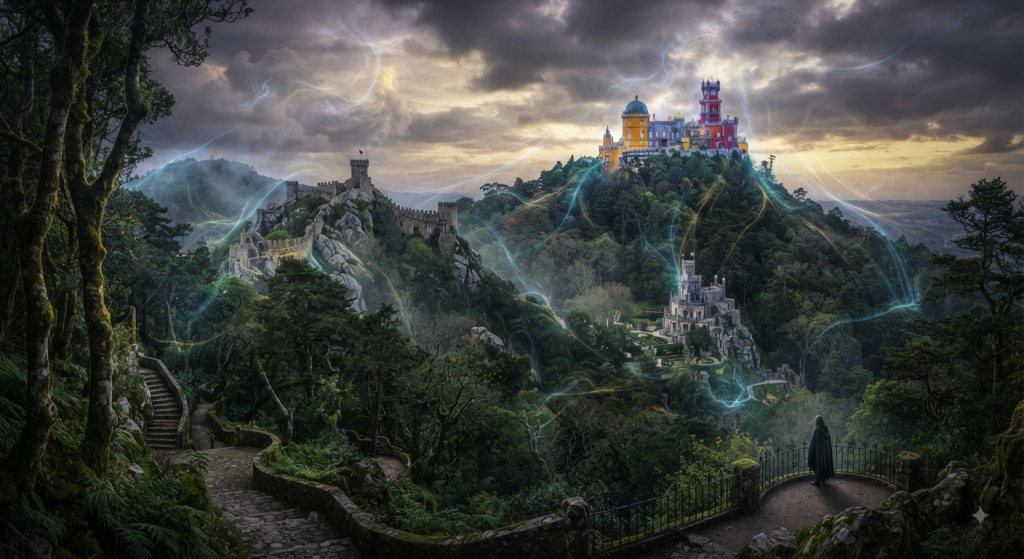
Sintra is a town in the hills west of Lisbon that has been understood as a place of supernatural significance for longer than the written record can trace. The Moors called it Xintrea and associated it with the moon. The Romans before them left votive offerings at its springs. The pre-Roman inhabitants built ritual sites in its rocky highlands. Lord Byron, who visited in 1809, called it the most beautiful village in the world and described it as glorious Eden in a letter home. What drew all of these people to the same place was partly the dramatic landscape, partly the unusual microclimate that keeps the hills green when the surrounding plains are dry, and partly something harder to define that everyone who has spent time in Sintra recognises without being able to fully explain.
The Moura Encantada tradition is particularly concentrated in Sintra, with specific locations in the town and the surrounding Sintra hills associated with enchanted women guarding treasure. The springs that emerge from the limestone hills were understood as supernatural locations, the points where the underground water world and the surface world made contact. The megalithic monuments that survive in the hills above the town were understood as fairy sites, places where the Fadas and the Mouros came close to the surface of the human world.
The Palaces
Sintra’s landscape is dominated by palaces, each one a different period’s attempt to inhabit the supernatural qualities of the place in architectural form. The National Palace in the town centre, with its distinctive twin conical chimneys that are visible for miles, was a royal residence from the medieval period and contains the most extensive surviving collection of Moorish azulejo tiles in Portugal. The Palace of Pena, built on a rocky peak above the town in the 1840s for Ferdinand II, is a Romantic fantasy of towers, battlements, and polychrome facades that makes the supernatural qualities of the location explicit in architectural form: the palace looks exactly like what a Romantic poet would build on a fairy hill.
The Quinta da Regaleira, built at the turn of the twentieth century by the eccentric millionaire António Augusto Carvalho Monteiro, is the most overtly supernatural of Sintra’s buildings, a neo-Gothic palace whose grounds contain an initiation well that descends nine levels, a network of underground tunnels, chapels, grottos, and architectural symbolism drawn from Freemasonry, the Knights Templar, alchemy, and the Rosicrucian tradition. The well, a reversed tower descending into the earth rather than rising from it, is one of the most extraordinary architectural spaces in Portugal and one of the most visited sites in Sintra.
The Sintra Hills and Their Creatures
The hills above Sintra — the Serra de Sintra — are a landscape of extraordinary character: granite outcrops emerging from dense forest, sudden mists, unexpected clearings, the sound of water everywhere, and a quality of enclosure that makes the ordinary world feel very far away even within sight of the town below. The Moura Encantada stories associated with specific springs and outcrops in these hills are among the most detailed in the Portuguese tradition, which suggests that the landscape itself encouraged the folk imagination in ways that more ordinary landscapes did not.
The castle of the Moors, built in the eighth and ninth centuries on a rocky ridge above the town and now in romantic ruin, is the most obvious physical reminder of the Moorish presence that underlies so much of the Portuguese supernatural tradition. The Mouras who guard treasure in Sintra’s ruins are haunting specifically these ruins, the physical remains of the civilisation that preceded the Christian reconquest.
Byron and the Romantic Tradition
Byron’s enthusiasm for Sintra in Childe Harold’s Pilgrimage introduced the town to the Romantic imagination of northern Europe and set the terms for how educated Europeans would understand the place for generations. His description of Sintra as the most beautiful village in the world, set among hills of rock and forest, with palaces and convents and the ruins of the Moorish castle, made it a destination for the Romantic tourist who wanted to experience the sublime in a specifically Iberian form.
For more on the folklore of Portugal, the Moura Encantada article covers the enchanted women whose tradition is particularly concentrated in the Sintra hills. The Fada article covers the Portuguese fairy tradition. The Portugal folklore hub page has every article in the cluster.
Never miss a myth
Thank you for being here. The site is brand new and every subscriber genuinely means something to me. If you're here, you care about this stuff as much as I do - and that's all the reason I need to keep going. New stories, videos and dark folklore from around the world, straight to your inbox. No algorithm. Just the stories, when they're ready.