Orpheus was the greatest musician who ever lived in Greek mythology. His lyre playing moved rocks and rivers. Wild animals followed him. Trees uprooted themselves to be closer to the sound. When the Argonauts needed to row past the Sirens, Orpheus played louder than the Sirens sang and the crew was safe. He was, in the most literal sense available to the tradition, the musician whose music shaped the physical world around him.
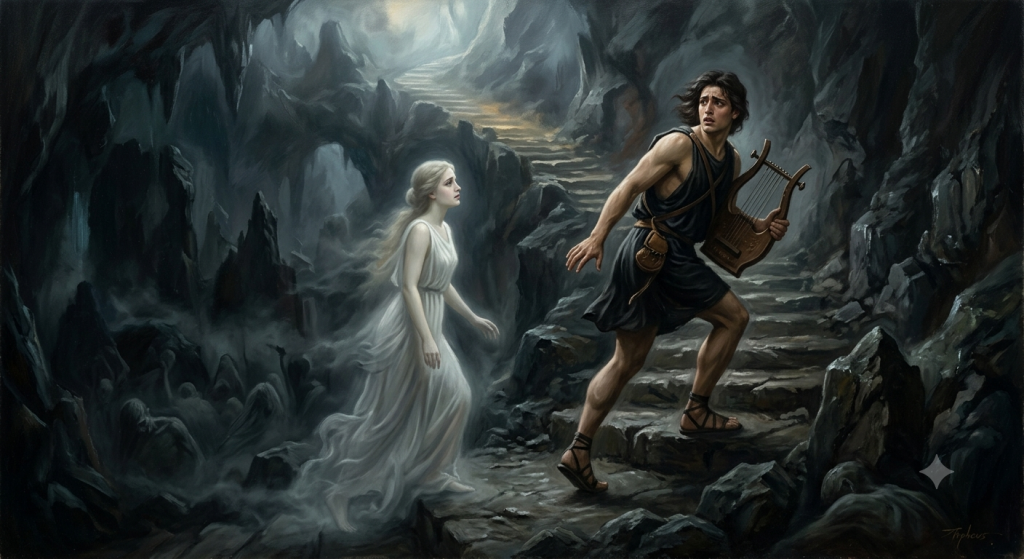
He used this power once to descend into the underworld to retrieve his wife Eurydice, who had died on their wedding day from a snake bite. He played for Hades and Persephone and moved them to tears — the only time the rulers of the dead wept in the Greek tradition — and was granted permission to take Eurydice back to the living world on one condition: he must not look back at her until they had both reached the surface.
He looked back.
The Death of Eurydice
Eurydice was a naiad, a water nymph, and she and Orpheus had just been married when she died. The most common version of her death describes her fleeing from Aristaeus, a minor deity who desired her, and stepping on a snake in the grass while running. The snake bit her and she died. It was their wedding day.
The abruptness of this is characteristic of how Greek mythology handles the deaths that drive its most significant narratives: they arrive without warning, disproportionate to any fault or failing of the person who dies, and the story that follows is the story of how the living respond. Eurydice dies in a sentence. The rest of the myth is what Orpheus does about it.
The Descent
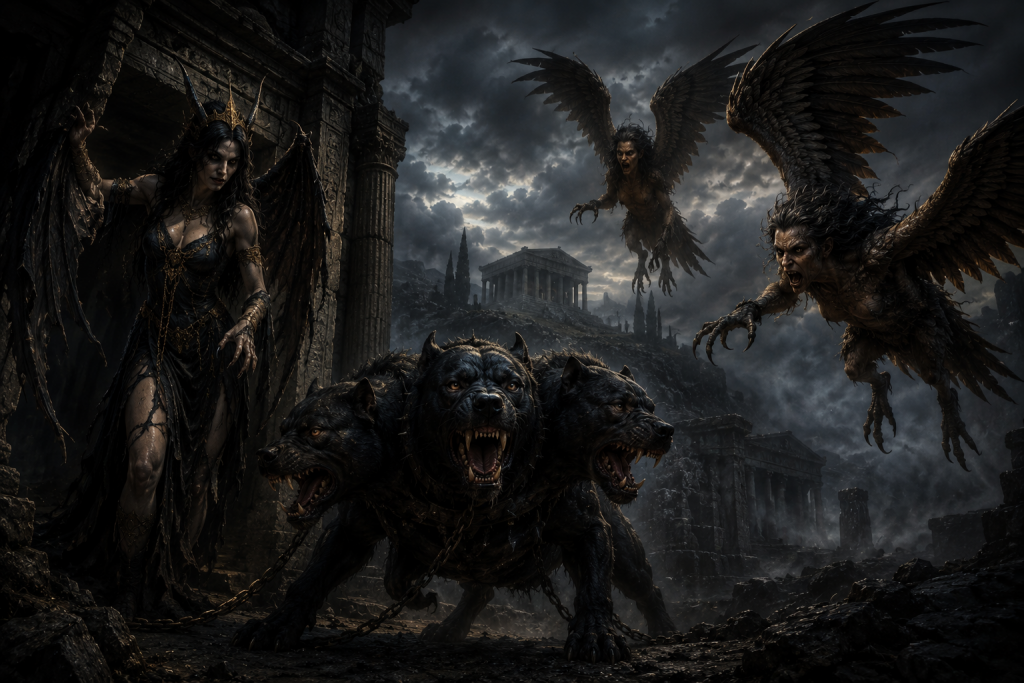
Orpheus went to the underworld. This is already extraordinary: the living do not go to the underworld and return without extraordinary circumstances and divine assistance. Orpheus went on the strength of his music alone. He played as he walked through the entrance to the dead realm and the music stopped everything: Tantalus forgot to reach for the receding fruit, Sisyphus sat down on his boulder, the Furies wept. The entire machinery of the underworld, with all its punishments and its routines, paused for Orpheus’s playing.
He played before Hades and Persephone and made his case in music rather than words. The argument of the song, as Ovid renders it in the Metamorphoses, was essentially this: everything comes to you eventually, Hades, every living thing passes through your realm in the end, so what does it cost you to loan me Eurydice for the rest of a human life? We will both return when our time comes. I am only asking for what is already yours.
Persephone wept. Hades agreed. Eurydice was brought forward, still limping from the snake bite. The condition was stated: Orpheus would walk ahead and Eurydice would follow, and he must not look back until both of them had reached the upper world.
The Look
The tradition does not tell us exactly when he looked back or why. What it gives is the moment: he was almost at the surface, the light of the upper world already visible, when he turned. Eurydice had not yet crossed the threshold. She was immediately pulled back into the underworld. She called out to him, or said goodbye, depending on the version. She was gone.
The why has generated more discussion than almost any other question in the myth. Ovid suggests it was love: he looked because he was afraid she was not there, because the silence behind him was unbearable, because the need to see her overcame the instruction not to. Others have suggested it was doubt: he did not fully believe the underworld would keep its word and looked to confirm she was following. Still others have read it as inevitable, a structural element of the myth rather than a psychological one: the condition was designed to be impossible to meet, because the living and the dead cannot simply walk back together from death’s realm, and the look was the form the impossibility took.
The tradition does not favour any one of these readings. It simply records that he looked, and she was gone, and he could not go back a second time because Charon would not ferry the living twice.
After Eurydice
Orpheus returned to the surface alone and spent the remainder of his life in grief, playing music that was now entirely sorrowful, refusing all other love. The Maenads, the female devotees of Dionysus, eventually tore him apart in their frenzy, either because he rejected their advances, or because he represented an Apollonian rational order opposed to Dionysian dissolution, or because Dionysus sent them as punishment for Orpheus’s excessive devotion to Apollo.
His severed head, thrown into the River Hebrus, continued to call out Eurydice’s name as it floated to the sea. The Muses collected his limbs and buried them at Leibethra. His lyre was placed among the stars as the constellation Lyra.
The Orphic tradition that developed from his mythology presented him as the founder of a mystery religion with its own theology of the afterlife, and Orphic gold tablets found across the Greek world give the dead instructions for navigating the underworld based on Orpheus’s descent. The musician who looked back became the guide for those who came after him.
Further Reading
If this article sparked your interest, these are the books worth reading next.
The Iliad — Homer (Penguin Classics)
by Homer — the primary source for everything in this article, and still the most vivid account of the Trojan War ever written.
The Odyssey — Homer (Emily Wilson translation)
by Homer, translated by Emily Wilson — the best modern English translation, and the book that contains Odysseus’s own account of the horse.
The Trojan War: A Very Short Introduction
by Eric Cline — the clearest and most up to date account of what archaeology actually tells us about Troy and whether any of it happened.
For more on the Greek tradition, the Hades article covers the ruler of the underworld who wept at Orpheus’s music and granted the only concession the dead realm ever made. The Persephone article covers the queen who was also moved to tears and whose agreement was necessary for Eurydice’s release. The Greek Mythology hub page has every article in the cluster.
Never miss a myth
Thank you for being here. The site is brand new and every subscriber genuinely means something to me. If you're here, you care about this stuff as much as I do - and that's all the reason I need to keep going. New stories, videos and dark folklore from around the world, straight to your inbox. No algorithm. Just the stories, when they're ready.