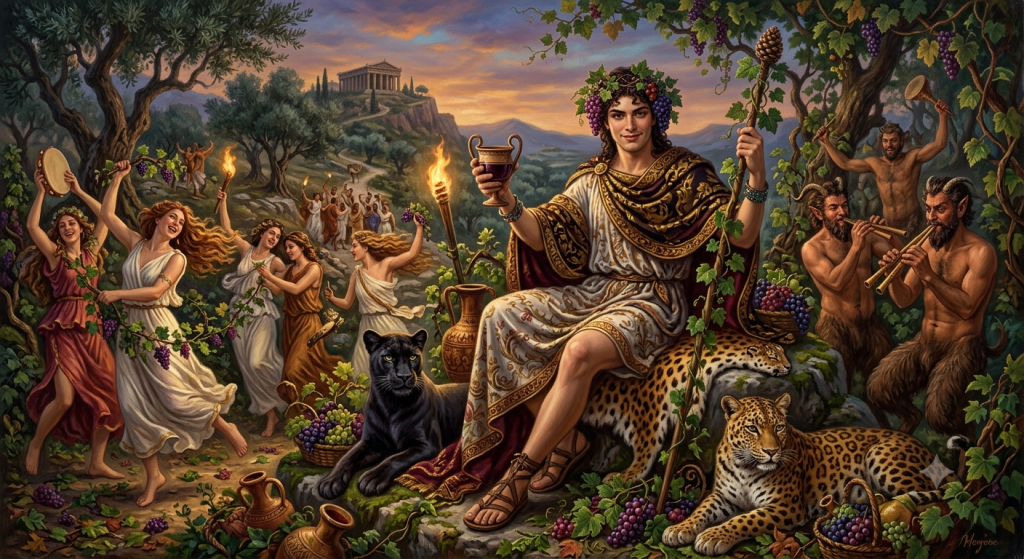
Dionysus is the last of the Olympians and the most unsettling. He is the god of wine, yes, and of festivity and theatre and the arts of civilisation that grow from the grapevine. He is also the god of ecstatic dissolution, of the boundary between self and world becoming permeable, of the controlled order of rational life coming undone in ways that can be joyful or catastrophic depending on whether the dissolution is accepted or resisted.
The tradition is consistent on one point: refusing Dionysus is more dangerous than accepting him. The kings and cities that resist his worship in the mythology are destroyed. The women who deny his divine nature are driven mad and do things they would never otherwise do. The sailors who try to kidnap him are turned into dolphins. The refusal of Dionysus produces worse outcomes than the embrace of him, which is a genuinely interesting theological position: the god of intoxication and loss of control is safer accepted than rejected.
The Birth and the Double Gestation
Dionysus has one of the most unusual birth stories in Greek mythology, involving two mothers and a gestation partly inside a god’s thigh. His mother was Semele, a mortal princess of Thebes and a lover of Zeus. Hera, in her habitual response to Zeus’s affairs, approached Semele in disguise and persuaded her to ask Zeus to reveal himself in his full divine form. Zeus had sworn an oath on the Styx to grant Semele any wish, and when she made this request he could not refuse.
No mortal could survive the full revelation of Zeus’s divine nature. Semele was consumed by divine fire. Zeus rescued the unborn Dionysus and sewed him into his own thigh to complete the gestation. When the time came Dionysus was born from Zeus’s thigh, which gave him the epithet twice-born and established his unusual dual nature: he is the son of a mortal woman and the son of the king of the gods, born of divine fire and divine flesh, belonging fully to neither the mortal nor the divine world.
The Wanderings and the Resistance
Before Dionysus established his worship in Greece he wandered across the world, from Asia to Egypt to Greece, spreading the cultivation of the vine and the practice of his worship. The wanderings are important because they explain his character as the foreign god, the one who comes from outside and whose worship is therefore always slightly alien, slightly threatening, slightly not quite Greek even when it is fully Greek.
His arrival in Greece was consistently met with resistance, and the myths of that resistance are among the most disturbing in the tradition. King Lycurgus of Thrace drove Dionysus and his followers into the sea. The gods blinded Lycurgus and drove him mad, and he attacked his own son believing him to be a vine, killing him. He was eventually torn apart by wild horses on Mount Pangaion.
In Thebes, King Pentheus refused to acknowledge Dionysus’s divine nature and tried to imprison him. This is the subject of Euripides’s Bacchae, one of the most powerful plays in the Greek dramatic tradition. The women of Thebes, including Pentheus’s own mother Agave, were driven into Dionysiac frenzy on the mountains. Pentheus, persuaded by Dionysus to spy on the women in disguise, was discovered and torn apart by the women in their frenzy. Agave returned to Thebes carrying his head, believing she had killed a lion, and gradually came to understand what she had actually done.
Theatre and the City
Dionysus is the god of theatre, and the connection between the god of ecstatic dissolution and the art form that allows an audience to experience emotions safely through fiction is one of the most interesting in the Greek tradition. The great dramatic festivals of Athens, the Dionysia, were religious celebrations in Dionysus’s honour at which the tragedies and comedies that are the foundation of Western theatre were performed. Aeschylus, Sophocles, Euripides, and Aristophanes all wrote plays for the Dionysian festivals.
Theatre in this context was not simply entertainment. It was a ritual technology for managing the experience of strong emotion, particularly the emotions most associated with Dionysus: grief, joy, ecstasy, and the loss of the boundary between self and world that comes with being fully absorbed in a story. The audience of a Greek tragedy was doing something religious: submitting to a controlled dissolution of ordinary consciousness in the presence of the god whose nature that dissolution expressed.
Ariadne
The most fully realised love story in Dionysus’s mythology is his marriage to Ariadne, the daughter of Minos of Crete who had helped Theseus navigate the Labyrinth and was abandoned by him on the island of Naxos when he sailed away. Dionysus found her there and married her. She became a goddess, and the crown he gave her was placed among the stars as the constellation Corona Borealis.
The tradition gives this ending in contrast to Ariadne’s abandonment: she helped the hero, was abandoned by him, and was found by the god and elevated. The god of wine and dissolution provided what the hero of rational action and civic order did not.
Further Reading
If this article sparked your interest, these are the books worth reading next.
The Iliad — Homer (Penguin Classics)
by Homer — the primary source for everything in this article, and still the most vivid account of the Trojan War ever written.
The Odyssey — Homer (Emily Wilson translation)
by Homer, translated by Emily Wilson — the best modern English translation, and the book that contains Odysseus’s own account of the horse.
The Trojan War: A Very Short Introduction
by Eric Cline — the clearest and most up to date account of what archaeology actually tells us about Troy and whether any of it happened.
For more on the Greek tradition, the Zeus article covers the father who completed Dionysus’s gestation in his own thigh. The Hera article covers the stepmother whose intervention caused Semele’s death and Dionysus’s unusual birth. The Greek Mythology hub page has every article in the cluster.
Never miss a myth
Thank you for being here. The site is brand new and every subscriber genuinely means something to me. If you're here, you care about this stuff as much as I do - and that's all the reason I need to keep going. New stories, videos and dark folklore from around the world, straight to your inbox. No algorithm. Just the stories, when they're ready.