At one point in the Odyssey, Athena drops her disguise and speaks to Odysseus directly. She has been appearing to him throughout the poem in various forms, guiding him, warning him, occasionally saving his life, while maintaining a level of divine discretion that keeps Poseidon from noticing her involvement. When she finally reveals herself on Ithaca, the conversation that follows is one of the most unusual in Greek mythology.
Odysseus immediately tries to trick her. Even knowing he is speaking to a goddess, he gives her a false account of who he is and how he got there. Athena is delighted. She drops the disguise entirely and tells him that this is precisely why she cannot abandon him: they are alike. She has renown among the gods for wit and tricks. He is by far the best among mortals for counsel and tales. They are the same kind of mind operating at different levels of the universe, and the recognition between them is mutual and genuine in a way that the relationships between gods and mortals in Greek mythology rarely are.
That exchange defines Athena’s role in the Odyssey and her character across the broader tradition. She is not simply a patron goddess protecting a favoured mortal out of obligation or piety. She is something more specific: a divine intelligence who recognises in Odysseus a mortal version of what she is, and who finds that recognition worth investing in across twenty years of wandering and war.
Interested in Greek Mythology? Check out my YouTube channel below
Who She Was
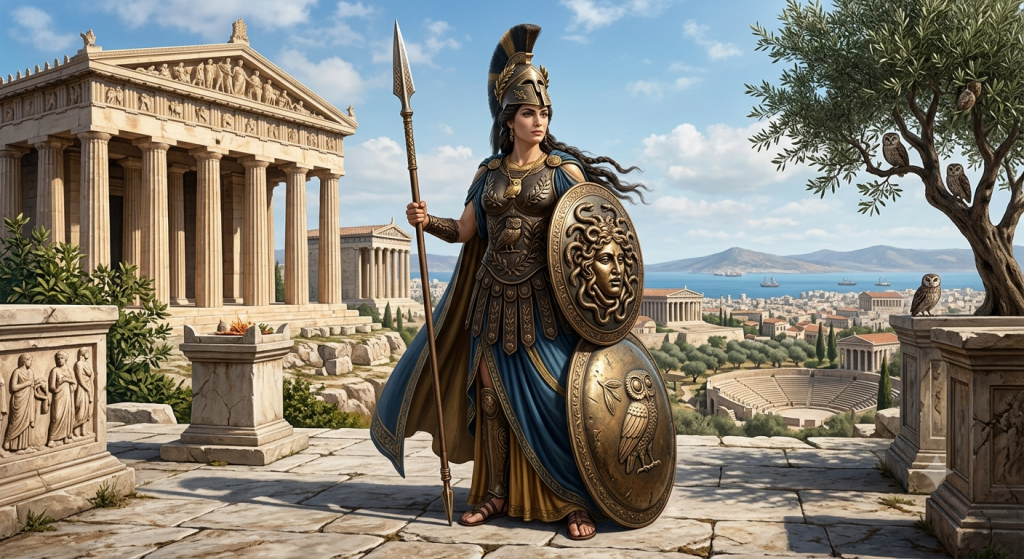
Athena was one of the twelve Olympians and among the most widely worshipped deities in the ancient Greek world. She was the goddess of wisdom, of craft, of strategic warfare, of the defence of cities, and of weaving and other domestic arts, a combination that seems contradictory until you understand that in the Greek conception, all of these things are expressions of the same quality: the application of intelligence and skill to the making of things, whether those things are pots, textiles, battle plans, or arguments in a court of law.
Her Roman equivalent was Minerva, and the identification was close enough that Roman writers used both names interchangeably in ways that caused no confusion. Her symbol was the owl, which in the Greek tradition was associated with wisdom and with the ability to see in the dark, both literal and metaphorical. The city of Athens was named for her, or she was named for the city depending on which tradition you follow, and the Parthenon on the Acropolis was her principal temple, one of the most elaborate and expensive religious buildings in the ancient world.
She is described consistently across Homer as bright-eyed or gleaming-eyed, epithets whose exact meaning has been debated since antiquity. The eyes of the owl, which sees what others cannot, is the most common interpretation. She is also described as grey-eyed in some translations, which has generated its own scholarly discussion about what colour the Greek word glaukopis actually indicates. What all the epithets share is an emphasis on the quality of her vision: she sees clearly when others do not, which is the defining characteristic of the kind of intelligence she embodies.
Born from a Head
Athena’s birth story is one of the most distinctive in Greek mythology and carries specific theological implications that the tradition developed carefully. Zeus swallowed his first wife Metis while she was pregnant, having been warned by a prophecy that her children would surpass their father in power. He thought he had prevented the birth entirely. Instead, Metis continued to develop inside him, eventually causing Zeus a headache of such severity that Hephaestus, the divine smith, split his skull open with an axe or a hammer depending on the source. Athena leapt out fully grown, fully armed, and with a battle cry so tremendous that heaven and earth shook at the sound of it.
The birth from Zeus’s head rather than from a mother’s womb gives Athena a specific character in the tradition. She is simultaneously motherless and the product of her mother’s swallowed intelligence: Metis, whose name means cunning wisdom or crafty thought, contributed the essential quality to Athena’s nature but had no role in her development or birth. Athena is wisdom born from the head of the sky god, inherited from a mother who was absorbed rather than acknowledged.
This origin makes Athena unusual among the Olympians in her relationship to both genders. Born from a male body, she is the daughter of her father in a more direct and literal sense than any other god. She is a virgin goddess who will never take a mortal lover in the way that Aphrodite or Ares do, and who sides with male authority consistently in the mythological tradition. When Orestes killed his mother Clytemnestra to avenge his father Agamemnon, and the resulting trial split the divine jury equally, it was Athena’s casting vote that acquitted him, with the argument that the mother is not the true parent but only the nurse of the seed implanted by the father. The argument is shocking by any modern standard. It is entirely consistent with the logic of Athena’s own birth.
And yet she is also the weaving goddess, the patroness of the domestic crafts that in the ancient world were exclusively female domains. She is the goddess who taught women to spin and weave, who competed with Arachne in a weaving contest and whose divine work depicted the Olympian gods in all their glory while Arachne’s depicted them in their most humiliating moments. The combination of male identification and female craft domain is precisely the tension that makes Athena one of the most interesting figures in the pantheon.
Athena in the Odyssey
Athena’s role in the Odyssey is more sustained and more personally involved than her role in any other text of the tradition. From the opening council of the gods, where she advocates for Odysseus’s release from Calypso’s island, to the final scene of the poem, where she imposes peace between Odysseus and the families of the slaughtered suitors, she is present in almost every significant development in the plot.
She works primarily through disguise and indirect intervention, partly because Poseidon’s active hostility to Odysseus means that any obvious divine assistance would be challenged, and partly because disguise and indirect action are simply how Athena operates. She appears to Telemachus as Mentes, a family friend, and sets him on the path of searching for his father rather than waiting passively in Ithaca. She appears to Nausicaa in a dream and prompts her to go to the river where Odysseus will wash up. She enhances Odysseus’s appearance at key moments, making him seem taller, broader, more radiantly heroic, while at other moments she reduces him to the appearance of a bent, ragged old beggar that nobody would look at twice.
The interventions are almost never miraculous in the conventional sense. She does not lift Odysseus out of danger with divine power. She creates conditions, plants suggestions, adjusts perceptions, and leaves the mortals to do the actual work. This is consistent with what Athena is: a goddess of strategy and craft, not of brute force. She does not solve problems. She creates the circumstances in which a sufficiently intelligent person can solve them.
Her relationship with Odysseus is also explicitly bounded in ways that the poem is careful to note. During the ten years of wandering before the poem begins, she has been largely absent from his story, restrained by Poseidon’s active opposition from helping him openly. The Odyssey begins at the moment when divine politics have shifted enough that she can intervene again, and the poem is partly the story of what happens when a mortal who has been navigating alone for a decade finally gets his divine patron back.
The Contest for Athens
Outside the Odyssey, the story most associated with Athena is the contest with Poseidon for the patronage of the city that would bear her name. Both gods wanted the honour of being Athens’s divine patron. They agreed to settle the matter by offering gifts to the city, with the people of Athens judging which gift was more valuable.
Poseidon struck the rock of the Acropolis with his trident and produced a saltwater spring. Athena planted an olive tree. Athens chose the olive tree. The reasoning varies across the ancient sources: some say the citizens voted and the women, who outnumbered the men by one, chose Athena, after which Poseidon flooded the surrounding land in anger and the Athenians stripped women of their voting rights as appeasement. Others say the gods themselves judged and found the olive more useful. What all versions agree on is that Athena won and that Poseidon was furious.
The olive tree she planted was understood to be the original olive tree, the ancestor of every olive tree in Attica, and it was said to stand on the Acropolis for centuries. The olive was the most economically significant crop in the ancient Greek world, providing food, oil for lighting, fuel for cooking, and a trade commodity of enormous value. Athena’s gift was not simply a tree. It was the agricultural and economic foundation of a civilisation.
Arachne and the Limits of Divine Tolerance
Not every myth involving Athena presents her as straightforwardly benevolent. The story of Arachne, preserved most fully in Ovid’s Metamorphoses, shows her at her most vindictive and raises questions about the relationship between divine patronage and divine pride that the tradition does not resolve comfortably.
Arachne was a Lydian woman of extraordinary skill at weaving, so skilled that she boasted her work surpassed Athena’s own. Athena appeared to her in disguise as an old woman and warned her to show appropriate humility before the gods. Arachne refused. Athena revealed herself and they competed directly, each weaving a tapestry before witnesses. Athena’s tapestry depicted the gods in their majesty, specifically including the founding contest for Athens and showing the Olympians at their most powerful and most authoritative. Arachne’s tapestry depicted the gods in their most undignified moments: their seductions of mortals, their deceptions, their betrayals, their transformations into animals in pursuit of sexual conquest. It was perfect. The technique was flawless. The subject matter was an act of sustained divine mockery.
Athena destroyed the tapestry and struck Arachne with her shuttle. Arachne, in shame or despair, hanged herself. Athena, feeling something the tradition does not quite name as guilt, transformed her into a spider so she could continue to weave forever. The spider hangs from a thread, perpetually suspended, perpetually working, perpetually the best at what she does and eternally punished for having demonstrated it too openly.
The myth says something uncomfortable about the limits of Athena’s patronage. She is the goddess of craft and wisdom, and she destroyed a craftsperson whose work was genuinely better in its honesty than anything Athena produced. The divine tapestry showed what the gods wanted to be seen as. Arachne’s showed what they were. Athena’s anger was not at the quality but at the truth of it, which is not what a goddess of wisdom is supposed to be angry about.
Zendaya and the 2026 Film
In Christopher Nolan’s Odyssey, Athena is played by Zendaya. The casting has generated significant discussion partly because of who Zendaya is as a cultural figure and partly because Athena’s role in the film, from what the production information and early reviews suggest, is as much a presence in Odysseus’s visions and internal life as it is a conventional divine patron appearing and disappearing from the plot.
Nolan’s use of Emily Wilson’s 2017 translation of the Odyssey as a primary source is significant for Athena specifically. Wilson’s translation is notable for its attention to the power dynamics of the poem and its refusal to soften the more uncomfortable aspects of divine behaviour. An Athena drawn from Wilson’s translation is likely to be a more morally complex figure than the straightforwardly helpful patron of most popular retellings, which fits with Nolan’s general tendency as a filmmaker to complicate rather than simplify.
Further Reading
If this article sparked your interest, these are the books worth reading next.
The Iliad — Homer (Penguin Classics)
by Homer — the primary source for everything in this article, and still the most vivid account of the Trojan War ever written.
The Odyssey — Homer (Emily Wilson translation)
by Homer, translated by Emily Wilson — the best modern English translation, and the book that contains Odysseus’s own account of the horse.
The Trojan War: A Very Short Introduction
by Eric Cline — the clearest and most up to date account of what archaeology actually tells us about Troy and whether any of it happened.
For more on the world Athena inhabits, the Zeus article covers the father from whose head she was born. The Hera article covers the goddess she outmanoeuvres in the Trojan War. The Ares article covers the war god she defeats twice in the Iliad. The Judgement of Paris article covers the beauty contest that earned Athena’s sustained hostility to Troy. The Circe article covers the goddess-sorceress whose relationship with Odysseus is the most extended divine encounter in the poem. The Penelope article covers the character whose intelligence most closely mirrors Athena’s own.
Never miss a myth
Thank you for being here. The site is brand new and every subscriber genuinely means something to me. If you're here, you care about this stuff as much as I do - and that's all the reason I need to keep going. New stories, videos and dark folklore from around the world, straight to your inbox. No algorithm. Just the stories, when they're ready.