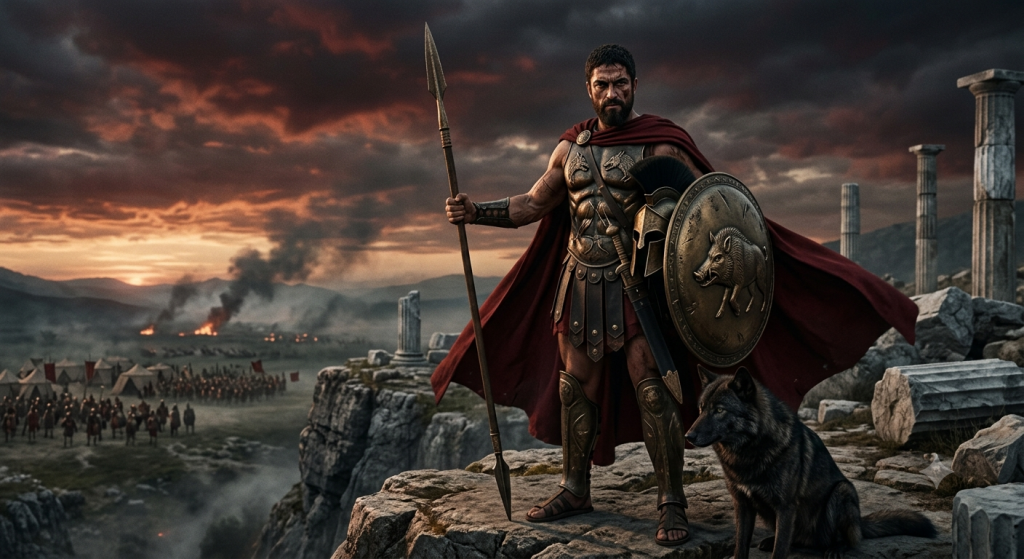
Ares is the god of war in Greek mythology, and he is one of the least respected figures on Olympus despite governing one of the most consequential aspects of human life. Zeus tells him directly in the Iliad that he is the most hateful of all the gods on Olympus. Athena defeats him in combat twice in the same poem. Hephaestus catches him in a net and displays him to the assembled gods. The Greeks, a warrior culture that built statues and temples to their gods across the Mediterranean world, built almost no temples to Ares and gave him almost no cult following in mainland Greece.
This is not because the Greeks did not value military success. They valued it enormously. It is because they distinguished between what Ares represented and what they actually wanted from war. Ares is the violence and the chaos and the bloodlust of battle, the part of war that is raw and brutal and without strategy. Athena is the part of war that wins: planning, tactics, the intelligent application of force toward a defined objective. The Greeks worshipped Athena. They acknowledged Ares.
His Position Among the Olympians
Ares is the son of Zeus and Hera, which gives him full Olympian parentage unlike several of the other gods who have mortal mothers. This does not improve his standing. In the Iliad, when he comes to Zeus wounded by Diomedes’s spear, Zeus tells him he would not help him if he were not his son, and that of all the gods his quarrelsome and contentious nature is the most hateful. His own father says this to him. Hera in various passages is equally dismissive of him.
He is associated with Thrace, the northern region beyond the borders of the civilised Greek world, and the Thracians were considered by Greeks to be among the most warlike and least culturally refined of peoples. His foreignness is part of his character: he represents the war that civilised people experience as an external threat rather than the war they conduct with discipline and strategy.
The Affair With Aphrodite
Ares’s most extended narrative in the tradition is his affair with Aphrodite, covered in detail in the Aphrodite article on this site. What is worth adding here is what the affair reveals about Ares’s position: he is caught in a net by Hephaestus, displayed to the assembled gods, and laughed at. The gods of the sea and sky and craft come to look at the god of war trussed up in an invisible net and find it funny. He is eventually released and departs to Thrace.
This is not the treatment a genuinely feared figure receives. The gods do not laugh at Zeus or Poseidon. They laugh at Ares because he is powerful in the way that brute force is powerful, which is not the kind of power that commands respect on Olympus.
Ares in the Iliad
The Iliad is the primary source for Ares as a character in the mythology, and he appears there as a partisan supporter of Troy whose actual effectiveness in the fighting is limited by the gods opposing him. Athena assists Diomedes in wounding him, guiding the spear to the one place it can penetrate his divine flesh. He retreats to Olympus, complains to Zeus, and is dismissed with the words quoted above. He returns to the fighting but is again removed from the field by divine interference before he can achieve any decisive result.
The contrast with Athena throughout the Iliad is pointed. She is present, effective, and instrumental in several of the poem’s key moments. He is present, wounded, and sent home complaining. Both are war gods. One of them wins.
Children of Ares
Ares’s children include several figures of significance in Greek mythology, and they tend to inherit his characteristics: Phobos and Deimos, Fear and Terror, who accompany him in battle; Harmonia, his daughter by Aphrodite, whose name means harmony and whose existence as the daughter of war and love is one of Greek mythology’s more elegant paradoxes; and several mortal sons who appear in the heroic tradition as founders of peoples or cities known for their martial character. The Amazons traced their descent to him, which is consistent with his Thracian associations and his connection to the wild northern world beyond Greek civilisation.
Further Reading
If this article sparked your interest, these are the books worth reading next.
The Iliad — Homer (Penguin Classics)
by Homer — the primary source for everything in this article, and still the most vivid account of the Trojan War ever written.
The Odyssey — Homer (Emily Wilson translation)
by Homer, translated by Emily Wilson — the best modern English translation, and the book that contains Odysseus’s own account of the horse.
The Trojan War: A Very Short Introduction
by Eric Cline — the clearest and most up to date account of what archaeology actually tells us about Troy and whether any of it happened.
For more on the Greek tradition, the Aphrodite article covers the goddess whose affair with Ares produced the most comic episode in the Odyssey. The Athena article covers the war goddess who defeats Ares twice in the Iliad and represents everything the Greeks actually wanted from battle. The Greek Mythology hub page has every article in the cluster.
Never miss a myth
Thank you for being here. The site is brand new and every subscriber genuinely means something to me. If you're here, you care about this stuff as much as I do - and that's all the reason I need to keep going. New stories, videos and dark folklore from around the world, straight to your inbox. No algorithm. Just the stories, when they're ready.