
Most of the dangerous things in Scottish folklore have the decency to be consistently dangerous. The Kelpie wants to drown you. The Each-Uisge wants to eat you. The Maighdean Mhara wants to pull you under. Their intentions, while fatal, are at least predictable, and there is a certain grim comfort in knowing exactly what you are dealing with.
The Glaistig offers no such comfort.
She is one of the most ambiguous figures in the entire tradition of Scottish supernatural beings, a creature capable of genuine devotion to the families she attaches herself to and of draining the life from a man who encounters her under the wrong circumstances, sometimes within the same story. She protects children and she kills adults. She tends cattle with a faithfulness that shames the humans she serves alongside and she dances men to their deaths on lonely hillsides. She is worshipped in some regional traditions and feared in others, and in many she is both at the same time.
The Glaistig is what happens when the supernatural world refuses to be categorised, when the thing you are trying to place in the column marked dangerous or the column marked benign simply will not stay in either.
The Shape of Her
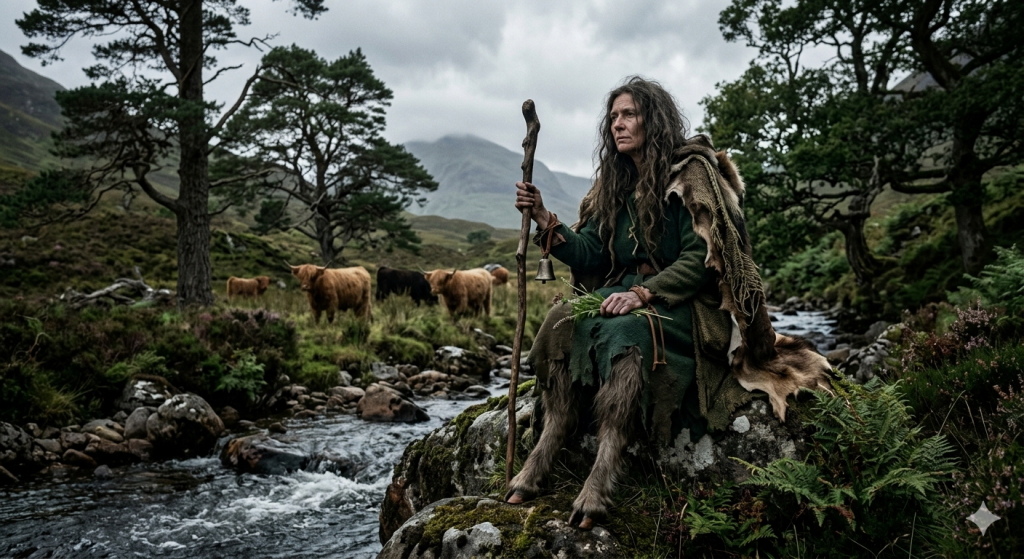
The Glaistig appears in Scottish Gaelic tradition as a woman of unearthly beauty from the waist up and a goat from the waist down, though she conceals the goat half beneath a long green or grey dress that trails along the ground and hides what lies beneath the hem. The colour of her dress is significant, green being the colour most consistently associated with the fairy world in Scottish and Irish Gaelic tradition, a signal to those who know how to read it that whatever beauty the upper half presents, the lower half is something else entirely.
Her skin is grey, which is where her most common epithet comes from. Glaistig derives from the Gaelic word for grey or pale, and the grey skin marks her as something outside the ordinary spectrum of living things, belonging to a category that is neither fully alive in the human sense nor fully dead. She is often described as thin, with a quality of translucency to her that suggests she is only partially present in the physical world, that the greater part of her exists somewhere else and what you can see is merely the portion that has chosen to make itself visible.
Her hair in most accounts is long and yellow, a detail that contrasts with the grey skin in a way that gives her appearance a slightly uncanny quality, too much colour in one place and not enough in another. She is beautiful the way things that are not quite right are sometimes beautiful, a beauty that the eye is drawn to and the instinct recoils from simultaneously.
The goat legs, when they are glimpsed beneath the dress, are the feature that crystallises what the Glaistig is. In the mythology of multiple traditions the goat is associated with wildness, with the untamed margins of the settled world, with the supernatural and the transgressive. A beautiful woman with goat legs belongs to both the human world and the world beyond it, and her behaviour in the tradition reflects this dual citizenship with uncomfortable consistency.
The Green Woman at the Hearth
One of the most striking aspects of the Glaistig tradition is the strongly domestic role she plays in some regional accounts. In parts of the Scottish Highlands, particularly in Argyll and the western mainland, the Glaistig was understood as a being who attached herself to a specific household or a specific stretch of land and took on a protective and productive role within the domestic economy of that place.
She herded cattle. She watched over children while their parents worked. She kept the farmstead in order in ways that went beyond what any human servant could manage, with a tirelessness and a care that suggested genuine attachment to the place and the people rather than the performance of duty. Households that had a Glaistig were understood to be fortunate, and the offerings left for her, typically a bowl of milk set out at dusk, were maintained as carefully as any other domestic ritual because the consequences of neglecting them were understood to be real.
This is not a minor or peripheral aspect of the tradition. In some communities the Glaistig occupied a role closer to that of a household deity than a supernatural pest, a being whose goodwill was actively cultivated and whose departure was mourned. There are accounts of Glaistigs who remained with specific families across multiple generations, moving with them if they relocated, maintaining the connection across decades in a way that suggests something closer to loyalty than mere habit.
The cattle herding role in particular is emphasised in enough regional traditions to be considered a core characteristic. The Glaistig as cowherder, keeping the herd together, finding the strays, driving off predators, doing the work that human herders did but doing it through the night and in conditions no human herdsman would have managed, appears in accounts from multiple parts of the Highlands with enough consistency to suggest a genuine and widely distributed tradition rather than a local variant.
The Dancer in the Dark
Set against this domestic protector is the Glaistig who appears to solitary men in wild places after dark, and the two figures are so different in their behaviour that it can be difficult to believe they belong to the same tradition.
The Glaistig encountered on a lonely hillside or beside a remote loch at night is a creature whose intentions are not domestic and not protective. She approaches the man alone, and she dances with him, and the dancing does not stop when he wants it to. It continues beyond his endurance, beyond his strength, beyond the point at which he understands that something is terribly wrong, because by the time understanding arrives his legs will not carry him away from her. She dances him until he is exhausted beyond recovery, and then she takes what she came for.
What she takes is described in the tradition variously as blood, as life force, as the essential energy that animates a living body and without which it becomes simply a body. The method of taking it varies between accounts, sometimes a bite at the wrist or the neck during the dance, sometimes a more gradual draining accomplished through the physical contact of the dancing itself. In either case, the man who dances with a Glaistig after dark does not generally survive to describe the experience.
The dancing predator is a figure that appears in traditions beyond Scotland, in the Baobhan Sith, which you will find elsewhere on this site, and in related supernatural women of Irish and Scandinavian tradition. What is specific to the Glaistig is the way this predatory behaviour coexists with the domestic protector tradition within the same figure, sometimes within the same regional community. The Glaistig who set out the milk offering for and who kept the cattle through the night was also, in some of these traditions, the Glaistig who would drain a man dry if she encountered him in the wrong place at the wrong time.
This is not a contradiction the tradition seems particularly troubled by. The Glaistig is not consistent in human moral terms. She operates according to her own logic, and her own logic includes both fierce loyalty to the households she has chosen and the casual predation of solitary men who have the misfortune to cross her path at night. These are not different Glaistigs. They are the same creature expressing different aspects of a nature that does not map neatly onto any human category of good or evil.
The Ghost Glaistig
A further layer of complexity in the tradition comes from the accounts that connect the Glaistig to the spirits of specific dead women, particularly women of the gentry or landowner class who had a strong attachment to their estates in life and who continued to exercise a form of oversight after death.
In these accounts the Glaistig is not a fairy creature or a supernatural being in the usual sense but a human woman whose death did not fully sever her connection to the place and the people she was responsible for. She continues to herd the cattle and watch over the household because she cannot stop, because the habits and obligations of her living self were strong enough to persist beyond the threshold of death in a form that is recognisably hers but altered in the ways that death alters things.
This tradition sits in interesting relationship with the more straightforwardly supernatural Glaistig accounts. It suggests that the Glaistig figure could absorb the spirits of specific real women in ways that grounded the mythology in individual human histories rather than purely in the abstract supernatural. The Glaistig haunting a particular glen might be, in local tradition, a specific woman from a specific family, her name perhaps still known, her history still part of the community’s memory.
The green dress in these accounts sometimes becomes the dress the woman was buried in, or a dress associated with her in life. The grey skin is the skin of death. The goat legs are the supernatural transformation that death has worked on a human form, the price of continuing to exist in a world you were supposed to have left.
The Offering and the Obligation
The ritual of leaving milk for the Glaistig, mentioned earlier, deserves more attention because it reflects a specific and consistent tradition of exchange between the human household and the supernatural being that protected it.
The milk was left at dusk, after the evening milking, in a specific location that varied by household and by tradition but was always the same location for a given household once established. A hollow stone near the byre was common, or a particular spot at the edge of the domestic enclosure. The offering was not optional in the communities that maintained this practice. It was an obligation, part of the running of the household as real as any other domestic task, and its neglect carried consequences.
A Glaistig who was properly propitiated with her milk offering would continue her protective work with the consistency and reliability the household depended on. A Glaistig whose offering was forgotten, or who was insulted, or whose household moved away without appropriate acknowledgement, was a different matter. The tradition is not entirely clear on what a neglected or offended Glaistig did in response, partly because households that maintained the tradition properly did not need to find out, but the implication in enough accounts is that her departure left a specific and tangible absence, a vulnerability in the household’s defences against the other things that moved through the night.
The milk offering connects the Glaistig tradition to a much wider practice of leaving offerings for household spirits that appears across Scottish, Irish, and Scandinavian tradition, a practical acknowledgement that some beings required active maintenance of their goodwill rather than simply the absence of provocation.
If you want more like this, the Tales of Myth and Magic newsletter delivers new creatures, legends, and forgotten folklore straight to your inbox.
No fixed schedule. No noise. Just the stories, when they are ready.
Sign up here →Why She Cannot Be Placed
The Glaistig resists every simple category the student of folklore might want to put her in, and this resistance is itself one of the most interesting things about her.
She is not a fairy in the straightforward sense, though she has fairy characteristics. She is not a ghost, though the dead woman tradition gives her ghost characteristics. She is not a simple predator, though she kills. She is not a simple protector, though she herds and guards and watches. She does not fit the nursery bogie function because she is not primarily used to frighten children into compliance. She does not fit the omen function because her appearances are not consistently predictive of specific events.
She is a being who belongs to the threshold spaces of the world, the edge between the domestic and the wild, between the living and the dead, between the protective and the predatory. She is most herself in the grey spaces between categories, which is perhaps why she is grey, and why her dress trails along the ground concealing the half of her that would make everything clear.
The families who left milk for her understood this. They did not need to categorise her. They needed to maintain the relationship, to keep the obligation current, to acknowledge that the thing looking after the cattle through the night was real and present and deserved the small recognition of a bowl of milk at dusk.
They did not ask whether she was good or evil. They asked whether the cattle were safe in the morning.
They were. As long as the milk was there.
The Grey Woman’s Continuing Presence
The Glaistig tradition has never entirely faded from the Highland communities where it was strongest. Unlike some aspects of Scottish supernatural folklore that survive primarily in academic collections, the Glaistig retained enough of a living presence in certain communities well into the twentieth century to be documented by fieldworkers who were recording living tradition rather than historical memory.
This persistence speaks to the function she served. The household that believed in the Glaistig was a household that had a framework for understanding certain kinds of good fortune and certain kinds of loss, a way of accounting for the cattle that stayed together and the cattle that strayed, for the children who were unharmed and the men who did not come back from the hill. The Glaistig explained these things in a way that was satisfying and that located the explanation in the specific relationship between the household and the supernatural world rather than in abstract forces beyond anyone’s influence.
She is still in the tradition, in the grey country between the domestic and the wild, between the living and whatever comes after. The long green dress still trails across the hillside. The cattle still come home in the morning.
The milk is still the price of that.
Further Reading
If this article sparked your interest, these are the books worth reading next.
Scottish Urban Legends: 50 Myths and True Stories
by Aaron Mullins — fifty Scottish urban legends including stories from Glasgow, Edinburgh, and the Highlands. The kind of tradition that Maggie Murphy belongs to, collected properly in one volume.
Scottish Urban Myths and Ancient Legends
by Grace Banks and Sheena Blackhall — vampires, werewolves, devil encounters, and the school playground legends of Scotland. A genuinely good collection of the stories Scots have been telling each other for generations.
The Lore of Scotland: A Guide to Scottish Legends
by Jennifer Westwood and Sophia Kingshill — the most comprehensive collection of Scottish legend in print, covering Glasgow to Shetland, exploring origins and historical basis. Endorsed by Terry Pratchett as the real macabre.
Never miss a myth
Thank you for being here. The site is brand new and every subscriber genuinely means something to me. If you're here, you care about this stuff as much as I do - and that's all the reason I need to keep going. New stories, videos and dark folklore from around the world, straight to your inbox. No algorithm. Just the stories, when they're ready.

Pingback: Uruisg: The Highland Brownie of the Waterfalls and Lonely Places - Tales of Myth and Magic
Pingback: The Green Lady of Crathes Castle: The Ghost the Skeleton Proved Real -