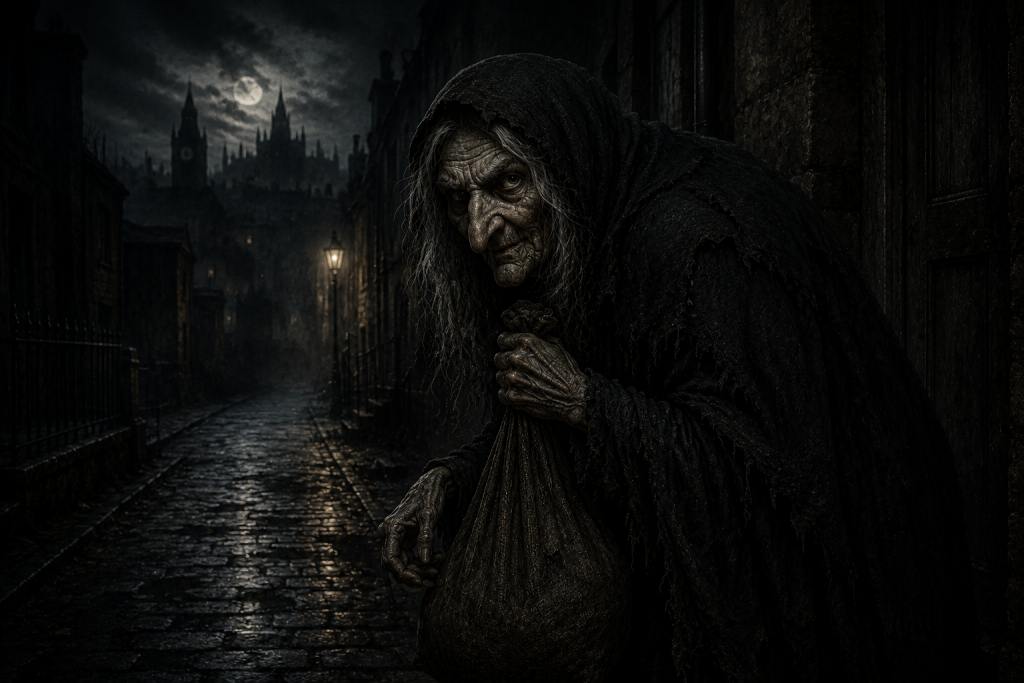

There is a particular category of Scottish ghost story that occupies an uncomfortable space between folklore and forensics, where the comforting distance of legend collapses into something considerably harder to dismiss. The Green Lady of Crathes Castle belongs firmly in that category. For generations she was simply a story, a pale figure in green seen drifting through a first-floor chamber, often carrying what witnesses described as an infant in her arms. And then, in the nineteenth century, workmen renovating that exact room lifted the hearthstone of the fireplace she was always seen approaching, and found bones.
A woman’s skeleton. An infant’s skeleton, beside her.
The Green Lady of Crathes is unusual among Scotland’s many castle ghosts precisely because of what that discovery did to the story. It crossed the legend from the safely deniable territory of folklore into something with physical weight behind it, the suggestion that behind the green dress and the sorrowful figure by the fireplace, there had been a real woman, a real infant, and a real silence about both of them that had lasted for centuries before the renovators’ tools exposed it.
A Castle Built Across Four Decades
Crathes Castle stands in Royal Deeside, Aberdeenshire, around fifteen miles west of Aberdeen, a masterpiece of Scottish baronial architecture with pink granite walls rising to crow-stepped gables and distinctive pepper-pot turrets. The Burnett family had held the surrounding land since 1323, when it was granted to them by Robert the Bruce himself, but construction of the tower house that stands today did not begin until 1553, and was not completed until 1596, delayed across more than four decades in part by the political instability surrounding the reign of Mary, Queen of Scots.
Inside, the castle holds some of the finest surviving painted ceilings in Scotland, their biblical scenes and vivid colours remarkably well preserved across more than four centuries. It is, by any measure, a building worth visiting for its architecture and its history alone. But the room most visitors ask about first is not the gallery with the painted ceilings. It is a more modest first-floor chamber that has carried a single name for as long as anyone can remember: the Green Lady’s Room.
The Sightings
Accounts of the Green Lady at Crathes stretch back further than anyone has been able to reliably date, transmitted through generations of the Burnett family and the staff who served them across nearly four centuries of continuous occupation. What is striking about the tradition, even before the skeleton was found, is how consistent the core description remained across that span of time and across however many individual witnesses contributed to it.
She is described as a young woman dressed in green, seen most often near the fireplace in the room that now bears her name, frequently described as carrying or cradling an infant in her arms. Witnesses across the centuries have consistently described her manner as sorrowful rather than threatening. She does not slam doors. She does not rattle chains or make the dramatic gestures of a vengeful spirit. She simply appears, by the fireplace, and is then gone, often seeming to pass directly into the wall at the point where the hearthstone stands.
Servants of past centuries reportedly refused to enter the room after dark, and the household understanding of her presence carried a specific and serious weight: she was considered an ill omen, her appearance taken as a warning that someone connected to the household was about to die. The Burnett family, who occupied Crathes continuously for the better part of four hundred years, were long aware of the tradition and appear to have accepted it as an established and unremarkable feature of life in the castle, an uncomfortable but familiar presence rather than a source of ongoing alarm.
Among the more notable witnesses credited with having seen her is Queen Victoria, whose own reported sighting during a visit to Crathes has become one of the most frequently cited details in the broader tradition, lending the story a degree of high-profile credibility that few Scottish castle ghosts can claim.
The Discovery Beneath the Hearth
The detail that distinguishes the Green Lady from the great majority of Britain’s castle ghost traditions is what happened during renovation work at Crathes in the nineteenth century, when a worker altering the fireplace in the Green Lady’s Room moved the hearthstone and found, concealed beneath it, a skeleton.
The accounts of precisely what was found vary in their specific detail, a variation that is itself worth noting honestly rather than smoothing over. Some versions describe the remains of an adult woman together with those of a newborn infant. Others describe the discovery in slightly different terms, the bones of a child presumed murdered found beneath the hearthstone, with the adult remains described separately or not specified at all. What the great majority of accounts agree on, across more than a century of retelling, is that human remains, including those of an infant, were found concealed in exactly the location where witnesses across generations had consistently described the Green Lady standing and then vanishing.
This is the detail that gives the Crathes haunting its particular and unusual weight. The location of the discovery was not chosen by the workers conducting the renovation. It was, by every account, simply where the existing hearthstone happened to be, in the room that had already carried its ghostly name and its specific, consistent description for generations before anyone lifted that stone to look beneath it.
Who She Might Have Been
The identity of the woman whose remains were found, and the precise circumstances of her death, have never been definitively established, and the absence of any documentary record from the period when her death presumably occurred means that what exists instead is a body of oral tradition offering several different, sometimes contradictory explanations.
The most commonly repeated version holds that she was a servant at Crathes who became pregnant outside marriage, a circumstance that in the social world of the castle’s earlier centuries carried genuinely severe and sometimes fatal consequences for an unmarried woman with no powerful family to protect her. Some versions of this account specifically attribute the child’s paternity to a member of the Burnett family itself, the laird or one of his relations, which would explain both the urgency of concealing the pregnancy and the lethal consequences that may have followed its discovery. Other versions offer a different father entirely, identifying him instead as a gillie, an estate worker employed on the Crathes lands, which removes the more scandalous Burnett family involvement but does nothing to soften the implied tragedy of what happened to the mother and child afterward.
None of these accounts can be verified against any surviving contemporary record. What can be said with more confidence is that the underlying shape of the story, a woman dying in circumstances connected to an illegitimate pregnancy, her remains concealed rather than given any proper burial or acknowledgement, fits a pattern that appears with grim regularity across Scottish castle ghost traditions of this general period, reflecting genuine and widespread realities about the precarious position of unmarried women, particularly servants, within the rigid social and religious structures of the time.
If you want more like this, the Tales of Myth and Magic newsletter delivers new creatures, legends, and forgotten folklore straight to your inbox.
No fixed schedule. No noise. Just the stories, when they are ready.
Sign up here →A Second Ghost: The White Lady
Crathes Castle is, in fact, home to more than one reported haunting, and the second tradition, considerably less famous than the Green Lady but connected to the same family history, deserves at least brief mention for context.
According to the broader Burnett family tradition, the original family seat was not Crathes itself but a house near a nearby loch, and the move to the newly built tower house at Crathes is said to have been motivated in part by a desire to distance the family from an earlier and genuinely tragic event. The story concerns Alexander Burnett, raised under the domineering authority of his mother, Lady Agnes, after his own father’s early death. Alexander fell in love with a distant cousin named Bertha, who had been placed in the household’s care, but during a period when Alexander was away from the estate, Bertha died, by some accounts through Lady Agnes’s direct intervention, motivated by jealousy or a determination to prevent a marriage she considered unsuitable.
The resulting White Lady tradition, sometimes identified as Lady Agnes herself and sometimes as the wronged Bertha, represents a second and distinct haunting at Crathes, separate from the Green Lady and her room, though the two traditions are sometimes conflated or confused by visitors encountering the castle’s ghost stories for the first time. The White Lady tradition lacks the specific physical corroboration that gives the Green Lady’s story its particular weight, existing instead in the more conventional territory of inherited family legend without a matching forensic discovery.
The Maighdean Uaine: A Connection Worth Drawing
If you have read the article on this site about the Glaistig, a detail in the wider folklore record around green-clad female spirits is worth drawing out explicitly, because it situates the Green Lady tradition within a considerably older Scottish supernatural framework than the specific Crathes legend alone might suggest.
One of the alternative names recorded for the Glaistig in Highland tradition is the Maighdean Uaine, the Green Maiden, a name that places her directly within the same broad category of green-dressed female spirit as the Green Lady traditions found at Crathes and at numerous other Scottish castles. The Glaistig, as covered elsewhere on this site, occupies a position of genuine ambiguity, capable of fierce domestic protectiveness toward a household she has attached herself to while also representing genuine danger under other circumstances, and her association with the colour green connects her to the much wider Highland tradition in which green was consistently understood as the colour of the fairy world and the supernatural more broadly.
This does not mean the Green Lady of Crathes should be understood as a literal Glaistig, particularly given the specific and grounded human tragedy that the skeleton beneath the hearthstone appears to confirm. But the deeper cultural association between green clothing and supernatural female presence in Scottish tradition, reaching back well beyond the specific architecture and family history of any individual castle, helps explain why so many of Scotland’s castle hauntings independently produced a Green Lady of their own. Fyvie Castle has one. Several other Aberdeenshire and Highland properties maintain similar traditions. The colour itself was already doing supernatural work in the Scottish imagination long before any individual castle’s specific tragedy gave that work a particular name and a particular room.
The Curse of the Weeping Stone
Crathes carries an additional layer of supernatural tradition beyond the Green Lady herself, connected to a stone kept within the castle’s charter room. Known as the weeping stone for its persistent dampness regardless of the surrounding temperature or season, the stone is said to be bound by a tradition connecting it, along with two other stones, to a prophecy attributed to Thomas the Rhymer], the medieval Border prophet whose predictions feature prominently elsewhere in Scottish folklore.
According to this tradition, the three stones must never be united under the same roof, with disaster predicted to follow should that condition ever be broken. Whether this specific prophecy genuinely traces back to the historical Thomas of Ercildoune or represents a later attachment of his already formidable prophetic reputation to a piece of local castle lore is impossible to verify, but the tradition adds another layer to Crathes’s accumulated reputation as a building where the boundary between documented history and supernatural inheritance runs unusually thin.
What the Room Holds Now
The Green Lady’s Room remains part of the visitor experience at Crathes Castle today, managed by the National Trust for Scotland since the property passed into the Trust’s care. The original hearthstone where the remains were discovered has since been replaced, though the room retains its name and its place at the centre of the castle’s identity, arguably the single most discussed feature of a building otherwise celebrated for genuinely remarkable architecture and some of the finest painted ceilings surviving anywhere in Scotland.
Visitor reports of unusual experiences in the room have continued well into the present day, including a widely reported 2016 incident in which a family photographing themselves during a visit found, upon reviewing their images afterward, what appeared to be an unexplained figure in the background of one photograph, an image that received considerable attention in the Scottish press at the time and reignited public interest in the older tradition.
The castle’s Halloween events, run by the National Trust for Scotland, have become genuinely popular fixtures of the Aberdeenshire calendar, drawing hundreds of visitors for evening tours through a building whose painted ceilings and crow-stepped architecture take on a rather different character once the light begins to fail and the conversation turns, as it inevitably does at Crathes, to the room where the hearthstone used to be.
A Story That History Confirmed
What makes the Green Lady of Crathes genuinely distinctive among the very large catalogue of Scottish castle ghosts is the specific sequence in which the evidence arrived. In most haunted castle traditions, a documented historical tragedy comes first, and the ghost story develops afterward as a kind of folkloric afterimage of events that were already known and recorded. At Crathes, the order was reversed. The ghost story existed first, consistent and specific across generations, describing a young woman in green carrying an infant, appearing and vanishing at one particular fireplace in one particular room. The physical confirmation came later, when workmen doing nothing more dramatic than routine renovation work happened to lift the hearthstone the ghost had always been seen approaching, and found exactly what the story, without any historical record to draw on, had apparently been describing all along.
Nobody now living can tell you the woman’s name. Nobody can confirm with certainty who fathered the child found beside her, or precisely what happened to bring mother and infant to rest beneath a hearthstone rather than in any churchyard. The documentary record that might once have answered these questions, if it ever existed at all, did not survive whatever circumstances led to her concealment in the first place.
What survived instead was the story. Told by servants who refused the room after dark, by a family who lived alongside the tradition for nearly four centuries without ever fully explaining it away, and eventually, when the hearthstone finally came up, by bones that had been waiting in the dark exactly where everyone had always said she stood.
The room is still there. The hearthstone has been replaced. And in the quieter hours of the afternoon, in that particular first-floor chamber at Crathes Castle, visitors still report the sense that someone in green is standing closer to the fireplace than the empty room would otherwise suggest.
If you enjoyed this article, the creatures and legends of Scotland are collected in my book Tales of Myth and Magic, Volume I: Scotland — 25 tales told in full, each traced to its earliest sources, with a map, glossary, and full bibliography. Available in paperback for £11.99.
Find Out More →Further Reading
If this article sparked your interest, these are the books worth reading next.
Scottish Urban Legends: 50 Myths and True Stories
by Aaron Mullins — fifty Scottish urban legends including stories from Glasgow, Edinburgh, and the Highlands. The kind of tradition that Maggie Murphy belongs to, collected properly in one volume.
Scottish Urban Myths and Ancient Legends
by Grace Banks and Sheena Blackhall — vampires, werewolves, devil encounters, and the school playground legends of Scotland. A genuinely good collection of the stories Scots have been telling each other for generations.
The Lore of Scotland: A Guide to Scottish Legends
by Jennifer Westwood and Sophia Kingshill — the most comprehensive collection of Scottish legend in print, covering Glasgow to Shetland, exploring origins and historical basis. Endorsed by Terry Pratchett as the real macabre.
Never miss a myth
Thank you for being here. The site is brand new and every subscriber genuinely means something to me. If you're here, you care about this stuff as much as I do - and that's all the reason I need to keep going. New stories, videos and dark folklore from around the world, straight to your inbox. No algorithm. Just the stories, when they're ready.