
Everyone has heard of Loch Ness. Far fewer people have heard of Loch Morar, which is, in its own way, a remarkable oversight, because Loch Morar is the deepest body of freshwater in the entire British Isles, its floor falling away to depths of over 300 metres, deeper than large stretches of the surrounding North Atlantic seabed. It sits roughly seventy miles southwest of its more famous neighbour, in the remote Lochaber district of the Western Highlands, separated from the open sea by little more than a narrow strip of land. It is colder, darker, and considerably less visited than Loch Ness, accessible for much of its length only on foot, by bicycle, or by boat.
It also has its own monster. Her name is Morag, and the tradition that surrounds her is, in some respects, genuinely stranger and considerably older than anything attached to her more famous cousin.
Nessie’s Quieter Cousin
It is impossible to write about any Scottish loch creature without the Loch Ness Monster looming somewhere in the background, and Morag is no exception. The two traditions share an obvious family resemblance. Both are large, dark, serpentine or hump-backed creatures said to inhabit a deep Highland loch. Both have generated photographs, sonar surveys, and serious if inconclusive scientific attention. Both sit on the same geological fault line, the Great Glen, that runs in a near-straight diagonal across Scotland from coast to coast, a line of genuine tectonic significance along which both Loch Ness and Loch Morar happen to lie.
The differences between the two traditions are, in some ways, more instructive than the similarities. Loch Ness has been a major thoroughfare for centuries, with a busy road running its full length since 1833, a castle on its shore, and a tourist economy that has actively cultivated and commercialised its monster since at least the 1930s. Loch Morar has none of this. It is reached by single track road at best, walked or cycled in many stretches, and has never supported anything like the volume of casual observation that has made Nessie one of the most reported cryptids on earth. That Morag has still accumulated more than thirty recorded sightings since 1887, from a population a fraction of the size and with a fraction of the opportunity to look, is one of the more genuinely interesting statistical features of her case, repeatedly noted by researchers as disproportionate to the loch’s remoteness.
Local affection for both creatures has occasionally produced the half-serious suggestion that Morag and Nessie might be connected through some undiscovered passage along the shared fault line, popping up in each other’s lochs the way old neighbours might call on one another. There is no genuine geological basis for this, but it captures something true about how the two traditions are held in the popular imagination: as siblings rather than strangers, with Nessie cast in the role of the famous one and Morag as the quieter relation who has never sought the same attention.
What the comparison tends to obscure, and what the rest of this article is concerned with, is that Morag’s own tradition runs in a direction Nessie’s largely does not. Long before anyone was describing a hump or a serpentine neck on Loch Morar, the loch had a creature whose presence meant something very specific to the people who lived beside it.
A Name as Old as the Loch
The name Morag, or Mòrag in Scottish Gaelic, derives from the word mòr, meaning great or eminent, combined with the diminutive suffix commonly used to form female given names in Highland tradition. The name itself shares its root with the name of the loch she inhabits, Loch Morar, which raises a genuinely interesting linguistic question that folklorists have never fully resolved: did the creature take her name from the loch, or did the loch, in some sense, take its name from her? The two are bound together at the level of language in a way that suggests the relationship between them is older than any specific recorded story.
This linguistic entanglement matters because it points toward something the broader popular understanding of Morag, as simply a second and lesser Loch Ness Monster, tends to obscure. Morag was not originally, and was not for most of her documented history, primarily understood as a cryptid in the modern sense, a large unidentified animal that science had simply failed to catalogue. She was understood as something considerably closer to a death omen, bound specifically to the fate of a particular family, in a tradition that predates anything resembling the Nessie phenomenon by a considerable margin.
The Carmichael Manuscripts
The most important source for understanding Morag’s older folkloric identity comes from the work of Alexander Carmichael, the same dedicated nineteenth century folklorist whose Carmina Gadelica preserved so much of the Caoineag tradition and whose collecting work across the Highlands and Islands remains one of the single most important sources for genuine, undiluted Gaelic oral tradition before it began to fade from living memory.
Carmichael visited the Morar district, by most accounts for only a couple of days, sometime around 1902, and recorded what he was told about the creature in the loch in a series of notes written in Gaelic. These notes were not published in his lifetime and were believed lost for the better part of a century, surviving only as part of an enormous and largely unsorted body of papers held in archive. It was not until researchers working on the Carmichael-Watson Project at the University of Edinburgh rediscovered and properly catalogued this material that Carmichael’s specific notes on Morag came back into wider circulation, a genuine piece of folklore detective work that added substantially to what was previously known about the tradition.
What Carmichael recorded, in his own words translated from the Gaelic, describes Morag in terms that have very little to do with a conventional lake monster. Morag is always seen before a death and before a drowning, he wrote, especially before the death of the proprietor. There is a creature in Loch Morar, and she is called Morag. She is never seen, save when one of the hereditary people of the place dies. The last time she was seen was when Aeneas Macdonnell died in 1898.
This is the Morag of the older tradition: not a creature encountered randomly by chance, but a being whose appearance was itself meaningful, tied specifically to the fortunes of the Macdonnell family of Morar, whose presence in the loch announced, with grim reliability, that a member of that specific hereditary line was about to die.
The Mermaid and the Black Heap
Carmichael’s notes, drawn from multiple separate informants across his brief time in the district, present two strikingly different physical descriptions of Morag, and the contrast between them is one of the most genuinely interesting features of the entire tradition.
In one account, Morag is described in terms that align her closely with the broader Scottish mermaid tradition of the Maighdean Mhara. Like the other water deities, Carmichael recorded, she is half-human, half-fish. The lower portions of her body are in the form of a grilse, a young salmon, and the upper in the form of a small woman of highly developed figure with long flowing yellow hair falling down her snow-white back. She is represented as being fair, beautiful, and very timid, and never seen save when one of the Morar family dies or when the clan falls in battle. Then she is seen rushing about with great speed and is heard wailing in great distress, bemoaning and weeping the loss of the House of Morar laid desolate.
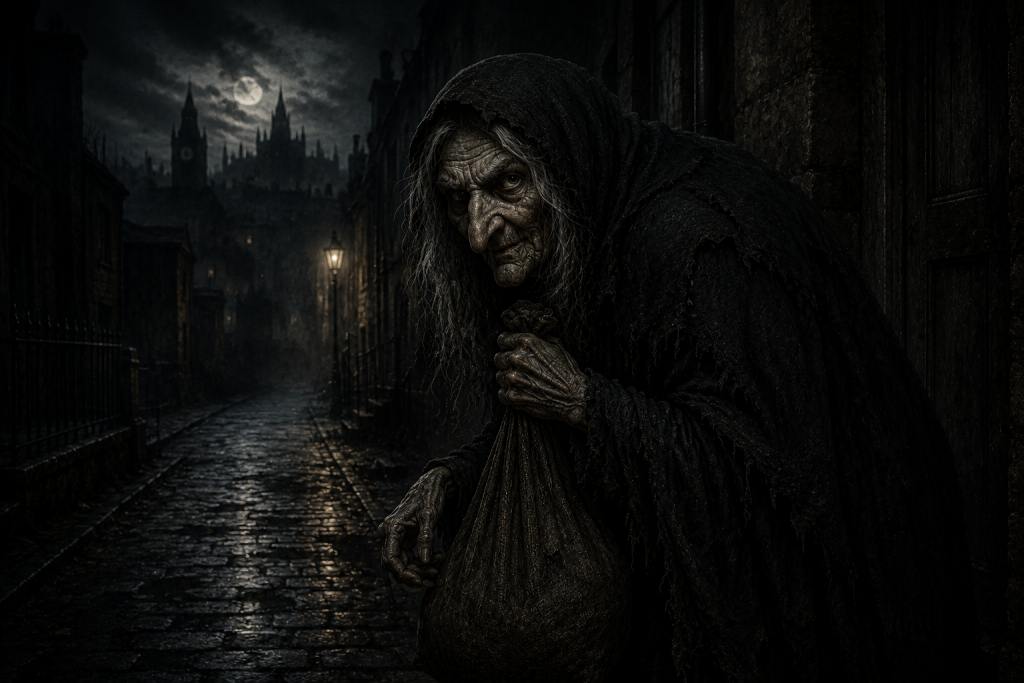
This is not a monster in any conventional sense. This is a grieving spirit, beautiful and timid, whose appearance is an expression of sorrow rather than a threat, considerably closer in character and function to the Caoineag or the Bean Nighe than to anything resembling a cryptozoological lake creature. Carmichael’s account even notes that the Morag, in this telling, had often brought the people living along the shores of the loch out of their houses at night, causing much anxiety to the men and much sore weeping to the women, a phrase that captures the genuine emotional weight this tradition carried for the communities who lived alongside the water.
The second description Carmichael recorded is starkly different. Rather than a beautiful weeping mermaid, this account describes simply a black heap or ball, slowly and deliberately rising in the water and moving along like a boat that has taken on water, low and waterlogged in its movement. The Morag in this telling is much disliked, Carmichael noted, and called by many uncomplimentary terms by the people of the district.
These two traditions, the grieving mermaid and the slow dark hump rising from the water, sit together uneasily within the same body of folklore, recorded by the same collector within what was likely the same short visit. They may represent genuinely distinct strands of local tradition that had not been fully reconciled even by the people telling them. They may represent the same underlying belief described by different informants with different emphases and different personal experience. What they demonstrate clearly is that Morag, even in her oldest and most carefully documented form, was never a single fixed image but a living tradition with room for real internal variation.
Death Marks Upon the Land
One particularly evocative detail preserved in the broader folklore record, beyond Carmichael’s own notes, holds that physical traces of Morag’s presence could be found at specific, named locations around the loch. Marks attributed to her feeding were pointed out at a place called Camus-nam-Bràthan, and further traces were said to exist at Ruidh nan Deorcag and Coll-nam-muc, place names that anchor the tradition to genuinely specific and locatable points on the actual landscape of the loch shore rather than leaving it as vague or generalised legend.
This kind of specific landscape attachment, the naming of exact locations connected to a creature’s activity, is a recurring feature across the strongest and most genuinely rooted Scottish folklore traditions covered on this site, from the Bennane Cave of Sawney Bean to the specific pools of the Uruisg’s waterfalls. It distinguishes tradition that grew organically within a community’s relationship to its own landscape from material invented or imported wholesale, and Morag’s tradition, with its named feeding sites and its specific clan attachment, sits firmly in the former category.
If you want more like this, the Tales of Myth and Magic newsletter delivers new creatures, legends, and forgotten folklore straight to your inbox.
No fixed schedule. No noise. Just the stories, when they are ready.
Sign up here →The Shift Toward the Modern Monster
Sometime across the early decades of the twentieth century, the character of the Morag tradition began to shift, moving away from the death-omen mermaid of Carmichael’s oldest notes and toward something considerably closer to the conventional lake monster cryptid that most people who have heard of Morag today would recognise.
The Highland News, reporting on Highland folklore traditions in April 1917, described a monster still located in Loch Morar in terms that had moved decisively away from the beautiful, weeping figure of the earlier tradition: a creature whose feeding marks could be found at specific points around the shore, described in language considerably closer to that of a physical animal than a grieving spirit. By this point the belief among local residents, as recorded in contemporary sources, was that the appearance of the loch’s monster signalled that some MacDonald or some Gillies, the two families most closely associated with the district, was about to leave the barren hills of Morar for, in the contemporary phrase, a fairer and more salubrious clime.
The first formally recorded sighting in the modern cryptozoological sense came in 1887, and the documented record of sightings since then runs to more than thirty separate accounts, a number that is genuinely striking given the remoteness of the loch and the comparatively small population of people who have ever lived along its shores or had reason to be out on its water.
The Modern Sightings
The twentieth century produced a body of Morag sightings that, taken together, describe a creature considerably more conventional in cryptozoological terms than Carmichael’s mermaid: large, dark, serpentine or hump-backed, moving through the water with a deliberate and sometimes alarming presence.
In 1948, a party of nine people aboard a boat on the loch reported observing an object approximately twenty feet in length moving through the water at a distance, attracting the attention of the boatman, John Gillies, whose name connects this twentieth century sighting directly back to the same family line the older death-omen tradition had specifically named.
The most dramatic and most frequently cited modern encounter took place in 1969, when two local fishermen reported that their boat had struck something large and solid in the water. According to their account, the creature reacted with apparent aggression, and the men responded by striking it with an oar and attempting to fire at it with a rifle they had aboard, before the creature submerged and disappeared from view. This account, unlike many cryptid encounters, involves genuine physical contact reported by named local witnesses with no obvious motive for fabrication, which has made it one of the more seriously considered pieces of evidence in the broader Morag case.
Sightings have continued into the present century, with reported encounters in the 1990s, the 2000s, and as recently as 2013, when two holidaymakers reported observing a large black shape in the water on three separate occasions across two days.
What Might Be Down There
Loch Morar’s extraordinary depth, deeper than the surrounding sea, makes it a genuinely plausible environment for the kind of speculation that Loch Ness has attracted for far longer and on a far larger international stage. The loch’s connection to the sea, separated by only a narrow strip of land that has not always been as solid a barrier as it currently is, has led some researchers to speculate about the possibility of large eels, misidentified seals, or other genuinely large aquatic animals finding their way into the loch’s deep water and remaining largely undetected given how rarely the loch’s full depth is surveyed.
A formal Loch Morar Survey was undertaken in the latter half of the twentieth century, employing sonar equipment to sweep significant sections of the loch in a genuine, if modestly funded, scientific attempt to determine whether the eyewitness testimony pointed toward something physically present in the water. The survey’s conclusions were cautious rather than definitive: the eyewitness testimony was judged consistent enough to suggest the possible presence of a large, unidentified animal in the loch, though no conclusive proof was obtained, and subsequent investigations using submersibles and extended sonar monitoring have continued without producing the kind of unambiguous evidence that would settle the question either way.
The geological connection between Loch Morar and Loch Ness, both of which lie along the same Great Glen fault line that runs diagonally across Scotland, has even given rise to speculative theories about some hidden underground connection between the two bodies of water, the suggestion, offered with a fair degree of local humour, that Morag and Nessie might be one and the same creature, or close relations, moving between the two lochs along some undiscovered passage. This remains firmly in the territory of folk speculation rather than anything approaching geological plausibility, but it speaks to the genuine affection with which Highland communities have continued to hold both traditions.
Two Creatures in One Name
What makes Morag a genuinely distinctive addition to Scotland’s body of water folklore, beyond the simple fact of being a second and lesser-known loch monster, is this layered duality at the heart of her tradition. She is, depending on which thread of the folklore you follow, either a beautiful and sorrowful death-omen spirit bound to a specific Highland family, weeping for losses that have not yet been announced by any more conventional means, or a large, dark, physically present creature inhabiting the deepest body of fresh water in the British Isles, struck by oars and fired upon by startled fishermen and tracked, inconclusively, by sonar survey across multiple decades.
These two Morags do not sit entirely comfortably together, and the honest position is that the folklore record does not require them to. Alexander Carmichael recorded a tradition of grief and omen from a community that understood their loch as something inhabited by more than fish. Twentieth century witnesses, working from a different cultural framework shaped by an age of cryptozoology and a famous neighbouring loch’s worldwide fame, described something considerably more physical, more aggressive, more conventionally monstrous.
Perhaps these are simply two different ways, separated by a century and a changing relationship with the supernatural, of describing the same underlying unease that a body of water this deep, this dark, and this remote has always generated in the people who live alongside it. Perhaps they are genuinely separate traditions that have become entangled under a single shared name. The loch itself, falling away to depths that swallow whatever finds its way into them and rarely gives anything back, is not in the business of resolving the question.
The Deepest Water in Britain
Loch Morar holds its depths in a silence that Loch Ness, with its busy road, its castle ruins, and its constant stream of tourist boats, has long since lost. The southern shore remains accessible only on foot or by water. The communities along its banks are small, and the loch’s history, the Macdonnells, the Gillies, the deaths that Morag was once understood to announce in advance, remains closer to living memory there than almost anywhere else in the Highlands with a comparable folklore tradition.
Whether what moves in that deep, cold, fault-line water is a grieving spirit tied to an old Highland family, a large and genuinely undiscovered animal, or simply the accumulated weight of more than a century of stories told along a remote shore, Morag remains exactly what Carmichael’s informants described to him in those few days in 1902: a presence in Loch Morar that the people who live there have never been entirely comfortable dismissing.
She is, by every account, timid. She does not seek out those who come looking for her.
But if you find yourself on the water and something rises ahead of you, slow and dark and waterlogged in its movement, the old tradition would tell you to go home and check on your family.
Someone may already be gone.

If you enjoyed this article, the creatures and legends of Scotland are collected in my book Tales of Myth and Magic, Volume I: Scotland — 25 tales told in full, each traced to its earliest sources, with a map, glossary, and full bibliography. Available in paperback for £11.99.
Find Out More →Further Reading
If this article sparked your interest, these are the books worth reading next.
Scottish Urban Legends: 50 Myths and True Stories
by Aaron Mullins — fifty Scottish urban legends including stories from Glasgow, Edinburgh, and the Highlands. The kind of tradition that Maggie Murphy belongs to, collected properly in one volume.
Scottish Urban Myths and Ancient Legends
by Grace Banks and Sheena Blackhall — vampires, werewolves, devil encounters, and the school playground legends of Scotland. A genuinely good collection of the stories Scots have been telling each other for generations.
The Lore of Scotland: A Guide to Scottish Legends
by Jennifer Westwood and Sophia Kingshill — the most comprehensive collection of Scottish legend in print, covering Glasgow to Shetland, exploring origins and historical basis. Endorsed by Terry Pratchett as the real macabre.
Never miss a myth
Thank you for being here. The site is brand new and every subscriber genuinely means something to me. If you're here, you care about this stuff as much as I do - and that's all the reason I need to keep going. New stories, videos and dark folklore from around the world, straight to your inbox. No algorithm. Just the stories, when they're ready.