
Most of the supernatural beings in Scottish Highland tradition have a shape. They have a form you might see, even briefly, even partially, even in conditions of poor visibility or fading light. The Kelpie has its horse body and its seaweed-tangled mane. The Each-Uisge has its terrible adhesive hide. The Sluagh moves in visible flocks across the night sky. Even the Bodach, who comes in the dark, is understood as a figure, a presence with dimensions.
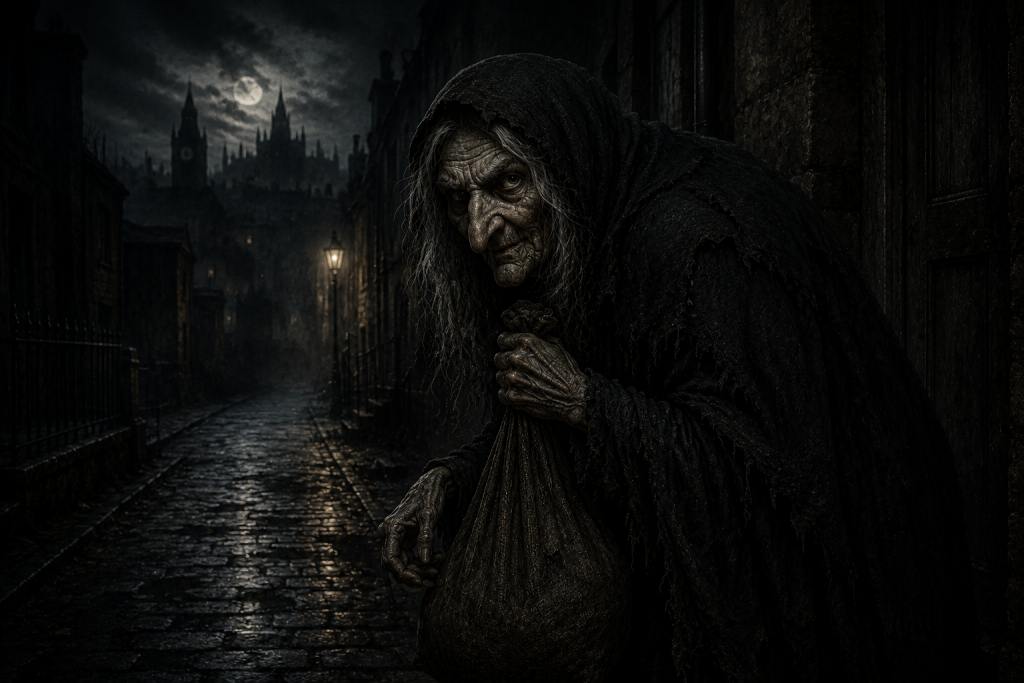
The Caoineag has none of this. She is invisible. Not difficult to see, not usually invisible, not invisible except under certain conditions. Simply invisible. No one has ever described what she looks like because no one has ever seen her. In a tradition that tends to furnish its supernatural beings with highly specific physical details, the complete absence of any physical description of the Caoineag is one of the most striking things about her.
What she has instead of a face is a sound. A keening, a wailing, a lamentation carried on the night air from the direction of the waterfall or the loch or the high bare shoulder of the mountain. A sound like grief taken to its furthest possible extension, like sorrow that has moved beyond the capacity of language and become pure voice. When you hear it in the dark, if you are someone who knows what it means, you do not try to find the source. You go home, and you wait for whatever news is coming, and you understand that the news will not be good.
What the Name Means
The Caoineag takes her name from the Scottish Gaelic word for weeper, pronounced approximately koo-nyak in the anglicised rendering, though the Gaelic pronunciation is closer to the sound of the word itself carrying a quality of breathed sorrow in the back of the throat. The root connects to Gaelic words for weeping and mourning more broadly, and the keening tradition of Highland and Irish Gaelic communities, the formal lamentation for the dead performed by women at wakes and funerals, shares the same linguistic root.
This is not coincidental. The Caoineag is doing what the keeners at a funeral do, lamenting the dead, mourning with a genuine and overwhelming grief. The difference is that she does it before the death rather than after, and she does it alone, at night, at the water, without an audience she is performing for. The grief is not social in the way that keening at a wake is social. It is absolute. It is just the Caoineag and the dark and the sound of the water and the knowledge of what is coming.
The Clan She Belongs To
One of the most distinctive features of the Caoineag tradition is that she is not a general death omen, a supernatural warning attached to no particular person or place. She is specific. Each Highland clan had its own Caoineag, a spirit bound to that family and that family’s fate, who wailed for their dead and only their dead, who was heard before disasters that befell that kindred and no other.
This clan-specific quality places the Caoineag in a tradition of familial supernatural attachment that appears across Gaelic Scotland and Ireland, most obviously in the Irish Banshee, who is similarly bound to specific families of Gaelic origin and wails for their dead and not for others. But the Caoineag and the Banshee are not the same figure, and the differences are worth understanding because they define what the Caoineag specifically is.
The Irish Banshee can sometimes be seen, a white-haired woman with a pale face, combing her hair at the waterside. She can be associated with specific named spirits with their own characters and histories. She is a presence with a form, however briefly glimpsed. The Caoineag remains invisible, defined entirely by sound, bound to the landscape in the specific form of moving water and high ground, and incapable of being engaged with in any way that might make the encounter interactive rather than simply terrifying.
If you asked who was weeping in the dark beyond the byre, the traditional answer was: Co ach Caoineachag, co ach Caoineachag bheag a bhroin. Who but Caoineag, who but little Caoineag of the sorrow.
Little Caoineag of the sorrow. The diminutive is not condescending. It carries something of the quality of the sound itself, something small and terrible in the dark, pouring out grief too large for whatever shape, if she had one, could contain it.
The Bean Nighe and the Difference Between Them
Since you have the Bean Nighe article on this site, the distinction between the two figures is worth drawing clearly, because readers familiar with one will arrive at the other looking for comparison.
The Bean Nighe, the washerwoman at the ford who scrubs the grave clothes of those about to die, is an active figure in the tradition. She can be approached. She can be caught. A bold and quick-footed person who manages to get between her and the water has her at a disadvantage, and if you can take her by surprise and get your hands on her before she sees you coming, you can extract from her the name of the person whose clothes she is washing, and you might be able to extract a wish besides. The Bean Nighe is dangerous, and the encounter with her is frightening, but it offers the possibility of information and even agency.
The Caoineag offers neither. She cannot be approached because she has no physical presence that approaching would connect with. She cannot be questioned because she is a sound rather than a being that speech could reach. She cannot be made to grant anything because there is no transaction available, no leverage point, nothing to take hold of. She is entirely one-directional. She weeps, and you hear it, and you know what it means, and that is the complete extent of what the encounter provides.
This makes her, in a specific way, the more terrifying of the two figures. With the Bean Nighe, there is something you can do. With the Caoineag, there is nothing. The death has, in some sense, already happened when you hear her. The grief she is expressing is not anticipatory. It is the grief of something that already knows, with complete certainty, what is coming, and is mourning it with a totality that human grief rarely achieves because human grief is always complicated by hope.
The Caoineag has no hope. That is what her invisibility expresses. She is grief that has moved past the stage where a face would be any use.
The Waterfall and the High Places
The Caoineag’s chosen locations are as specific as her invisibility is absolute. She haunts the waterfalls, the burns, the lochs, the high glens and the mountainsides where the wind is loud and the sound of moving water is constant. She does not appear in towns or near the comfortable domestic world of the hearth and the byre. She belongs to the places where the natural world is loudest and most indifferent, where the sound she makes could almost be mistaken for something else, where the darkness is real and the distance from any settlement is sufficient that what you hear cannot be easily verified.
This is not accidental. The Caoineag’s chosen habitat is the landscape where sound carries and distorts and where the already existing sounds of water and wind provide a context in which her keening might initially be mistaken for something natural. The moment of recognition, the moment when the sound resolves from natural noise into something that clearly has grief in it and clearly has intention, is itself part of the terror the tradition describes.
She also belongs at water because water in Scottish Gaelic supernatural tradition is one of the primary boundaries between the human world and whatever lies beyond it. The waterfall is a threshold, a place where two states of matter are in transition, where the solid becomes the liquid and the still becomes the moving, and the Caoineag haunts these thresholds with the consistency of a being that exists at the boundary between the living and the dead.
She is also, in some regional classifications, counted among the Fuath, the family of malevolent water spirits in Highland tradition, which places her alongside the Each-Uisge and the Shellycoat and other water-associated supernatural beings. The classification sits a little uneasily, because the Caoineag is not predatory in the way the Fuath tend to be. She does not attack. She does not deceive. She does not take anything from the living. She simply grieves, loudly and invisibly, at the water, for the dead who are not yet dead.
The Massacre of Glencoe
The most historically specific and most widely recorded tradition attached to the Caoineag is the one that connects her to the Massacre of Glencoe on the 13th of February 1692, one of the darkest events in the already dark history of the Highland clans.
The Massacre of Glencoe was not a battle. It was the killing of members of the MacDonald clan by government soldiers who had been billeted with them as guests for nearly two weeks, eating their food and sleeping in their houses, before receiving orders to kill every MacDonald under seventy years of age. The violation of Highland hospitality involved, the use of trust as the instrument of slaughter, gave the massacre a specific quality of treachery that marked it differently from the ordinary violence of the period.
In the tradition recorded by Alexander Carmichael, whose Carmina Gadelica remains the most important collection of Gaelic folklore from the period, the Caoineag of Clan MacDonald was heard wailing night after night in the glen before the soldiers came. Her keening echoed from the waterfalls and carried through the glen in the winter dark, and some of the MacDonalds heard it and understood what it meant.
Those whose fears were roused by her keening left the glen before the killing and escaped the fate of those who remained behind. The Caoineag had not prevented the massacre. She had not named the threat or identified the traitors or provided any actionable intelligence about what was coming. She had simply wept, night after night, with the particular intensity of grief that the tradition recognised as specific to her.
The people who listened left. The people who did not listen stayed. On the morning of the 13th of February, the soldiers rose before dawn.
Thirty-eight MacDonalds were killed in the valley that morning. Others escaped into the winter hills, where some died of exposure. The Caoineag had not lied. She had told them everything she could, in the only language she had, which was sorrow.
If you want more like this, the Tales of Myth and Magic newsletter delivers new creatures, legends, and forgotten folklore straight to your inbox.
No fixed schedule. No noise. Just the stories, when they are ready.
Sign up here →What She Knows and How She Knows It
The question of what the Caoineag is and how she knows what she knows has been treated differently in different parts of the tradition.
The most common understanding places her as a spirit of the clan itself, a being of supernatural origin who is bound to the family by ties that go beyond the individual members of any given generation, who mourns not for a specific person she knows but for the clan she belongs to in the way that the land belongs to the clan. She is, in this reading, something like the genius of the family expressed in supernatural form, the accumulated spirit of everything the clan has lost given a voice and a location if not a face.
A less common tradition suggests that she may have been human once, a woman of the clan whose grief at some ancient loss was so absolute and so consuming that it transformed her into something beyond the ordinary human categories of living and dead. This origin gives her a tragic dimension that the purely supernatural reading does not provide, suggesting that the Caoineag weeps for the current dead out of a sorrow that began with her own death, that she is trapped in grief as surely as Thomas the Rhymer was trapped in the fairy world, unable to stop mourning because mourning is now what she is.
Both traditions agree on the essential facts. She is invisible. She is bound to a specific clan. She appears at water. She cannot be engaged or bargained with. And when you hear her, the time for preventing what she is mourning has either already passed or is passing so quickly that the most useful response is to pay very close attention to what she is telling you and decide, quickly, whether you are going to stay or whether you are going to leave the glen tonight.
Hearing the Caoineag
The tradition of the Caoineag was alive in the communities of the Scottish Highlands and Hebrides well into the modern period, recorded by serious collectors including Carmichael and John Gregorson Campbell in the late nineteenth century as a functioning belief rather than a historical artefact.
What people reported hearing was not a generalised supernatural sound. It was a specific quality of keening that those familiar with the tradition recognised as distinct from the wailing of wind through a corrie or the sound of a bird in distress or any of the other sounds that a Highland night produces in abundance. The Caoineag’s keening had grief in it in a way that natural sounds do not have grief in them, a human quality to the sorrow that the wind does not produce, however loudly it howls.
In a landscape where waterfalls are numerous and constant and where the wind moves through glens and corries in ways that produce sounds of remarkable variety and occasional eeriness, the insistence of the tradition that the Caoineag’s sound was recognisably different from everything else the landscape produced is itself significant. These were communities that knew their soundscape intimately. They were not people who jumped at wind in the heather. When they said they had heard the Caoineag, they were saying that what they had heard was not wind in the heather.
The last MacDonald to hear her before Glencoe knew what they were hearing. The ones who acted on it survived.
The Sound in the Dark
There is a particular quality to the dark in the Highland glens at night that city dwellers and those who have not spent time in genuinely remote Highland landscape find difficult to fully imagine. The darkness is real in a way that the darkness of any inhabited or lit environment is not. It has texture and depth and the sounds that come through it have a different quality from sounds heard in ordinary ambient light, a dimensionality and a presence that daylight flattens.
The Caoineag belongs to this specific dark. She belongs to the night that has no light pollution in it and no distant traffic and no reassuring hum of other human activity. She belongs to the night that the clan communities of the Highland glens inhabited, where the nearest settlement was a long walk away and the waterfall was close and the sound it made covered a great deal of what might otherwise be heard approaching.
In that dark, a sound like grief at the waterfall was not a comfort. And if you knew the Caoineag’s tradition, if you had grown up in a community that understood what that specific quality of keening meant, you would not be wondering whether it was the wind.
You would be deciding how long it would take you to pack what you needed and whether the children could travel tonight and which route through the hills avoided whatever was coming down the glen.
The Caoineag wept for the MacDonalds for nights before the soldiers came. Her grief was accurate. Her warning was real. The people who heard her and understood what they were hearing had a choice she could not make for them.
She is still at the waterfalls of the Highlands. She is still bound to the clans she mourns for. Whether there is anyone left who knows how to listen for her the way the old communities listened is a question the dark of the Highland night does not answer.
But the waterfalls are still running. And some sounds, when they reach you across the dark, carry grief in them that the natural world alone cannot account for.
If you hear it, do not try to find the source.
Go home. Pack what you need. Decide quickly.
If you enjoyed this article, the creatures and legends of Scotland are collected in my book Tales of Myth and Magic, Volume I: Scotland — 25 tales told in full, each traced to its earliest sources, with a map, glossary, and full bibliography. Available in paperback for £11.99.
Find Out More →Further Reading
If this article sparked your interest, these are the books worth reading next.
Scottish Urban Legends: 50 Myths and True Stories
by Aaron Mullins — fifty Scottish urban legends including stories from Glasgow, Edinburgh, and the Highlands. The kind of tradition that Maggie Murphy belongs to, collected properly in one volume.
Scottish Urban Myths and Ancient Legends
by Grace Banks and Sheena Blackhall — vampires, werewolves, devil encounters, and the school playground legends of Scotland. A genuinely good collection of the stories Scots have been telling each other for generations.
The Lore of Scotland: A Guide to Scottish Legends
by Jennifer Westwood and Sophia Kingshill — the most comprehensive collection of Scottish legend in print, covering Glasgow to Shetland, exploring origins and historical basis. Endorsed by Terry Pratchett as the real macabre.
Never miss a myth
Thank you for being here. The site is brand new and every subscriber genuinely means something to me. If you're here, you care about this stuff as much as I do - and that's all the reason I need to keep going. New stories, videos and dark folklore from around the world, straight to your inbox. No algorithm. Just the stories, when they're ready.