
Most supernatural figures in the Scottish Highland tradition do not negotiate. The Kelpie takes you into the water. The Each-Uisge eats you. The Nuckelavee pursues you across the moor. The encounters these beings offer are not ones where you can improve your situation through careful behaviour or clever questions. You either escape or you do not.
The Bean Nighe is different. She can be bargained with. The tradition is specific about how, and the specifics are strange enough to suggest they are genuinely old rather than later elaborations.
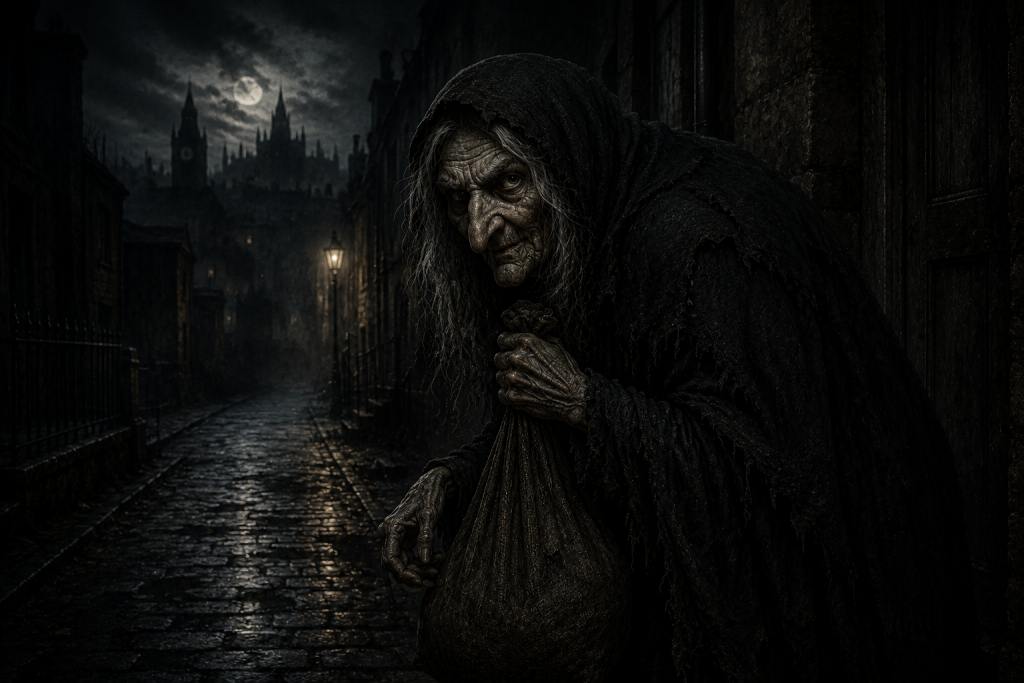
She is found beside lonely rivers and streams, crouching at the water’s edge, washing. What she washes is bloodstained clothing that belongs to someone who has not yet died. Her presence at a particular river crossing is a sign that someone whose garments she holds is soon to die, and in some accounts the witness can identify who by recognising the clothing. She does not do this to cause the death. She is preparing for it. The distinction is important because it changes what kind of being she is: not a cause but a herald, not malevolent but burdened, a figure whose knowledge of coming death comes with a sorrow she did not choose.
Her Name and What It Means
Bean Nighe is Scottish Gaelic for washing woman, pronounced roughly as ban nee-yeh. The name is straightforwardly descriptive: she is a woman who washes, and the washing is what she does and what she is. Unlike the Banshee, whose name connects her to the fairy mounds and to the Otherworld as a category, the Bean Nighe’s name connects her to an action. She is defined by what she does rather than by where she comes from, which is consistent with her character in the tradition: a figure whose identity is bound up with her task rather than with her nature.
The tradition is documented most thoroughly in John Gregorson Campbell’s work on Highland and island supernatural belief, collected in the late 19th century from oral sources, and in earlier accounts from Highland travellers and folklorists who recorded what they heard from community members. The consistency of the core descriptions across these sources suggests a tradition that had been stable for considerable time before it was written down.
The Origin: A Woman Who Died in Childbirth
The most consistent explanation given for the Bean Nighe’s condition is that she is the ghost of a woman who died in childbirth before her natural lifespan had ended. This is not simply background information about who she once was. In the logic of the tradition it is the explanation for everything: why she is bound to wash, why she cannot move on, and why her washing concerns the deaths of others rather than her own.
The Highland tradition understood death in childbirth as a specific kind of incomplete death. The woman had not lived out the span of years allotted to her. She died with work undone, a life unfinished in a very literal sense, and the supernatural consequence of this incompleteness is that she cannot rest until the time when she would naturally have died has passed. In the meantime she is bound to the work she was assigned by her condition: washing the clothes of those who are about to die, preparing for deaths she cannot prevent, in rivers and streams where the boundary between the living world and the Otherworld is thinnest.
This origin gives the Bean Nighe a tragic quality that most descriptions of her understate. She is not choosing to be at the ford. She is not a malevolent being who enjoys her work. She is a woman serving out a supernatural sentence for the circumstance of her own death, and the sadness that the tradition consistently attributes to her is consistent with that condition. She is grieving, as the Banshee grieves, but she is also trapped in a way the Banshee is not: the Banshee’s attachment to a family is presented as a bond, while the Bean Nighe’s attachment to the ford is presented as a compulsion.
What She Looks Like
The Bean Nighe’s physical description is among the more specific in the Highland supernatural tradition, with details that recur consistently enough across independent accounts to suggest they were fixed elements rather than individual elaborations.
She is typically small and hunched, dressed in green or grey, with long tangled hair that is sometimes described as the colour of moss or water. Her feet are bare. Her hands are stained with the blood of the garments she washes. Her skin is pale in the way that things that live near water in Highland landscapes tend to be pale: a cold, washed-out pallor that belongs to the riverbank rather than to any human complexion.
The most distinctive and most consistently reported physical feature is her breasts, which the tradition describes as long and hanging down to her waist or below. This detail appears regularly enough across independent accounts that it was clearly a fixed element of the tradition rather than embellishment. It is also specifically connected to the ritual interaction that the tradition permits: according to the instructions passed down in Highland communities, a person who encountered the Bean Nighe could suckle from her breast, which would establish a foster-mother relationship with her and compel her to grant a wish or answer questions. The long breasts make this possible even at a distance from the front, which is part of the specific geometry of the encounter ritual.
The breast detail is characteristic of the Highland tradition’s engagement with supernatural beings through specific physical protocols rather than through strength or trickery. The tradition has worked out, in its own terms, what the rules of engagement with this particular being are, and those rules involve a specific and intimate physical act that transforms the relationship between the witness and the Bean Nighe from encounter to kinship.
The Ritual: How to Bargain With Her
The instructions for how to interact with the Bean Nighe are more specific than most accounts convey, and the specificity is the thing worth examining carefully because it suggests a genuine and sustained tradition of thinking about how these encounters could be managed rather than simply survived.
The first instruction is positional. If you come upon the Bean Nighe at the ford, you must position yourself between her and the water before she sees you. This is the precondition for everything else: if she sees you first, the encounter proceeds on her terms and you have no standing. If you reach the correct position first, she is bound by the rules of the tradition to interact with you rather than simply continuing her work or fleeing.
From that position, you can either suckle from her breast, establishing the foster-mother relationship and gaining the right to make requests, or you can simply ask questions. The tradition is consistent that she must answer truthfully and that she can ask questions in return, to which you must also answer truthfully. The exchange is genuinely reciprocal: she is not simply a supernatural information source that you can access with the right physical protocol. She has standing to ask, and what she learns from your answers has consequences in the tradition that are not always specified.
What you can learn from her varies across accounts. In some versions she will tell you whose clothing she is washing and when that person will die. In some she will reveal other future events. In some she will grant a wish if the foster-mother protocol has been followed. The common thread is that the information or gift comes at the cost of the encounter itself, which requires courage and specific knowledge to navigate correctly.
The tradition of protective knowledge about how to handle supernatural beings is not unusual in Highland folklore, but the Bean Nighe’s protocol is more detailed and more specific than most, which suggests it was thought about seriously and passed down with care. Communities that lived near rivers and fords where she might be encountered needed to know what to do if they found her there, and the tradition provided those instructions in a form precise enough to be actionable.
Water, Thresholds, and the Ford
The Bean Nighe’s location at fords and river crossings is not incidental to her character. In the Highland tradition, as in the broader Celtic tradition, crossing water is a threshold act: you move from one state or territory to another, and the act of crossing makes you temporarily vulnerable in ways you are not when you are firmly on one side. The ford is the specific point where this vulnerability is greatest, where the river is shallow enough to cross but where the crossing is still a transition across moving water.
The Bean Nighe occupies this threshold space permanently. She is neither on one bank nor the other, neither fully in the living world nor fully in the Otherworld, neither completing her washing nor stopping. She is the figure of a threshold that cannot be crossed: the threshold between her death and the death she should have had, which she cannot traverse until the time is right. Her location at the ford is a spatial expression of her temporal condition.
This is why she is associated with rivers and streams rather than with lochs or the sea. The Kelpie belongs to lochs. The Each-Uisge belongs to sea lochs. The Morrigan in her washing woman aspect belongs to rivers before battles. The Bean Nighe belongs to the specific kind of water that people cross rather than simply stand beside, because it is crossing that she is about and crossing that defines her situation.
The Bean Nighe and the Banshee
The relationship between the Bean Nighe and the Irish Banshee is discussed in more detail in the Banshee article, but it is worth noting here that the two figures represent different emphases within a shared tradition of female foreknowledge of death rather than simply being regional variants of the same figure.
The Banshee’s defining characteristic is sound: her cry is the thing that announces death and the thing that those who encounter her remember. The Bean Nighe’s defining characteristic is action: her washing is the thing that signals death and the thing that gives her encounters their specific quality. The Banshee mourns. The Bean Nighe prepares. Both are doing something that precedes a death that cannot be prevented, but what they are doing and why they are doing it are different, and those differences reflect something genuine about the traditions on either side of the North Channel.
Both figures, and the washing Morrigan who stands behind both of them in the mythological tradition, belong to a Gaelic understanding of death as something that approaches gradually and that can be perceived by those who know how to read the signs. The Bean Nighe at the ford is one of those signs, and the tradition that preserved the instructions for how to interact with her was taking seriously the possibility that you might need them.

If you enjoyed this article, the creatures and legends of Scotland are collected in my book Tales of Myth and Magic, Volume I: Scotland — 25 tales told in full, each traced to its earliest sources, with a map, glossary, and full bibliography. Available in paperback for £11.99.
Find Out More →Further Reading
If this article sparked your interest, these are the books worth reading next.
Scottish Urban Legends: 50 Myths and True Stories
by Aaron Mullins — fifty Scottish urban legends including stories from Glasgow, Edinburgh, and the Highlands. The kind of tradition that Maggie Murphy belongs to, collected properly in one volume.
Scottish Urban Myths and Ancient Legends
by Grace Banks and Sheena Blackhall — vampires, werewolves, devil encounters, and the school playground legends of Scotland. A genuinely good collection of the stories Scots have been telling each other for generations.
The Lore of Scotland: A Guide to Scottish Legends
by Jennifer Westwood and Sophia Kingshill — the most comprehensive collection of Scottish legend in print, covering Glasgow to Shetland, exploring origins and historical basis. Endorsed by Terry Pratchett as the real macabre.
For more on the Scottish supernatural tradition, the Scotland category covers the broader range of Highland creatures and legends. The Glaistig article covers another female Highland supernatural figure whose relationship to humans is defined by ambivalence rather than straightforward threat. The Morrigan article covers the mythological ancestor that the Bean Nighe shares with the Banshee.
Never miss a myth
Thank you for being here. The site is brand new and every subscriber genuinely means something to me. If you're here, you care about this stuff as much as I do - and that's all the reason I need to keep going. New stories, videos and dark folklore from around the world, straight to your inbox. No algorithm. Just the stories, when they're ready.