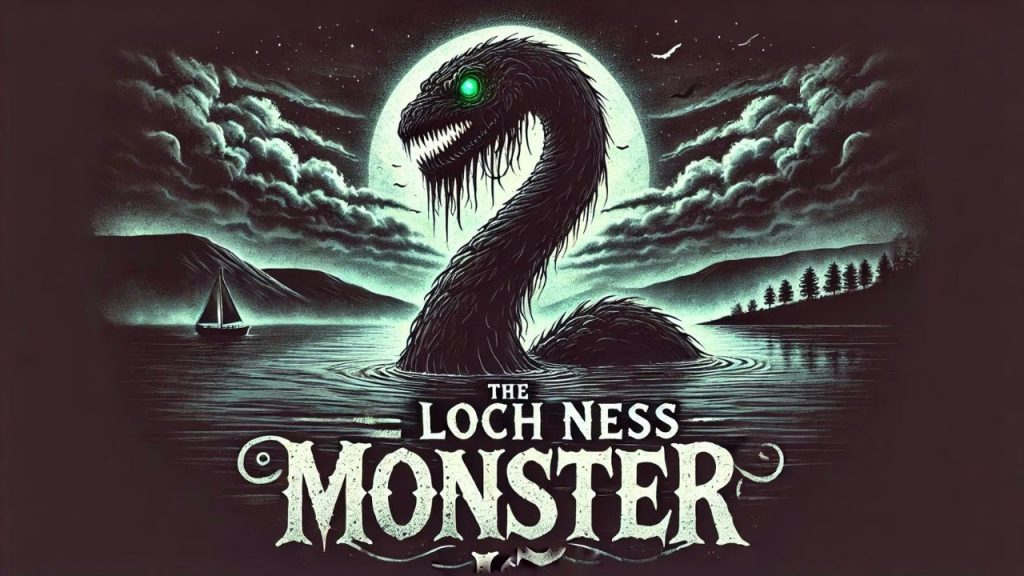
The water is 230 metres deep in places. It holds more fresh water than all the lakes of England and Wales combined. It is stained so dark by the peat from the surrounding hills that visibility drops to almost nothing within a few feet of the surface. If something were living in Loch Ness, it could spend its entire existence without ever coming within reach of human eyes.
A Loch Built for Secrets
Loch Ness is not simply a large lake. It is a geological phenomenon, carved along the Great Glen Fault, a vast strike-slip fracture that cuts diagonally through the Scottish Highlands from Inverness in the north-east to Fort William in the south-west. The fault itself formed between 420 and 250 million years ago. The loch that fills this section of it stretches for nearly 23 miles, reaches depths of up to 230 metres, and contains a volume of water so vast that it could, in theory, submerge the entire human population of the earth several times over.
The water is almost entirely opaque. Peat from the surrounding Highland landscape washes continuously into the loch, staining it a rich, dark brown and reducing visibility underwater to a matter of feet. Sonar signals bounce strangely off the sloping walls of the fault. The bottom is largely unexplored, its precise topography still uncertain in places. Loch Ness is, in every relevant respect, exactly the kind of place where something could exist without being found.
This is not an argument that something does exist in it. It is simply an observation about the nature of the place, and about why the question of what might be in it has never been answered to everyone’s satisfaction.
The Ancient Tradition and Saint Columba
The legend of something in Loch Ness did not begin in 1933, though 1933 is where the modern phenomenon originates. The oldest written reference to any creature in these waters comes from the Life of Saint Columba, written by the abbot Adomnan around 690 AD based on earlier accounts of the sixth century Irish monk who brought Christianity to much of Scotland.
According to Adomnan’s account, Saint Columba was travelling near the River Ness in 565 AD when he encountered a group of locals burying a man who had been attacked and killed by a creature in the water. Columba sent one of his companions to swim across the river to retrieve a boat on the other side. The creature rose again from the water and moved toward the swimmer with open mouth. Columba made the sign of the cross and commanded the beast, in the name of God, to go no further and return to where it had come from. The creature, according to Adomnan, stopped as though pulled back by ropes and fled.
Historians and folklorists have treated this account with appropriate care. Adomnan was writing more than a century after the events he described, drawing on sources of uncertain reliability, and the story follows a pattern of hagiographic storytelling in which saints routinely demonstrate divine authority over dangerous animals. The River Ness is not the loch itself. Most serious scholars treat this reference as an illustration of how water beast traditions existed in this region of Scotland long before the twentieth century, rather than as direct evidence for a creature in Loch Ness specifically.
The Picts, the pre-Christian inhabitants of the Scottish Highlands, left behind a rich tradition of carved stones depicting animals both realistic and fantastical. Among their carvings is an unidentified creature, part of a recurring set of symbols, that some have suggested resembles an aquatic animal of unusual shape. The identification is disputed and the connection to Loch Ness is not direct. What these references collectively establish is that the Highland landscape had its own tradition of water-dwelling mystery creatures well before anyone called one a monster.
1933 and the Birth of a Modern Legend
The story that most people know begins not with a medieval monk or a Pictish stone but with a road.
In 1933, a new road was completed along the northern shore of Loch Ness, providing clear, unobstructed views of the water for the first time for anyone travelling through the area. In May of that year, the Inverness Courier published an account from a local couple, Aldie and John Mackay, who claimed to have seen an enormous animal rolling and plunging on the surface of the loch while driving along this new road. The editor of the Courier, looking for a word to describe what was being reported, chose monster.
The story was picked up by the national press immediately. London newspapers sent correspondents north. A circus offered a reward of twenty thousand pounds for the capture of the beast. And within months, a wave of sightings was being reported from various points around the loch by people who had now been primed to look for something.
In August of 1933, George Spicer and his wife reported seeing an enormous animal cross the road in front of their car near the loch’s southern shore, describing it as a dragon or prehistoric monster before it disappeared into the water. This land sighting raised the stakes considerably: whatever was in the loch was apparently also capable of coming out of it.
By the end of 1933, Loch Ness had the attention of the world. The Daily Mail, seizing the commercial opportunity, hired a big-game hunter named Marmaduke Wetherell to travel to the loch and find evidence of the creature. Wetherell returned from his expedition with what he claimed were the footprints of a large, four-toed animal on the loch’s shore. The Natural History Museum examined casts and identified the prints as having been made with a dried hippopotamus foot, the kind sold as umbrella stands at the time. Wetherell was publicly humiliated and the Daily Mail distanced itself from him rapidly.
The footprints were almost certainly a prank by someone taking advantage of the mania that had descended on the area. What nobody knew at the time was that the humiliation of Marmaduke Wetherell would, within months, produce the most famous and most consequential image in the entire history of the Loch Ness Monster legend.
The Surgeon’s Photograph
On 21 April 1934, the Daily Mail published a photograph that would define the visual identity of the Loch Ness Monster for the next sixty years and shape the global imagination of what Nessie looked like.
The image showed a small, dark head and a long, slender neck rising from the rippling surface of the loch, framed against open water. It appeared to show exactly the kind of creature that witnesses had been describing: something elongated, serpentine, with a neck that rose from the water at an angle suggesting a much larger body beneath. The photograph was attributed to a London gynaecologist named Robert Kenneth Wilson, who wished to remain anonymous, which is why it became known as the Surgeon’s Photograph rather than by his name. Wilson’s medical credentials gave the image instant credibility. For a photograph that might have been dismissed if attributed to an enthusiastic amateur, the association with a respected professional lent it an authority it would retain for decades.
The Surgeon’s Photograph was considered the best available evidence for the Loch Ness Monster’s existence for sixty years. Experts examined it, debated it, subjected it to analysis, and never agreed on what it showed. Then, in 1994, the truth emerged from a deathbed confession.
Christian Spurling, ninety three years old and near death, admitted to his involvement in a carefully orchestrated conspiracy. His stepfather, Marmaduke Wetherell, humiliated by the hippo foot debacle and furious at the Daily Mail for the way they had treated him, had recruited Spurling to build a model monster. Spurling, a skilled model maker, constructed the creature by grafting a sculpted head and neck onto the conning tower of a toy submarine. Wetherell and his son Ian drove the submarine to Loch Ness, photographed it at low angle in the water to make it appear larger and more distant than it was, and then, to conceal Wetherell’s own involvement, persuaded Dr Wilson to act as the named photographer and sell the image to the press.
The result was a photograph that gave the Daily Mail exactly the kind of Nessie story they had commissioned Wetherell to find in the first place, while allowing Wetherell to extract his revenge privately, watching the paper enthusiastically publish a hoax that he had personally engineered. It was, by any measure, an extraordinarily petty and extraordinarily effective piece of revenge.
Wilson was fined by the British Medical Association for allowing his name to be associated with the image, which the BMA considered a breach of professional ethics. He never publicly admitted his role and maintained the fiction until his death in 1969. Wetherell also never admitted the truth publicly.
The deconstruction of the photograph’s full history took decades of patient research by the Loch Ness investigator Alastair Boyd and a colleague named David Martin, who tracked down Spurling after finding an obscure 1975 newspaper interview in which Ian Wetherell had hinted at the truth. Even after Spurling’s 1994 confession, Boyd, who had spent years exposing the photograph as a fake, maintained his own personal belief that something genuine existed in the loch.
A Register of Over a Thousand Sightings
The Surgeon’s Photograph was not the only evidence ever offered for the Loch Ness Monster, and its exposure as a hoax did not end the sightings. The Official Loch Ness Monster Sightings Register, maintained by a voluntary team of registrars, had recorded over 1,160 sightings as of late 2025, spanning centuries of accounts and drawing from a diverse range of witnesses including scientists, military personnel, police officers, and ordinary members of the public with no obvious motivation to invent anything.
Some of the more compelling individual accounts are difficult to explain away entirely. Arthur Grant, a veterinary student, claimed in January 1934 to have nearly collided with an enormous animal while riding his motorbike near Abriachan in the early hours of the morning, describing a creature with a long neck, small head, and large body that he estimated at between fifteen and twenty feet in length. His account was detailed and reported immediately, before the general Nessie hysteria of that year had fully taken hold.
Multiple sonar explorations of the loch, conducted in 1987 by Operation Deepscan and in 2003 by the BBC as part of a scientific investigation using 600 separate sonar beams, returned unexplained readings of large moving objects in the water that could not be attributed to known fish species. Neither expedition could prove the existence of a large unknown animal, but neither could rule one out entirely given the loch’s size and depth.
Science Looks Into the Water
The most rigorous scientific investigation of the loch’s contents was conducted in 2018 and 2019 by Professor Neil Gemmell of the University of Otago in New Zealand, leading an international team that took 250 water samples from various depths and locations throughout the loch and subjected them to environmental DNA analysis.
Environmental DNA, or eDNA, is the genetic material shed constantly by every living organism into its surrounding environment, from skin cells and scales to waste and secretions. Modern analysis techniques can identify species from vanishingly small quantities of this material, making it one of the most powerful tools available for determining what lives in a body of water without physically capturing or observing the animals in question.
Professor Gemmell’s team tested the Loch Ness water against global DNA databases covering hundreds of thousands of known species. The results were unambiguous on several key points. There was no evidence of any reptilian DNA in the loch, which effectively ruled out the plesiosaur theory, the idea that a population of these prehistoric marine reptiles had somehow survived in the loch since the Jurassic period. There was no shark DNA, no catfish DNA, no sturgeon DNA.
What there was, in unexpectedly large quantities, was eel DNA. Eels were present throughout the loch at every sampling location and every depth. The volume of eel DNA detected was striking enough that Professor Gemmell was prepared to say publicly that he could not rule out the possibility of abnormally large eels in the loch. European eels do not typically grow beyond a metre or so in length, but there are documented cases of individual eels reaching considerably greater sizes, and the unusual conditions of Loch Ness, its depth, its cold temperature, its relative isolation, could theoretically allow an eel to reach a size well outside the normal range if it lived long enough.
As Gemmell noted himself, the eDNA analysis could not determine the size of the eels whose DNA was present. A large population of ordinary-sized eels would leave exactly the same genetic signature as a small number of abnormally large ones. What the study established was that eels of some kind were abundant in the loch, and that an eel large enough to be mistaken for something much more dramatic was at least a biological possibility that the data did not exclude.
If you want more like this, the Tales of Myth and Magic newsletter delivers new creatures, legends, and forgotten folklore straight to your inbox.
No fixed schedule. No noise. Just the stories, when they are ready.
Sign up here →What People Are Actually Seeing
The scientific consensus, as it stands, explains most Loch Ness sightings through a combination of misidentification, the unusual optical effects of the loch’s dark water and Highland light conditions, wishful thinking, and the powerful influence of expectation on perception. People who go to Loch Ness looking for Nessie are primed to interpret ambiguous shapes and movements in ways that people who are simply driving past are not.
The most common natural explanations for sightings include large otters, whose swimming style can produce a series of humps visible above the water surface. Floating logs and debris that resurface after releasing trapped gases and move against the wind in ways that appear purposeful. Optical distortions produced by the temperature layers of the dark water. Large birds landing on the surface, their wake persisting after they have dived below the surface. Diving and surfacing stags, whose antlers and outstretched necks can look, at distance, surprisingly like a large animal with a long neck and multiple humps.
Eels of various sizes remain the most scientifically plausible explanation for sightings that do not fit any of the above, particularly those in which a long, sinuous shape moves through the water at speed.
None of these explanations account for every reported sighting in any satisfying way, which is part of why the debate has never entirely closed. The possibility of misidentification is compelling as a general principle, but it becomes harder to apply with complete confidence to every individual witness account, particularly the older and more detailed ones.
The Loch Today
The Loch Ness Monster is now one of Scotland’s most significant tourist assets, drawing visitors to the area with an economic impact that runs into millions of pounds annually. The Loch Ness Centre at Drumnadrochit, the principal visitor attraction dedicated to the legend, underwent a substantial redevelopment in recent years and presents both the history of the sightings and the scientific investigations of the loch with considerable care and balance.
The loch itself is unchanged. The Great Glen Fault is as deep and as dark as it has always been. The peat-stained water still reduces visibility to next to nothing within feet of the surface. The bottom is still incompletely mapped. The sonar still returns occasional unexplained readings.
The official sightings register continues to accept new reports. Volunteers maintain their vigils on the banks. Scientists continue to develop new techniques for investigating what might live in very deep, very dark bodies of water.
And in the loch itself, whatever is or is not down there continues to do exactly what it has always done: nothing that makes the question any easier to answer than it was when a local newspaper editor in Inverness reached for the word monster and started something that has not stopped since.
Further Reading
If this article sparked your interest, these are the books worth reading next.
Scottish Urban Legends: 50 Myths and True Stories
by Aaron Mullins — fifty Scottish urban legends including stories from Glasgow, Edinburgh, and the Highlands. The kind of tradition that Maggie Murphy belongs to, collected properly in one volume.
Scottish Urban Myths and Ancient Legends
by Grace Banks and Sheena Blackhall — vampires, werewolves, devil encounters, and the school playground legends of Scotland. A genuinely good collection of the stories Scots have been telling each other for generations.
The Lore of Scotland: A Guide to Scottish Legends
by Jennifer Westwood and Sophia Kingshill — the most comprehensive collection of Scottish legend in print, covering Glasgow to Shetland, exploring origins and historical basis. Endorsed by Terry Pratchett as the real macabre.
Never miss a myth
Thank you for being here. The site is brand new and every subscriber genuinely means something to me. If you're here, you care about this stuff as much as I do - and that's all the reason I need to keep going. New stories, videos and dark folklore from around the world, straight to your inbox. No algorithm. Just the stories, when they're ready.