Theseus is the national hero of Athens, the founder-king whose mythology explains what Athens was and what it stood for. He killed the Minotaur, unified Attica under Athens’s leadership, established democratic institutions according to some traditions, and fought in more significant mythological events than almost any other hero. He is also the man who abandoned Ariadne on an island after she saved his life, who forgot to change his ship’s sails and caused his father’s death, who abducted Helen of Troy when she was a child, who helped his friend attempt to abduct Persephone from the underworld, and who died in exile pushed off a cliff by a king he had gone to for help.
The tradition presents all of this as the biography of the same man, and does not resolve the tension between the civic hero and the personal catastrophist, because Theseus is both simultaneously and the tradition sees no contradiction in this.
The Birth and the Swords
Theseus was the son of Aegeus, king of Athens, or of Poseidon depending on which tradition is followed. His mother Aethra conceived him on a night when both Aegeus and Poseidon visited her, and both have a claim to his paternity. The dual parentage is significant: it gives Theseus both divine power and legitimate royal succession, the combination that the heroic tradition requires.
Aegeus left Troezen before Theseus was born, placing his sandals and his sword under a great rock and telling Aethra that if she bore a son strong enough to lift the rock and retrieve the items, she should send him to Athens. When Theseus was grown he lifted the rock, retrieved the sandals and sword, and went to Athens. He chose the overland route rather than the sea route, because the overland route was more dangerous and he wanted to establish himself before arriving at his father’s court.
The journey to Athens is itself a series of heroic encounters: Theseus killed six bandits and criminals who preyed on travellers, each by the method they used on their victims. Periphetes the club-bearer was killed with his own club. Procrustes, who fitted travellers to his bed by stretching or cutting them, was fitted to his own bed. The journey to Athens is a programme of road-clearing, the same civilising function the Twelve Labours served for Heracles, establishing Theseus as a hero of order rather than simply of strength.
The Minotaur and Ariadne
Athens was required to send a tribute of seven young men and seven young women to Crete every nine years to be fed to the Minotaur, the half-human half-bull creature that lived in the Labyrinth built by Daedalus. Theseus volunteered to go as one of the tribute, intending to kill the Minotaur and end the tribute.
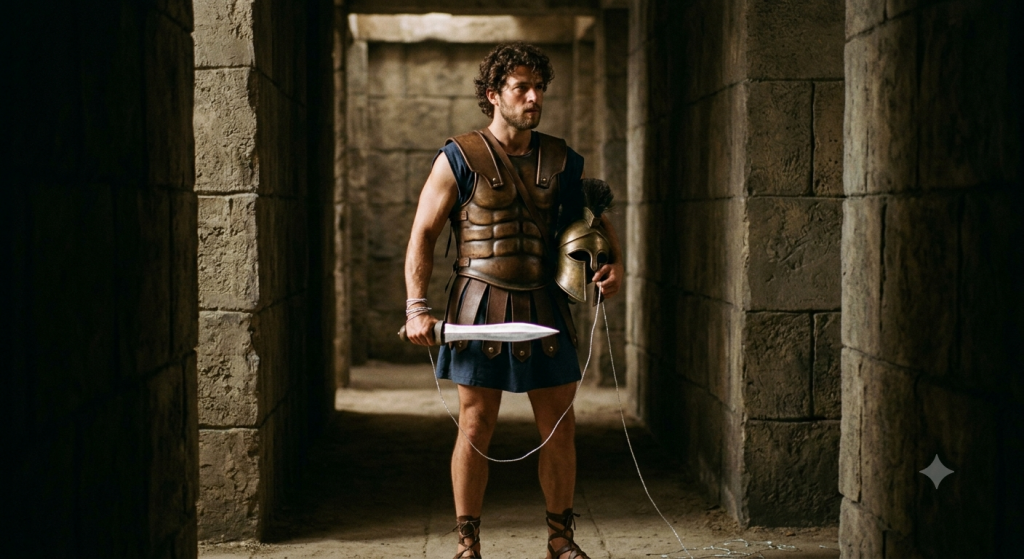
In Crete, Ariadne, daughter of King Minos, fell in love with Theseus and gave him a ball of thread to unwind as he entered the Labyrinth so he could find his way back out. He killed the Minotaur, followed the thread back, gathered the Athenian tributes, and sailed for home with Ariadne.
He left her on the island of Naxos while she slept. The tradition offers various explanations: he forgot her, he was instructed by the gods to leave her, he simply abandoned her. None of them is fully satisfying. Dionysus found her on Naxos and married her, which is the better ending for Ariadne if not for Theseus’s reputation.
On the return to Athens, Theseus forgot to change the ship’s sails from black, the colour of mourning used for the tribute ships, to white, the colour of triumph he had promised to display if he was successful. Aegeus, watching from a cliff, saw the black sails and threw himself into the sea believing his son was dead. The sea is called the Aegean after him.
Athens and the Civic Hero
As king of Athens, Theseus is credited with the synoikismos, the unification of the separate communities of Attica under Athens’s leadership, which is the political foundation of the Athenian city-state. He established festivals, including the Panathenaea. He was said to have been the first to divide the citizen population into nobles, craftspeople, and farmers. Later Athenian tradition credited him with establishing the groundwork for democratic institutions, though this attribution reflects later political values being projected back onto the mythological founder.
His bones were eventually retrieved from the island of Scyros by the Athenian general Cimon in 476 BCE, following an oracle’s instructions, and reinterred in Athens with great ceremony. The Athenians believed they possessed the physical remains of their founder-hero, and the Theseum built to house them was one of the significant monuments of the classical city.
Further Reading
If this article sparked your interest, these are the books worth reading next.
The Iliad — Homer (Penguin Classics)
by Homer — the primary source for everything in this article, and still the most vivid account of the Trojan War ever written.
The Odyssey — Homer (Emily Wilson translation)
by Homer, translated by Emily Wilson — the best modern English translation, and the book that contains Odysseus’s own account of the horse.
The Trojan War: A Very Short Introduction
by Eric Cline — the clearest and most up to date account of what archaeology actually tells us about Troy and whether any of it happened.
For more on the Greek tradition, the Minotaur article covers the creature Theseus kills in the Labyrinth. The Dionysus article covers the god who finds Ariadne on Naxos after Theseus leaves her there. The Greek Mythology hub page has every article in the cluster.
Never miss a myth
Thank you for being here. The site is brand new and every subscriber genuinely means something to me. If you're here, you care about this stuff as much as I do - and that's all the reason I need to keep going. New stories, videos and dark folklore from around the world, straight to your inbox. No algorithm. Just the stories, when they're ready.