The Osiris myth is the most important story in Egyptian mythology. Not because it is the most dramatic, though it is that. Not because it features the most powerful gods, though it does. It is the most important because every other significant belief in the Egyptian tradition connects to it: the authority of the pharaoh, the hope of resurrection, the judgment of the dead, the meaning of mummification, the cycle of the Nile’s flooding. Pull any thread in Egyptian religious thought far enough and you find Osiris at the other end.
He was a king before he was a god. The tradition presents him as the first great ruler of Egypt, the one who taught humanity agriculture and law and the arts of civilisation, who transformed his people from barbarism into something worth governing. He was beloved, wise, and legitimate. He was also murdered by his brother, dismembered and scattered across Egypt, and reassembled by his wife through magic that the tradition describes as unprecedented in its power and devotion.
What happened next is the theological foundation on which the entire Egyptian understanding of death was built.
The Primary Sources
Unlike the Norse tradition, which preserves its mythology in two major 13th century Icelandic collections, Egyptian mythology must be assembled from sources spread across three thousand years of religious texts, temple inscriptions, funerary papyri, and ritual documents.
The Pyramid Texts, carved on the walls of royal pyramids from around 2400 BCE onward, contain the oldest references to Osiris and the conflict with Set. These are among the oldest religious texts in the world and their references to Osiris assume an audience already familiar with the basic mythology rather than explaining it from the beginning.
The Coffin Texts, which democratised the afterlife beliefs previously reserved for royalty and extended them to wealthy non-royal Egyptians, expand the mythology further. The Book of the Dead, used across the New Kingdom and later periods, provides the most extensive practical guide to the beliefs built on the Osiris myth.
The most complete narrative account of the full story comes from a Greek writer: Plutarch’s De Iside et Osiride, written in the 1st century CE, which synthesises Egyptian traditions into a coherent narrative that no single Egyptian source provides. Plutarch was a Greek writing about a tradition not his own, and his account has been shaped by that position, but it remains the single most complete retelling available and is broadly consistent with what the Egyptian sources describe in fragments.
The Murder
Set, Osiris’s brother, murdered him. The method differs across sources: in Plutarch’s account, Set constructs a beautifully made chest perfectly fitted to Osiris’s body and tricks him into lying in it at a feast, then seals it and throws it into the Nile. In other accounts the killing is more direct. What is consistent across all versions is the motive: Set wanted the throne of Egypt and Osiris had it.
The chest floated down the Nile and eventually came to rest at Byblos in what is now Lebanon, where a tamarisk tree grew around it and enclosed it. The king of Byblos cut the tree to use as a pillar for his palace, not knowing what was inside. Isis, Osiris’s wife and sister, searched the world for her husband and eventually found him there, retrieved the chest, and brought it back to Egypt.
Set found the body and this time was more thorough. He dismembered it into pieces: the Pyramid Texts mention fourteen pieces, later traditions give forty-two, one for each nome of Egypt. He scattered them across the land.
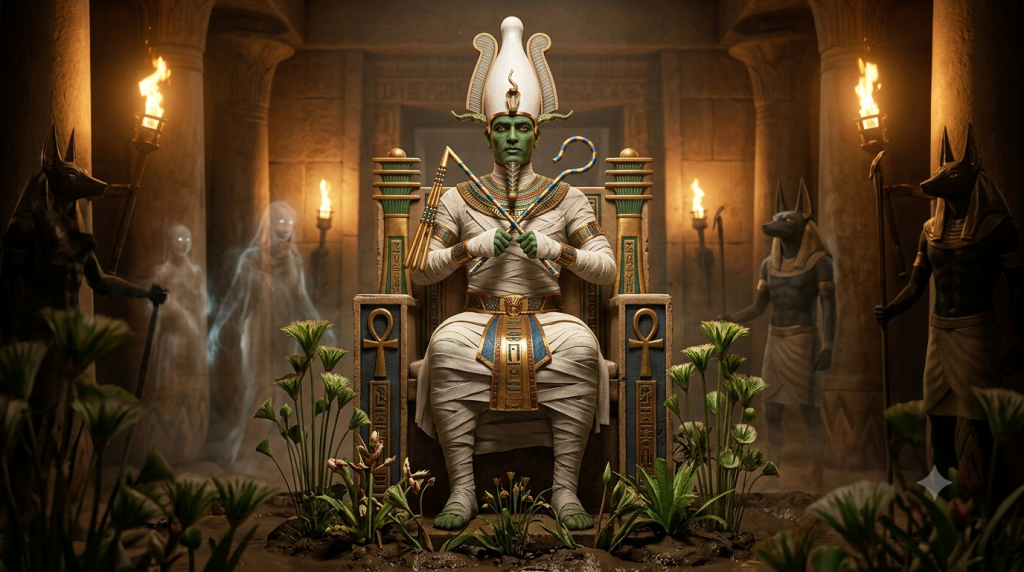
Isis and her sister Nephthys searched Egypt and recovered each piece. Anubis, the god of embalming, joined them and together they reassembled the body and embalmed it, making Osiris the first mummy. Isis used her magic to breathe life back into the body long enough to conceive a son, Horus, who would grow up to avenge his father and claim the throne. Then Osiris descended to the Duat, the Egyptian underworld, where he became its ruler and its judge.
He could not return to the world of the living. The resurrection was real but incomplete: enough to produce an heir, not enough to reclaim a living throne. Osiris became something new, the first being to undergo death and transformation into divine afterlife existence, and his new role was more important than his old one.
What Osiris Ruled and What the Judgment Meant
In the Duat, Osiris presides over the judgment of the dead. Every person who dies must eventually stand before him in the Hall of Two Truths, where their heart is weighed against the feather of Maat by Anubis, while Thoth records the result. If the heart is lighter than the feather, the dead person is admitted to the Field of Reeds, the Egyptian paradise where they live in a perfected version of the life they knew on earth. If the heart is heavier with the accumulated weight of wrongdoing, Ammit the Devourer consumes it and the person undergoes the second death, the absolute annihilation from which there is no return.
The connection between Osiris’s myth and this judgment is the theological core of Egyptian religion. Osiris died, was dismembered, was reassembled and transformed, and became the ruler of the afterlife. Every Egyptian who died hoped to do what Osiris had done: to undergo the same transformation and emerge into divine existence on the other side. The funerary texts refer to the dead as “the Osiris of” followed by their name, identifying each person’s hope of resurrection with the prototype established by the god himself.
This means that Osiris’s murder was not a tragedy in the conventional sense. It was a necessary event. The transformation he underwent could not have happened any other way. Set, the agent of his death, was therefore not simply a villain but a necessary force: the thing that made the most important transformation in Egyptian theology possible. Egyptian religion could hold this complexity without resolving it into simple good versus evil, and the tradition’s treatment of Set reflects this capacity for holding contradictions simultaneously.
The Nile and the Agricultural Cycle
Osiris was associated from very early in the tradition with the annual flooding of the Nile and with the renewal of vegetation that the flooding made possible. The green colour often used in his iconography connects him to growing things. His death and resurrection were understood as the mythology behind the agricultural cycle: the land dies in the dry season, the Nile floods and brings fertile silt, the land is reborn.
This association made Osiris’s myth not simply a story about a murdered king but an explanation of the most important natural phenomenon in Egyptian life. The Nile flood was the difference between survival and starvation for an entire civilisation, and the god who presided over the agricultural cycle was among the most practically important in the pantheon. His worship was not simply a matter of theological interest. It was directly connected to the fertility of the land and therefore to the survival of everyone who depended on it.
Osiris and the Pharaoh
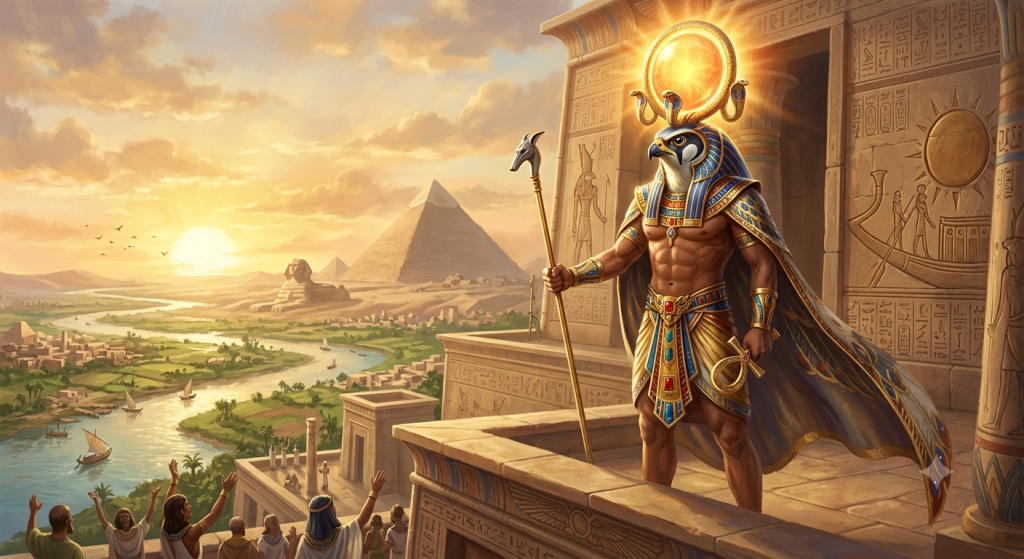
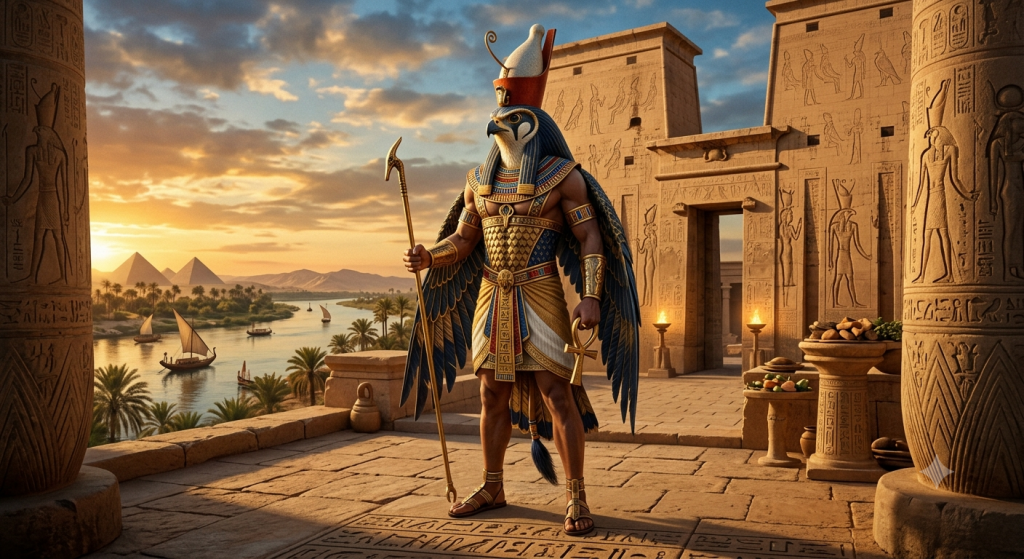
The political theology built on the Osiris myth is one of the most sophisticated in the ancient world. The living pharaoh was identified with Horus: the rightful heir who had defeated chaos and taken the throne of his father. When a pharaoh died, he became Osiris: the dead king who now rules the afterlife while his son and successor takes the living throne as the new Horus. The cycle repeated at every royal succession, connecting every transition of power to the foundational mythology of murder, resurrection, and legitimate inheritance.
This meant that the authority of the pharaoh was not simply political or military. It was theological, grounded in the myth that had established what legitimate kingship looked like: a ruler beloved by his people, murdered by chaos, vindicated by divine justice, and succeeded by a rightful heir who defeats the usurper. Every pharaoh claimed this mythology as his own, and the myth validated every pharaoh’s claim to rule.
Abydos: Where Osiris Was Buried
The city of Abydos in Upper Egypt was the most important cult centre of Osiris in the Egyptian tradition and one of the most sacred sites in the ancient world. The Egyptians believed that Osiris’s head was buried there, and the site was the destination of major religious pilgrimages for thousands of years. Annual festivals at Abydos reenacted the death and resurrection of Osiris in dramatic form, with processions, ritual battles between the forces of order and chaos, and the eventual triumph of Osiris’s restoration.
The earliest kings of Egypt were buried at Abydos, and later pharaohs built cenotaphs and temples there to connect themselves to the foundational mythology the site represented. The temple of Seti I at Abydos, built around 1280 BCE and among the best preserved in Egypt, contains some of the most beautiful reliefs in Egyptian art depicting the Osiris myth and the rituals associated with it.
For the Egyptian people, a pilgrimage to Abydos and the erection of a small stele there was a way of placing oneself into the Osiris mythology, participating in the hope of resurrection by proximity to the site where the prototype of resurrection was believed to be buried. The steles of ordinary Egyptians found at Abydos, thousands of them over thousands of years, are among the most moving testimonies to how deeply and widely the Osiris hope was held.
For more on the figures connected to Osiris’s story, the Isis article covers the wife whose magic and devotion made the resurrection possible. The Horus article covers the son whose conflict with Set and eventual victory completed what the myth began. The Set article covers the brother whose murder of Osiris set every subsequent event in motion.
Never miss a myth
Thank you for being here. The site is brand new and every subscriber genuinely means something to me. If you're here, you care about this stuff as much as I do - and that's all the reason I need to keep going. New stories, videos and dark folklore from around the world, straight to your inbox. No algorithm. Just the stories, when they're ready.