
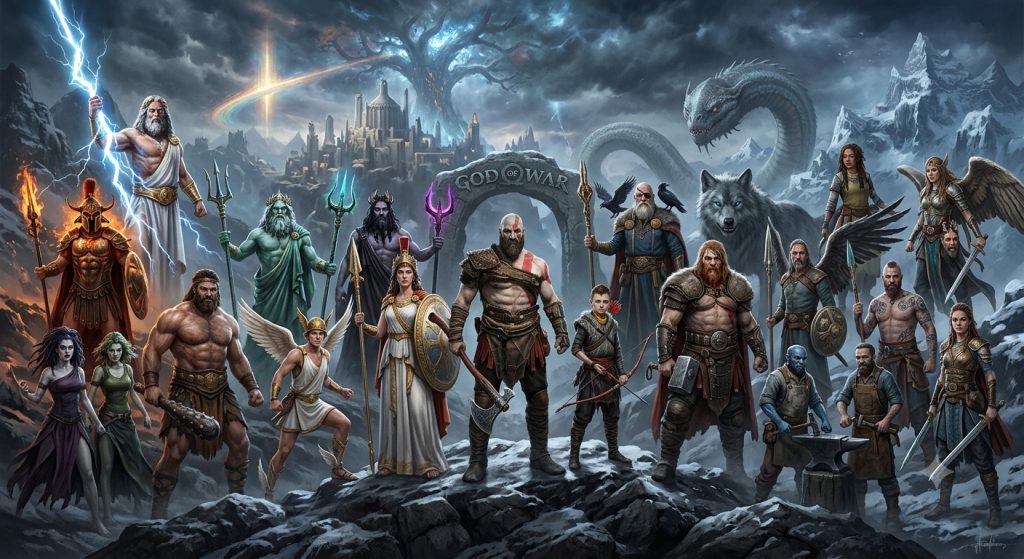
God of War 2018 and God of War Ragnarök are two of the most successful video games ever made, and a significant part of their appeal is how seriously they take the mythology they draw from. Santa Monica Studio did genuine research. The games are full of details that come directly from the Poetic Edda and the Prose Edda, and the liberties they take are mostly deliberate creative decisions rather than ignorance of the source material.
If you came to this site because you played the games and wanted to know what was real, this article covers every major character and event in both games and tells you what the actual Norse tradition says about each of them. Some of what the games do is remarkably faithful. Some of it is deliberately and interestingly different. And some of it raises questions about the real tradition that the games, for all their quality, do not have space to answer.
There are significant spoilers for both games throughout this article.
Kratos: The Character Who Does Not Exist in Norse Mythology
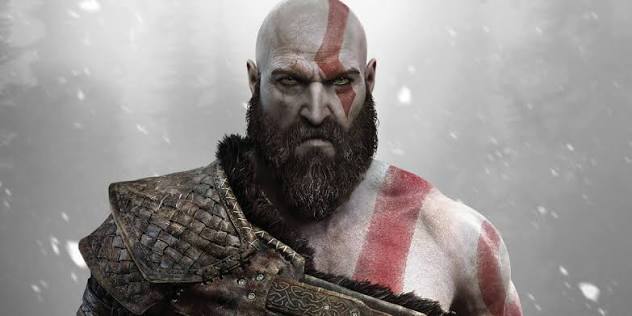
Start with the obvious. Kratos is not a Norse mythological figure. He is the original creation of the God of War series, loosely inspired by the Greek personification of strength called Kratos but not directly based on it. The game director of God of War III described the name connection as a happy mistake: the team chose the name before realising it had any Greek mythological resonance.
In the Norse games, Kratos is a Greek god who has somehow survived the events of the earlier Greek mythology games and ended up in Midgard. The Norse tradition has no equivalent figure: a god from one mythological tradition wandering into another was not a concept that either the Greek or Norse traditions entertained. The Norse cosmos is self-contained, the nine worlds connected by Yggdrasil, and there is no route between the Norse cosmological framework and the Greek one.
That said, the games use Kratos’s outsider status intelligently. He does not know the Norse tradition from the inside, which means Mimir and other characters can explain it to him and therefore to the player. His perspective as someone from outside the system gives the games a natural expository voice without requiring the player to accept that the protagonist already knows everything.
Atreus and Loki: The Games’ Most Interesting Mythology Decision

The revelation at the end of God of War 2018 that Atreus’s true name is Loki is the games’ boldest mythology decision and one of their most carefully constructed. The connection is not arbitrary. The games built it from the ground up across the entire first game before revealing it.
In the actual Norse tradition, Loki’s parents are the giant Fárbauti and a figure called Laufey. In the games, Kratos’s wife and Atreus’s mother is Faye, whose real name is Laufey. The name Fárbauti in Old Norse means cruel striker, which the games acknowledge as an almost accurate description of Kratos. Loki in the tradition is the son of giants, adopted into the Aesir community, and eventually becomes their greatest internal threat. In the games, Atreus is half giant through his mother and half Greek god through his father, and his story in Ragnarök involves travelling to find the last of the giants in Jötunheim, echoing the tradition’s connection of Loki to the giant world.
What the games change is Loki’s relationship to Odin. In the Eddas, Loki is Odin’s sworn blood-brother, a peer who lived among the Aesir for centuries before their relationship deteriorated. In the games, Atreus has no prior relationship with Odin and encounters him as an enemy from the beginning of Ragnarök. The deep and complicated intimacy of the Loki-Odin relationship in the tradition, which makes Loki’s eventual betrayal so much darker, is replaced by a more straightforward antagonism.
The real Loki article on this site covers what he actually was in the tradition in considerably more depth.
Odin: The Games’ Most Accurate Major Portrayal

Odin in God of War Ragnarök is arguably the most faithful major character portrayal in either game. The games present him as a manipulative, knowledge-obsessed figure who will sacrifice anything and anyone in his pursuit of information and control, who maintains elaborate deceptions including impersonating Tyr for much of Ragnarök, and who is ultimately killed not in heroic combat but executed by Sindri after being trapped.
This is recognisably the Odin of the tradition. The real Odin is defined by his relentless pursuit of knowledge at any cost, his willingness to deceive gods, humans, and giants alike in service of his goals, and his preparation for Ragnarök through means that are morally questionable at best. He is not a straightforwardly heroic figure in the Eddas. He engineers the deaths of warriors he has favoured, he breaks oaths when it suits him, and he consults the heads of the dead for counsel because a living advisor is sometimes less useful than a dead one who cannot leave.
The games give him Huginn and Muninn, his two ravens, which is accurate. They give him his spear. They portray his obsession with preventing Ragnarök, which is broadly consistent with how the tradition presents his preparation for it, though in the tradition Odin knows Ragnarök is inevitable rather than preventable and prepares accordingly rather than trying to stop it.
The one significant departure is Odin’s death. In the Eddas, Odin is swallowed by Fenrir at Ragnarök, and his son Víðarr avenges him by tearing the wolf’s jaws apart. The game replaces this with Odin being killed by Sindri after Kratos and Atreus defeat him, and his soul being destroyed in a marble rather than continuing in any form. The games’ Odin dies considerably less mythologically than the real one.
Thor: The Most Physically Accurate Portrayal in Any Modern Media
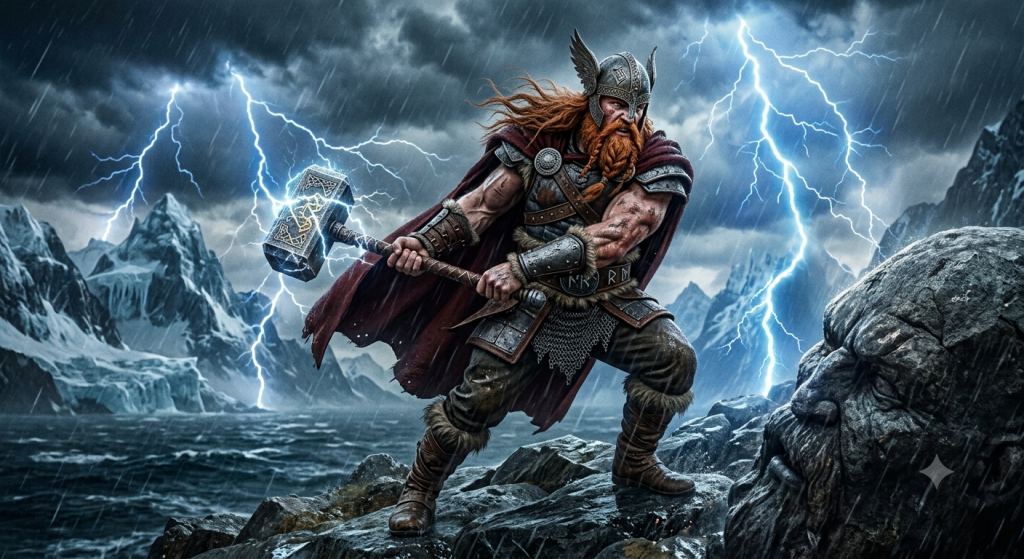
The games’ version of Thor deserves particular recognition because it makes a design decision that almost no other adaptation has been willing to make: it depicts him as the tradition actually describes him. Thor in the Eddas is enormous, red-haired, red-bearded, and eats and drinks in quantities that the tradition treats as both impressive and slightly comic. He is not sleek or conventionally heroic in appearance. He is a physically massive figure whose power comes from strength rather than grace.
The games’ Thor, voiced by Ryan Hurst, is visibly overweight, red-bearded, and imposing in a way that feels genuinely threatening rather than glamorous. This is considerably closer to the tradition than the blond, conventionally handsome Marvel version, and the games acknowledge this implicitly by having Mimir comment that the stories do not quite prepare you for what Thor actually looks like in person.
Thor’s characterisation in the games is also interesting from a mythology perspective. He is presented as a figure who is aware, at some level, that what he does for Odin is wrong, who drinks to suppress that awareness, and who ultimately chooses to break from Odin’s control before being killed. This is more psychologically complex than the tradition’s Thor, who is not presented as conflicted about his role, but it is not incompatible with the tradition’s broader understanding of Thor as a figure who operates according to his nature rather than through careful strategic thinking.
The real Thor article on this site covers the mythology in full, including why he was more widely worshipped than Odin and what the short handle on Mjolnir actually means.
Freya and Frigg: The Games’ Deliberate Merger
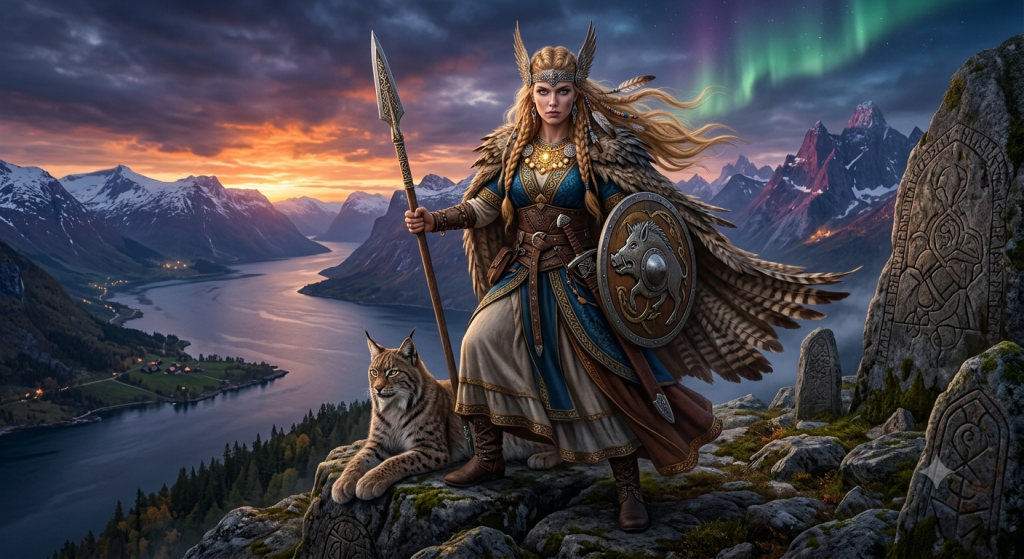
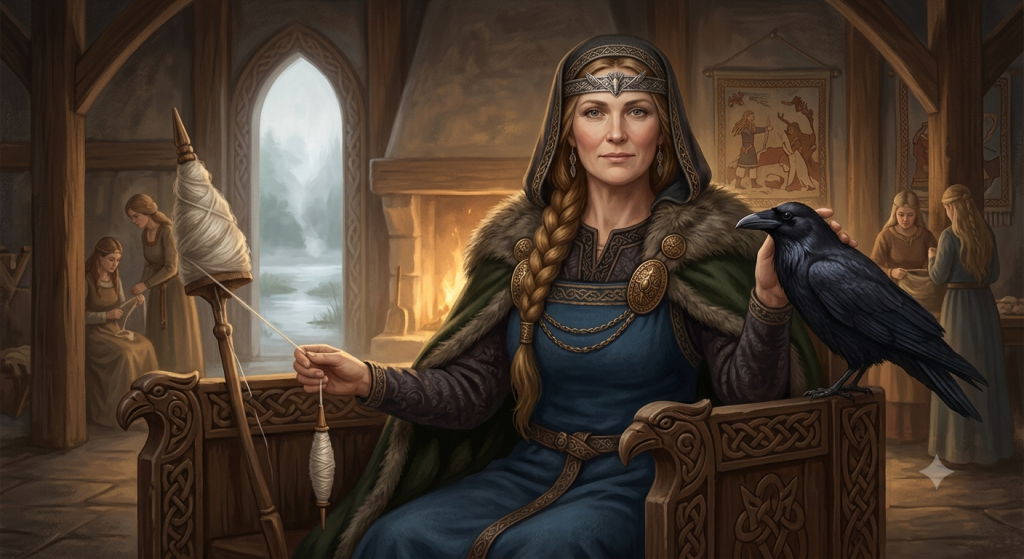
One of the most discussed mythology decisions in the 2018 game is the treatment of Freya. In the game, Freya is Baldr’s mother, which in the mythology was Frigg’s role. Freya and Frigg are two distinct goddesses in the Eddas: Frigg is Odin’s wife and the queen of Asgard, while Freya is a Vanir goddess, Freyr’s sister, and the ruler of Fólkvangr. The game merges them into a single character.
The merger is not entirely arbitrary. As covered in the Frigg article on this site, scholars have long debated whether Frigg and Freyja were originally a single deity who split into two distinct figures at some point in the development of the Germanic tradition. The games effectively reverse that split, creating a single character who has characteristics of both. The game’s Freya is a Vanir goddess who was married to Odin, which gives her elements of both figures simultaneously.
What the merger loses is the specific tragedy of Frigg’s position in the Baldr myth: a goddess who knows the fates of all beings, who knows Baldr will die, who extracts oaths from every substance in existence to prevent it, and who fails because she overlooked one thing. The game version of the Baldr story is considerably more action-oriented and considerably less about the limits of maternal protection against fate.
Baldr: What the Game Changed and Why It Works Anyway
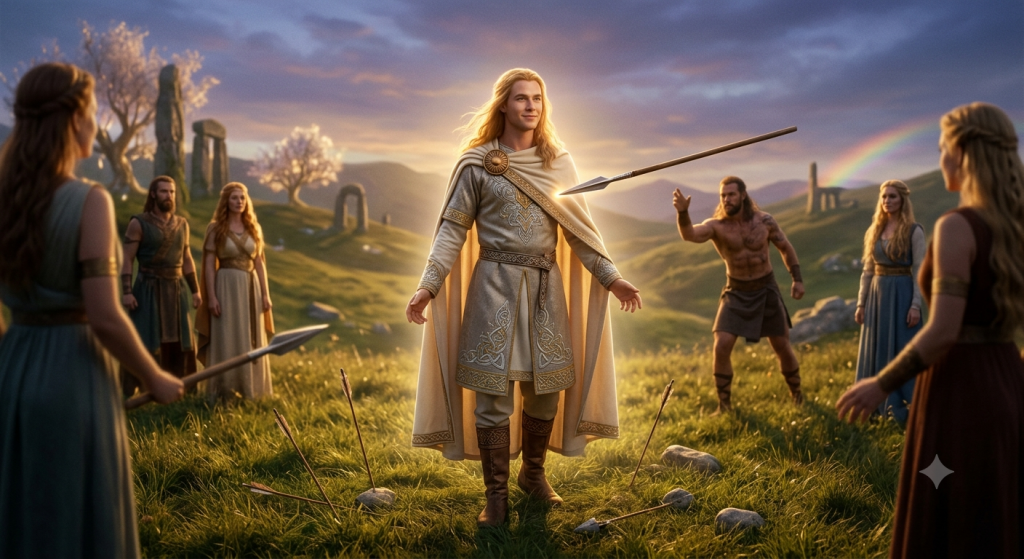
The game’s version of Baldr’s invulnerability is different from the tradition in an important way. In the Eddas, Frigg extracts oaths from every substance not to harm Baldr, and the gods amuse themselves throwing things at him. Loki finds the one exception, mistletoe, guides the blind Höðr’s hand, and Baldr falls dead. In the game, Freya places a curse on Baldr that makes him unable to feel anything, rendering him invulnerable but also immune to all sensation. This makes him the villain rather than the victim: his suffering from the inability to feel drives his obsession with finding a way to break the curse, and he pursues Kratos in the hope that the magical mistletoe arrows Atreus carries might end it.
The game’s inversion of Baldr from beloved victim to tormented antagonist is a genuinely creative mythology decision. It takes the key element of the Baldr myth, the mistletoe exception, and recontextualises it completely. Instead of being the weapon of his accidental death, mistletoe becomes the one thing that can give him back sensation, which makes it the object of his obsession and eventually the mechanism of his actual death when Kratos kills him at the end of the game.
In the mythology, Baldr is defined by his goodness and his loss. In the game, he is defined by his suffering and his rage. Both are legitimate ways to build a character from the same raw material.
Mimir: Surprisingly Faithful to the Tradition
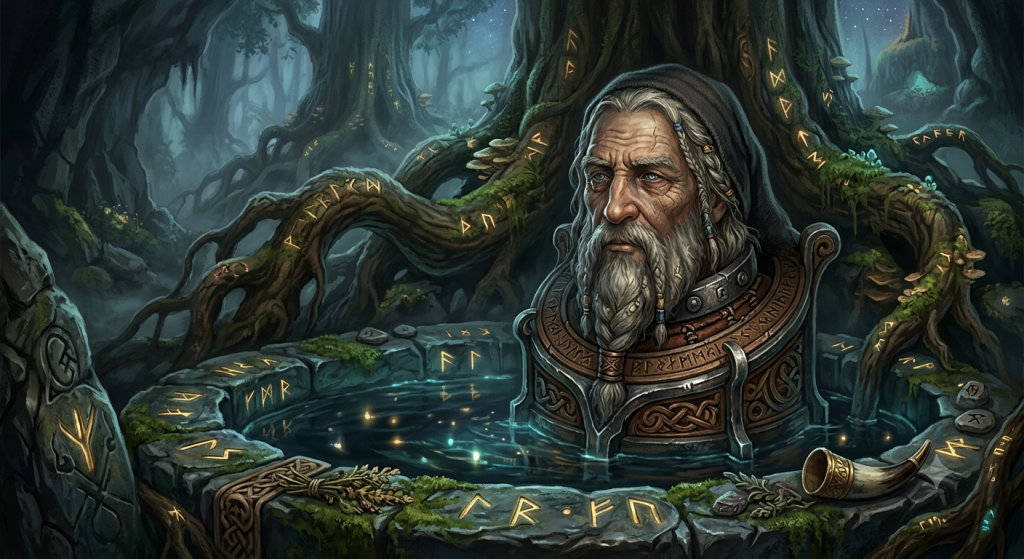
Mimir in the games is the smartest man alive, an advisor to Odin who has been imprisoned on a tree for centuries, and who asks Kratos to behead him so that Freya can resurrect the head and he can serve as their companion and guide. This is considerably closer to the actual Norse tradition than most people expect.
The real Mímir is the wisest being in the Norse cosmos, the guardian of the well of cosmic wisdom from which Odin sacrificed his eye for a drink. He was beheaded during the Aesir-Vanir War when the Vanir sent him and Hœnir as hostages and eventually concluded that Hœnir was useless without Mímir to advise him. Odin received the severed head, preserved it with herbs, and used it for counsel thereafter.
The games change the beheading from a war consequence to a voluntary act by Kratos at Mimir’s own request, and they attribute the resurrection to Freya rather than to Odin’s magic. But the core of the character, a severed head that continues to provide indispensable wisdom, is genuinely drawn from the tradition. The games also give Mimir the ravens Huginn and Muninn as a connection to Odin, which is accurate.
Brok and Sindri: The Dwarven Craftsmen
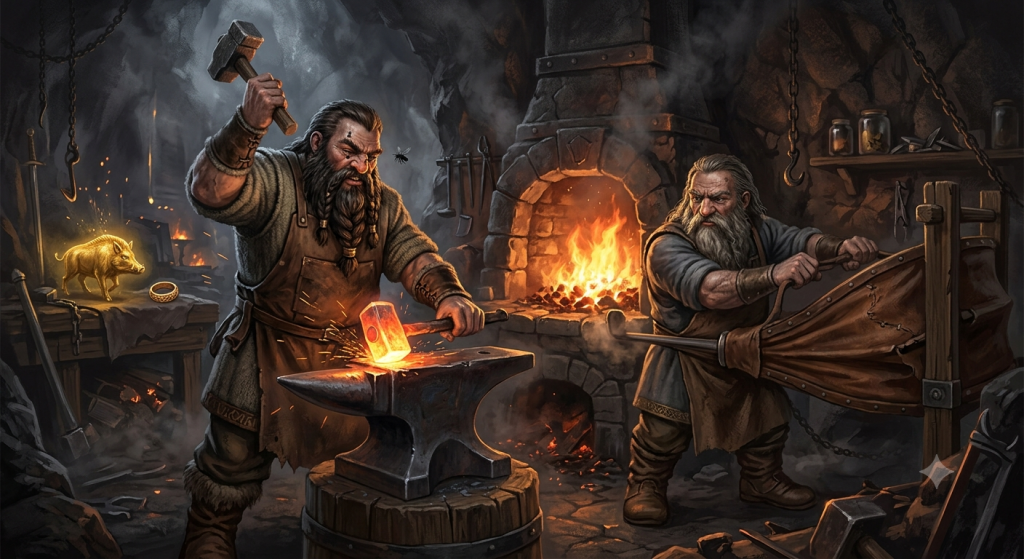
Brok and Sindri in the games are the dwarven craftsmen who upgrade Kratos’s equipment and provide much of the games’ humour and emotional depth. Their real mythology counterparts are Brokkr and Eitri, the dwarves who forged Mjolnir, Gullinbursti the golden boar, and Draupnir the ring that produces eight identical rings every nine nights.
The games are broadly faithful to the tradition’s depiction of the dwarves as the finest craftspeople in the Norse cosmos, capable of making objects of supernatural power and quality. In the mythology, the forging of Mjolnir happens because Loki makes a bet with Brokkr that he cannot produce treasures equal to those made by another group of dwarves, and Loki sabotages the forging by biting Brokkr’s eyelid while he works the bellows, producing the short handle that is Mjolnir’s defining flaw. The games reference this mythology without directly reproducing it.
Read more about Brok and Sindri here.
The Nine Realms: What Is Real and What Is Invented
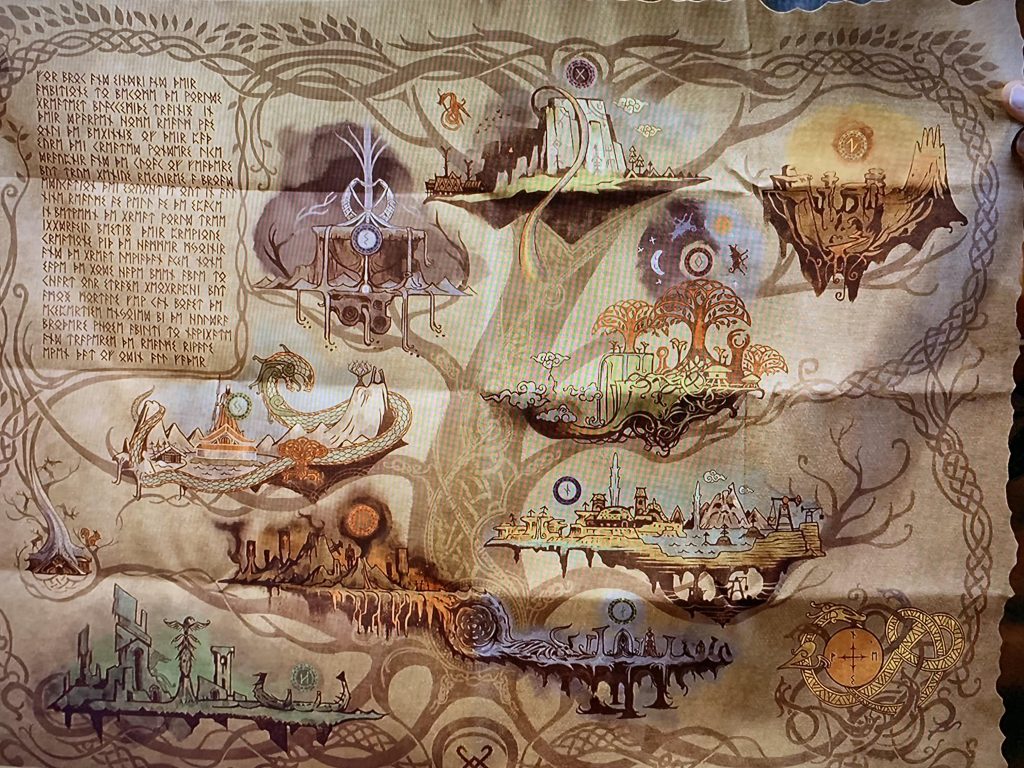
The games use the nine realms of Norse cosmology as their primary worldbuilding structure, and the realms they depict are broadly consistent with what the tradition describes, with some significant additions and modifications.
Midgard, Asgard, Jötunheim, Alfheim, Helheim, Niflheim, Muspelheim, Vanaheim, and Svartalfheim are all present in the games and are all attested in the Norse sources. The tradition never gives a complete consistent list of all nine worlds in a single source, as covered in the Yggdrasil article on this site, but these nine are the most commonly identified from across the various sources.
What the games add is primarily visual and experiential: the specific appearance of each realm, the ecology of each world, the specific creatures that inhabit them. The tradition is not very detailed about what Alfheim looks like or what you would encounter in Vanaheim. The games fill in those gaps with considerable imagination, and the results are generally consistent with the spirit of the tradition even when they go beyond what the sources say.
The Bifröst as a travel mechanism between realms is used in the games in a way that is broadly consistent with the tradition’s description of it as the rainbow bridge between Midgard and Asgard, though the games extend its function to allow travel between all realms rather than just between those two.
Fimbulwinter: One of the Games’ Best Mythology Decisions

The use of Fimbulwinter as the framing device for God of War Ragnarök is one of the games’ best mythology decisions and one of the most faithful to the tradition. In the Eddas, Fimbulwinter is the great winter that precedes Ragnarök: three consecutive winters with no summer between them, during which the social order collapses and the world grows dark. It is the first sign that the end has begun.
The games use Fimbulwinter as the entire setting of Ragnarök, with the world already experiencing the catastrophic winter that signals what is coming. Mimir notes that Fimbulwinter should have been a hundred years in the future if Kratos had not altered events at the end of the first game, which is an interesting way of acknowledging the games’ departure from the tradition’s timeline while using the tradition’s own mechanisms.
The Ragnarök article on this site covers the real Fimbulwinter and its possible connection to the catastrophic volcanic winters of the 530s AD.
Read more about Fimbulwinter here.
Tyr: What the Games Do With the God of Justice
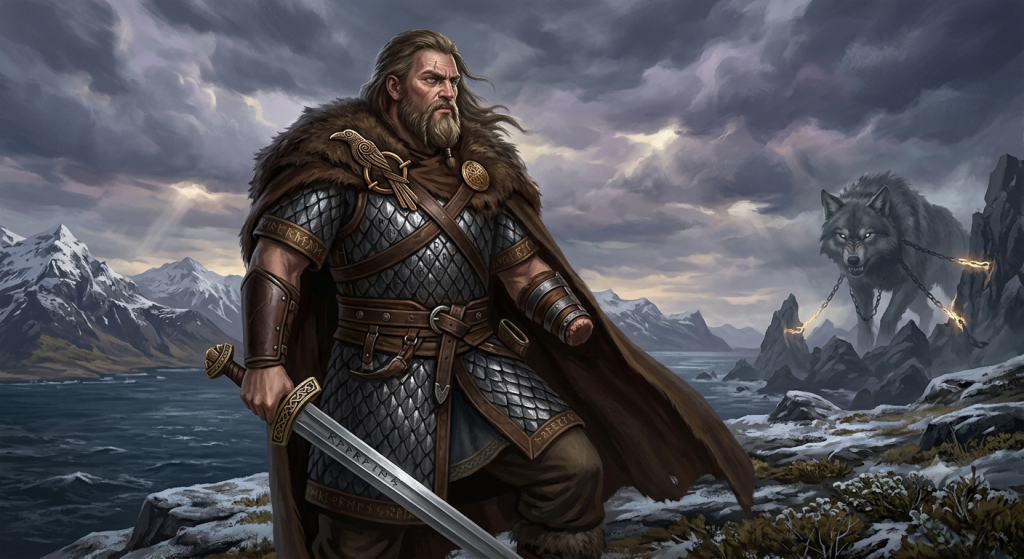
Tyr in God of War Ragnarök is one of the game’s most interesting mythology decisions. The real Tyr is the god of justice and law, the one-handed god who put his hand in Fenrir’s mouth as a pledge of good faith during the binding and lost it when the wolf discovered the deception. The games give him this backstory and the missing hand, which is one of the details they get most precisely right.
The major twist in Ragnarök, that the Tyr Kratos and Atreus rescue and ally with is actually Odin in disguise, is entirely the games’ invention. The real Tyr has no such deception in the tradition. What he has is the single act of genuine moral courage covered in the Tyr article on this site: the willingness to put his hand in the wolf’s mouth when every other god looked at each other and waited.
Tyr’s fate in the actual mythology is to fight the hound Garm at Ragnarök and die in mutual killing. The games use his apparent death differently but the essential detail of the missing hand and the binding of Fenrir is preserved.
Heimdall: Closer Than You Might Expect
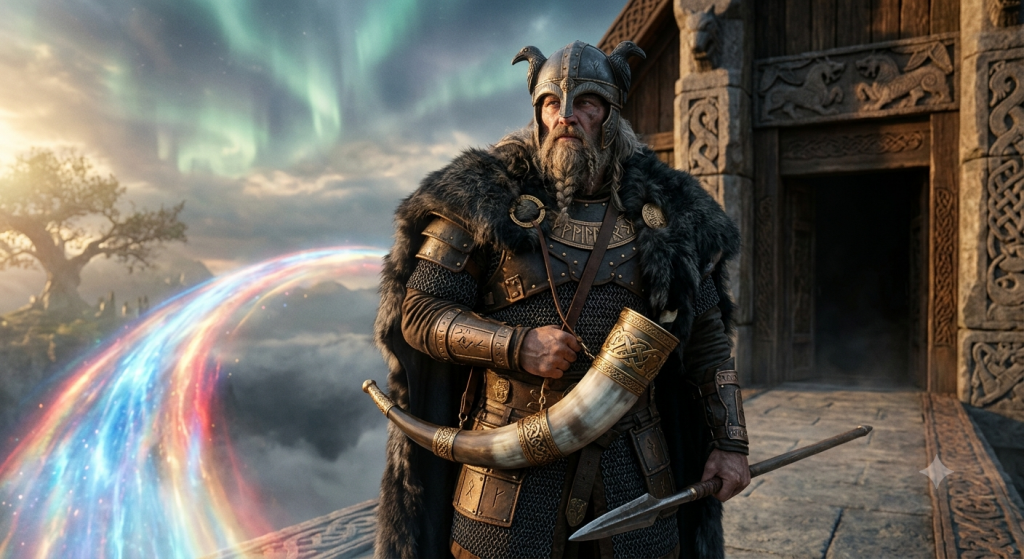
Heimdall in God of War Ragnarök is depicted as arrogant, prescient, and deeply hostile to Atreus, which maps reasonably well onto the tradition. The real Heimdall is the watchman of Asgard whose senses are so acute that he can hear wool growing on sheep and grass growing in meadows, and whose ancient enmity with Loki is one of the most structurally important relationships in Norse mythology. That Heimdall and Atreus, who is Loki, are enemies from the moment they meet is entirely consistent with the tradition.
Heimdall’s death in the game at Kratos’s hands is a departure from the tradition, where Heimdall and Loki kill each other at Ragnarök in a mutual killing that the tradition presents as the most symmetrical death of the final battle. The game gives Kratos the kill instead, which repositions Heimdall’s death as another consequence of Atreus’s choices rather than the direct resolution of the Loki-Heimdall enmity.
Fenrir and Jörmungandr: The Monsters as Written

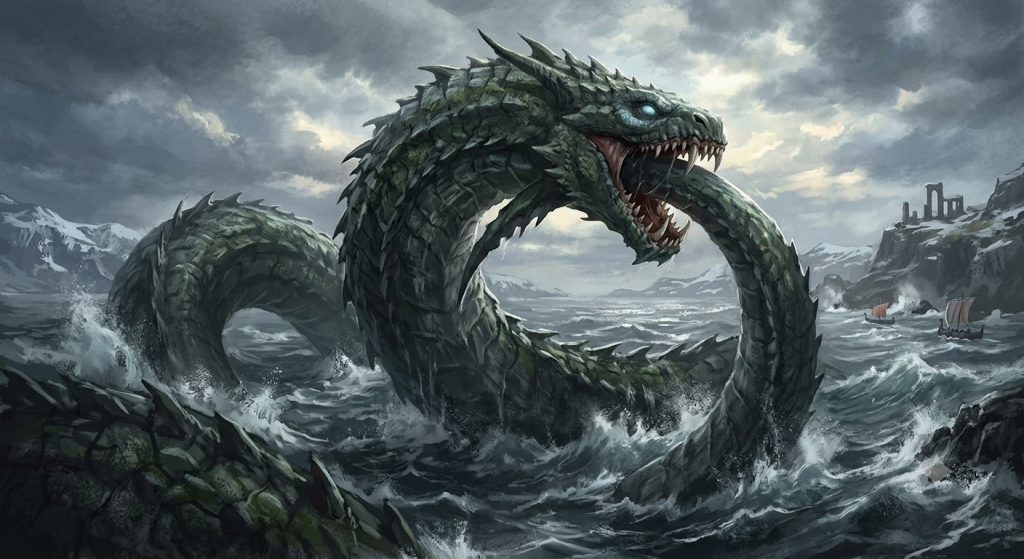
Both Fenrir and Jörmungandr appear in the games in ways that are broadly faithful to the tradition. Fenrir as the great wolf bound by the gods, whose eventual release signals the onset of Ragnarök, is handled correctly. Jörmungandr as the World Serpent who encircles Midgard, who is fated to fight Thor at Ragnarök, and whose presence in the game’s version of Midgard serves as an ally rather than an enemy, is one of the games’ most interesting mythology decisions.
The games add an explanation for why Jörmungandr is present in the timeline: he was sent backwards in time by the impact of Thor’s hammer at Ragnarök, arriving in the pre-Ragnarök period before the events of either game. This is entirely invented but it is a creative solution to the problem of including Jörmungandr as a character before Ragnarök, since in the tradition the serpent spends the pre-Ragnarök period at the bottom of the ocean holding his own tail.
The real Fenrir article on this site covers the binding and the river of Expectation. The Jörmungandr article covers the three encounters with Thor and why the serpent is more than simply a monster.
Sköll and Hati: A Detail Most Players Miss
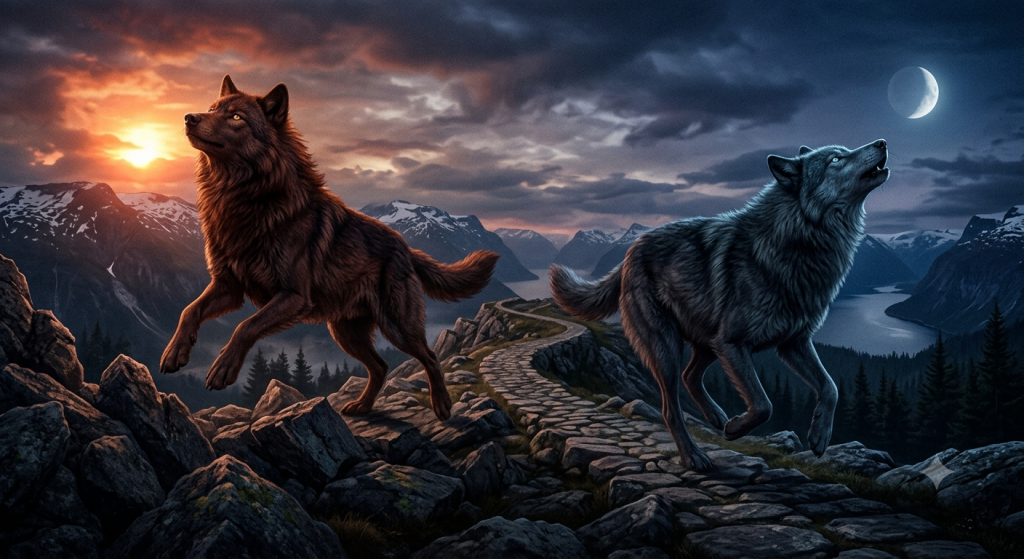
One of the most precisely accurate mythology details in God of War Ragnarök appears briefly enough that many players miss it. At one point in the game, two wolves can be seen in the sky, with one chasing the sun. These are Sköll and Hati, the wolves who in Norse mythology spend the entire pre-Ragnarök cosmos chasing the sun and moon respectively, finally catching them at the onset of Ragnarök.
The Grímnismál in the Poetic Edda names these wolves and describes their endless pursuit. Including them as a visual detail in the game is exactly the kind of mythology research that distinguishes the God of War games from less careful adaptations.
Read more about Sköll and Hati here.
What the Games Cannot Cover
The God of War games draw on Norse mythology with genuine intelligence and significant research, but two games covering the full arc from Fimbulwinter to Ragnarök cannot fully convey what makes the tradition remarkable. The philosophical depth of Odin’s knowledge of his own fate, the structural complexity of the Norns and what fate actually means in the Norse cosmos, the theological seriousness of the tradition’s understanding of death and the afterlife: all of these are present in the games in simplified form.
The articles linked throughout this piece cover each major figure and concept in the depth the games cannot provide. The Norse mythology section of this site covers every major god, creature, and event in the tradition. If the games sent you looking for what the Eddas actually say, start with Odin and follow the links from there. The tradition the games drew from rewards direct engagement in ways that any adaptation, however good, cannot fully replicate.
Further Reading
If this article sparked your interest, these are the books worth reading next.
Norse Mythology
by Neil Gaiman — the most accessible modern retelling of the Norse myths, written with genuine respect for the source material.
The Prose Edda (Penguin Classics)
by Snorri Sturluson — the thirteenth century Icelandic text that is the primary source for almost everything we know about Norse mythology.
The Viking Spirit
by Daniel McCoy — the best modern scholarly introduction to Norse mythology, written for general readers without being dumbed down.
For the full Norse mythology coverage on this site, the Norse Mythology category has every article in the cluster. Individual articles for Odin, Loki, Thor, Fenrir, Ragnarök, and every other major figure are all available from that page.
Never miss a myth
Thank you for being here. The site is brand new and every subscriber genuinely means something to me. If you're here, you care about this stuff as much as I do - and that's all the reason I need to keep going. New stories, videos and dark folklore from around the world, straight to your inbox. No algorithm. Just the stories, when they're ready.
