The witch is the defining visual symbol of Halloween. She appears on every seasonal decoration, every costume rack, every piece of Halloween imagery produced in the last hundred years: pointed hat, broomstick, black cat, green skin, hooked nose, cackling laugh. She is so thoroughly embedded in the visual language of the holiday that it is difficult to see her clearly anymore. She has become a costume rather than a figure, an aesthetic rather than a belief, a silhouette rather than a person.
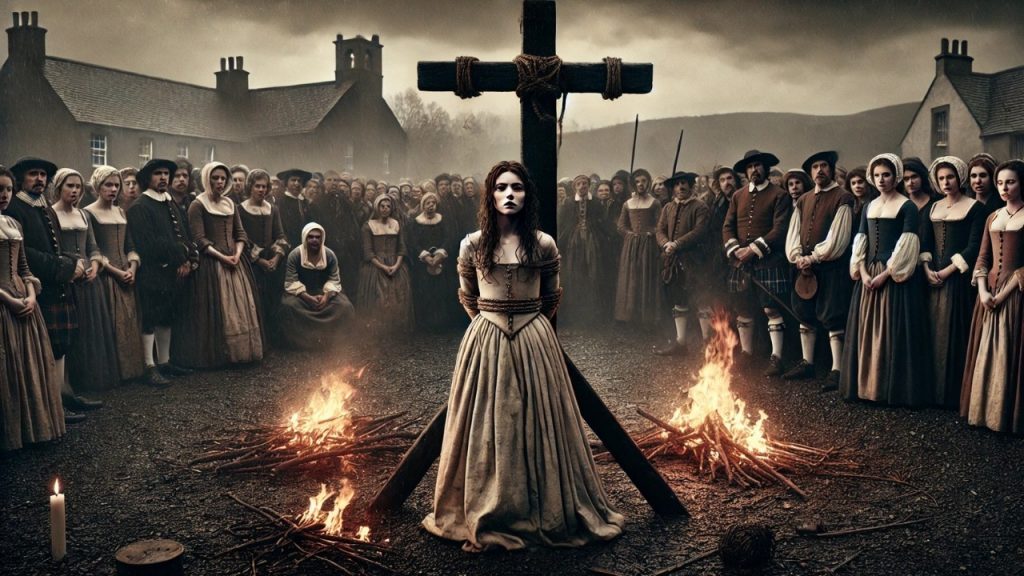
Behind the silhouette is one of the most disturbing histories in European culture. The witch was not a folk invention or a theatrical creation. She was the central figure of a legal and theological framework that killed somewhere between forty and sixty thousand people across Europe between roughly 1450 and 1750, the vast majority of them women, through a system of accusation, torture, confession, and execution that operated across Catholic and Protestant territories alike and reached its most intense expression in precisely the communities that might be expected to know better. Understanding why the witch became Halloween’s mascot requires understanding what the witch actually was, what the trials actually involved, and how the image that resulted from that history was gradually detached from its origins and transformed into something safe enough to put on a child’s costume.
What Witch Belief Actually Was
Witch belief in pre-modern Europe was not a fringe superstition maintained by the ignorant masses against the resistance of educated elites. It was a fully developed theological and legal framework that was constructed, refined, and implemented by the most educated people in Europe: university-trained theologians, trained lawyers, senior Church officials, and the judges of both ecclesiastical and secular courts. The witch was a specific theological category with a specific definition, specific attributes, and specific legal consequences, and the framework that defined her was the product of sustained intellectual effort over more than two centuries.
The definition that emerged from this effort, most completely expressed in the Malleus Maleficarum of 1486, was as follows: a witch was a person, typically though not exclusively female, who had entered into a formal pact with the devil. The pact involved the renunciation of Christianity and the submission of the witch’s soul to the devil in exchange for supernatural powers. These powers included the ability to cause harm through magical means, the ability to fly, the ability to transform into animal form, and the ability to participate in the sabbath, the nocturnal gathering of witches over which the devil presided. The harm a witch could cause included illness and death in humans and animals, destruction of crops, interference with reproduction, and the specific harm of demonic possession in victims who had not consented to the witch’s attack.
This framework was explicitly diabolical rather than simply magical. The distinction matters because it is the diabolical framework that makes the witch specifically a Christian heretic rather than simply a practitioner of folk magic. The cunning folk, the healers, the diviners, and the wise women who populated the practical magical landscape of pre-modern Europe were not generally understood as witches in the theological sense precisely because their magic was not understood as diabolically sourced. It was the specific combination of diabolical pact, sabbath attendance, and malicious intent that defined the witch and made her a target for the legal apparatus of the trials.
The Malleus Maleficarum
The Malleus Maleficarum, the Hammer of Witches, was published in 1486 by the Dominican inquisitor Heinrich Kramer, with the co-authorship of Jacob Sprenger disputed by historians. The text was accompanied by a Papal Bull from Pope Innocent VIII, the Summis desiderantes affectibus of 1484, which authorised Kramer’s inquisitorial activities in Germany and lent apparent Papal authority to the witch-hunting enterprise. The combination of Papal imprimatur and the recent invention of the printing press made the Malleus the most widely distributed witch-hunting manual in European history, going through at least twenty editions between 1486 and 1520 and remaining in print and in use for the following two centuries.
The Malleus is a document of considerable intellectual sophistication and considerable viciousness. It is organised as a scholastic argument, proceeding through the formal question-and-answer structure of medieval academic theology, and it addresses systematically the nature of witchcraft, the methods by which witches cause harm, the forms of harm they are capable of, the methods by which they should be identified and tried, and the appropriate punishments for the various degrees of witchcraft offence. Its treatment of women is consistently hostile: Kramer argues at length that women are more susceptible to the devil’s temptation than men, drawing on a complex of misogynistic theological arguments about female nature, female sexuality, and female weakness of will that had deep roots in the medieval theological tradition.
The text’s specific claim that women are particularly susceptible to witchcraft because of their inherently flawed nature, their stronger sexual appetites, and their weaker rational faculties provided the theological justification for the gender imbalance in the trials that followed. Across Europe as a whole, approximately three quarters of those executed for witchcraft were women, though the proportion varied significantly by region: in some areas it was much higher, in others, including Iceland and Russia, men were a majority of those accused.
The Sabbath and What Happened There
The sabbath — the nocturnal gathering of witches with the devil — is the element of the witch trial tradition most directly relevant to Halloween, because it is the source of the specific imagery that eventually became the Halloween witch: the night flight, the broomstick, the gathering in a remote location, the devil presiding over the assembly.
The sabbath as described in witch trial testimony across Europe had consistent features that appeared in confessions extracted from defendants who had no obvious means of communication with each other: the witches gathered at night in a remote location, often a crossroads or a hilltop; they flew to the gathering on broomsticks, pitchforks, or other implements after anointing themselves with a flying ointment; the devil presided over the assembly, sometimes in human form, sometimes as a black animal; the witches danced, feasted on food that tasted of nothing, and engaged in sexual intercourse with the devil or with each other; they made reports of the harm they had done during the previous period and received assignments of harm to do in the coming period; and they trampled on the cross and renounced their baptism as ritual acts of apostasy.
The consistency of this testimony across independent trials has been explained in several ways. The most cynical and probably most accurate explanation is that the torture used to extract confessions was sufficiently standardised, and the questions asked by inquisitors were sufficiently leading, that defendants in different locations confessing to different crimes naturally produced similar descriptions of similar events. When the torturer asks whether you flew to the sabbath on a broomstick, the answer yes produces relief from the torture and the answer no prolongs it, and the result is a consistent testimony that reflects the questioner’s assumptions rather than the defendant’s experience.
A more nuanced explanation, developed by historians including Carlo Ginzburg in his study of the Benandanti, suggests that the sabbath testimony drew on genuine folk belief about nocturnal spirit journeys and the out-of-body experiences associated with certain states of consciousness, which the inquisitorial process then reinterpreted through the diabolical framework of witch belief. The folk tradition of the night journey, in which the spirit leaves the body during sleep and travels through the supernatural landscape, was recast as a flight to a diabolical gathering, with the inquisitors supplying the diabolical content that the original folk tradition did not contain.
The Flying Ointment
The flying ointment with which witches were said to anoint themselves before their sabbath flights is one of the most discussed elements of the trial testimony and one of the most genuinely interesting from a pharmacological perspective. The ingredients described in various accounts include belladonna, henbane, mandrake, and aconite, all of which are plants containing alkaloids with genuine psychoactive properties. Applied topically to the skin, particularly to the mucous membranes through which alkaloids are absorbed most efficiently, these substances can produce hallucinations, sensations of flying, and dissociative states in which the boundary between ordinary experience and supernatural experience becomes genuinely difficult to maintain.
The pharmacological explanation for the sabbath suggests that some of the witches who confessed to flying may have been describing genuine hallucinatory experiences produced by the topical application of psychoactive plants, and that the broomstick or staff used as the application implement, being inserted into the body in the area most efficient for alkaloid absorption, may have been a genuine element of the practice rather than simply a symbolic detail. This reading was proposed by the anthropologist Michael Harner and the historian of science Harner in the 1970s and has been widely discussed though not universally accepted. Its main weakness is that it does not explain the consistency of sabbath testimony in cases where the defendants were clearly not using any such substances.
The Geography and Chronology of the Trials
The witch trials were not evenly distributed across Europe either geographically or chronologically, and understanding the pattern of their distribution illuminates something important about the conditions that produced them. The peak period of trial activity was roughly 1560 to 1630, with significant concentrations in southwestern Germany, Switzerland, Scotland, and parts of France. The regions of highest trial intensity were not the most remote or backward parts of Europe but precisely the areas that were most directly engaged with the religious conflicts of the Reformation period.
The correlation between the Reformation and the intensification of witch-hunting is not coincidental. The disruption of the established religious order created a crisis of spiritual authority in which the boundaries between the sacred and the diabolical became simultaneously more important and more contested. Both Catholic and Protestant authorities were intensely invested in demonstrating that they could identify and suppress diabolical activity within their territories, and the witch provided the most convenient available demonstration of diabolical threat. The result was that witch-hunting intensified precisely in the regions where the competition between Catholic and Protestant authorities was most acute, as each side attempted to demonstrate its superior capacity to protect the faithful from supernatural evil.
Scotland is a particularly significant case for the Halloween connection because Scottish witch belief and Scottish Halloween tradition are so closely intertwined. The North Berwick witch trials of 1590 to 1591, in which a group of Scottish witches were accused of attempting to kill King James VI through magical means, were among the most politically significant in British history, involved James’s personal participation in the interrogation of defendants, and directly influenced the writing of his treatise Daemonologie published in 1597. James’s Daemonologie, which he brought with him to England when he became James I in 1603, shaped English witch-hunting policy and influenced Shakespeare’s Macbeth, whose three witches are directly indebted to the North Berwick tradition.
The Broomstick
The broomstick as the witch’s flying vehicle is so thoroughly embedded in the Halloween image that it seems self-evidently ancient. Its actual history is more complicated. Images of witches riding on staves, broomsticks, or pitchforks appear in European art from the fifteenth century onward, and the specific association with the broomstick appears to have solidified in the early modern period through the combination of trial testimony and visual art that mutually reinforced each other.
The broomstick’s specific significance may relate to its domestic character. The broom was the quintessential female domestic implement, and its appropriation as a vehicle for the night flight was a inversion of domestic order: the witch who should be at home managing the household was instead flying abroad at night on her own broom, the symbol of her domestic role transformed into the instrument of her transgression. This reading connects the broomstick to the broader structure of witch belief as the inversion of proper female behaviour: the good woman stayed home, spun her flax, tended her children, and honoured her husband; the witch flew at night, attended the sabbath, harmed her neighbours, and submitted herself to the devil.
The association between the broomstick and the Halloween witch was reinforced through nineteenth and twentieth century visual culture — greeting cards, illustrations, and eventually film — in ways that gradually detached the broomstick from its trial-testimony origins and made it simply a convention of Halloween imagery. By the time the broomstick appeared in films like The Wizard of Oz and later in the Harry Potter series, it had long since lost its connection to the specific theological and legal framework that originally produced it.
The Pointed Hat
The pointed hat is the element of Halloween witch iconography whose historical origins are most genuinely obscure. Unlike the broomstick, which has clear documentation in trial testimony and early modern art, the pointed hat as a witch signifier does not appear consistently in the earliest witch imagery. Early modern depictions of witches typically show them as ordinary women, often elderly, sometimes naked, sometimes in the clothing of their social class, but not characteristically wearing a pointed hat.
The pointed hat’s association with witchcraft appears to have developed gradually through the early modern period through a combination of influences that have not been definitively disentangled. Pointed hats were associated with Jews in medieval Christian iconography, where they appeared as a marker of religious otherness. They were worn by certain professional categories in early modern Europe, including some forms of academic and professional dress. They appeared in illustrations of fairy tale figures including wizards and wise women. And they were used in some jurisdictions as a ritual humiliation during the punishment of convicted witches, placed on the condemned person’s head as a mark of shame during the procession to execution.
None of these specific origins fully explains the pointed hat’s dominance in the Halloween witch image, and the most honest answer is that the hat became conventional through the accumulation of visual representations rather than through any single originating moment. Once it appeared in enough illustrations, it was reproduced in more illustrations, and eventually it became the defining visual marker of the Halloween witch regardless of its historical relationship to actual witch belief.
The Green Skin
The green-skinned witch of Halloween popular culture has the clearest and most recent origin of any element of the Halloween witch image. It was created by the makeup department of the 1939 MGM film The Wizard of Oz for the character of the Wicked Witch of the West, played by Margaret Hamilton. The green skin was chosen partly to distinguish the character visually from the other players in the new Technicolor format, partly to signal her supernatural otherness through colour, and partly simply because it looked striking on the new colour film stock.
There is no precedent for green skin in the historical witch tradition. Witches in trial testimony and early modern visual art are not described as green. The colour associations with witchcraft in the historical tradition run toward black, red, and sometimes yellow, not green. The Wicked Witch’s green skin is a purely cinematic invention of 1939 that has become so thoroughly embedded in the Halloween witch image through decades of repetition and cultural transmission that most people assume it must be ancient.
The film’s influence on Halloween imagery more broadly cannot be overstated. The Wicked Witch of the West established the visual template for the Halloween witch that all subsequent popular culture representations have drawn on, and the green skin is only the most obvious element. The cackling laugh, the flying broomstick prominently featured, the black pointed hat, and the association with the black cat all received their definitive Halloween form in the 1939 film before being disseminated through decades of Halloween merchandise, decoration, and costume.
Why the Witch Became Halloween’s Symbol
The witch’s specific association with Halloween rather than with other occasions of supernatural danger is not simply a matter of timing or coincidence. It reflects a genuine historical connection between the witch and the seasonal moment that Halloween marks.
Witch belief in the folk tradition was specifically associated with the threshold times of the year, the moments when the boundary between the ordinary world and the supernatural world was understood to be at its thinnest. Samhain was precisely such a moment, and the folk belief that witches were particularly active at Samhain — gathering at crossroads, flying through the night sky, performing their ceremonies at the year’s turning — made the witch a natural figure for the Halloween season.
The sabbath tradition, with its nocturnal gathering at a remote location, its flight through the night sky, and its association with the devil, mapped naturally onto the Samhain tradition of supernatural beings moving through the landscape at the year’s turning. The witch who flew to her sabbath was in many respects the Christianised version of the supernatural being who moved freely through the human world at Samhain: both were creatures of the night, both operated during the period when ordinary rules did not apply, and both represented the inversion of the normal order that the threshold season permitted.
By the time Halloween became a commercial holiday in nineteenth century America, the witch was already firmly established as a seasonal figure, and the commercial imagery that developed around the holiday simply confirmed and amplified an association that already existed in the folk tradition. The green skin and the Wicked Witch came later, adding a specifically cinematic layer to a figure whose connection to Halloween had much older roots.
Further Reading
If this article sparked your interest, these are the books worth reading next.
Halloween: From Pagan Ritual to Party Night
by Nicholas Rogers — the best single-volume history of Halloween, tracing it from its Celtic and medieval roots through to its commercialisation as a global holiday. Properly researched and clearly written.
Trick or Treat: A History of Halloween
by Lisa Morton — a thorough and highly readable history of Halloween’s customs and traditions, from souling and guising to the modern American commercial holiday.
The Halloween Encyclopedia
by Lisa Morton — the most comprehensive reference on Halloween in print, covering every aspect of the holiday’s history, folklore, customs, and cultural expressions in detail.
For more on the Halloween tradition, the Origins of Samhain article covers the Celtic festival at the root of Halloween and the supernatural dangers that were understood to operate at the year’s turning. The Wild Hunt at Halloween article covers the other great supernatural tradition of the Halloween season. The Black Cats in Folklore article covers the real history of the witch’s most famous companion. The Halloween hub page has every article in the cluster.
Never miss a myth
Thank you for being here. The site is brand new and every subscriber genuinely means something to me. If you're here, you care about this stuff as much as I do - and that's all the reason I need to keep going. New stories, videos and dark folklore from around the world, straight to your inbox. No algorithm. Just the stories, when they're ready.