Samhain is the oldest ancestor of Halloween, and almost everything that most people believe about it is either oversimplified, invented, or wrong in ways that matter. The festival was not a celebration of a god called Samhain — no such god exists anywhere in the Celtic tradition. It was not primarily a festival of death, though death was present in it. It was not suppressed by the Church so much as absorbed by it, and the absorption was more complicated and more interesting than the standard narrative of Christian oppression replacing ancient wisdom suggests.
What Samhain actually was is considerably richer and stranger than any of these simplified versions. It was one of the four great hinge points of the Celtic year, the moment when the pastoral and agricultural cycles turned from one phase to another, when the boundary between the living world and the otherworld became dangerously thin, when fires were extinguished and relit from a sacred central flame, when the dead returned and the supernatural moved through the landscape with unusual freedom. Understanding it properly means going back to the actual sources, reading what they say rather than what the internet has decided they say, and sitting with the genuine complexity of a tradition that survived in fragments rather than as a coherent whole.
What Samhain Meant and When It Fell
The word Samhain comes from Old Irish and means roughly summer’s end. It is pronounced sow-in in Irish Gaelic, closer to sah-vin in Scottish Gaelic, and it referred both to the festival and to the month of November in the old Irish calendar. The festival fell at the midpoint between the autumn equinox and the winter solstice, placing it at approximately what we now call the 1st of November, though in a lunar calendar the precise date shifted from year to year.
The Celtic year was divided into two halves. The light half, running from Beltane in May through the summer, was the season of growth, grazing, and campaigning. The dark half, beginning at Samhain, was the season of withdrawal, shelter, and the activities that belong to the interior: storytelling, craft work, the processing of the summer’s harvest, and the management of relationships both human and supernatural. Samhain was the door between the two halves, the moment of transition that was neither one season nor the other and therefore belonged to neither the ordinary world nor its rules.
Its counterpart festivals were Imbolc in February, which marked the beginning of spring and was associated with the goddess Brigid; Beltane in May, which marked the beginning of summer with fire ceremonies and the driving of cattle between two fires for purification; and Lughnasadh in August, the harvest festival associated with the god Lugh. Together the four festivals structured the Celtic year around the pastoral cycle of animal husbandry rather than around the astronomical events of solstice and equinox that structured the Roman calendar. This is important because it explains why the festivals do not fall on the astronomically significant dates: they mark the lived reality of agricultural life rather than the movements of celestial bodies.
The Primary Sources and What They Actually Say
The primary sources for Samhain are medieval Irish texts, written down by Christian monks between roughly the seventh and twelfth centuries. This creates an immediate problem of interpretation: the people recording the tradition were members of a religion that had officially replaced the tradition they were recording, and they were writing centuries after the events and practices they described. What we have is not direct documentation of the pre-Christian festival but the Christian period’s understanding of it, filtered through monastic learning and hagiographic purpose.
The most important sources are the mythological and Ulster cycle texts, including the Book of the Dun Cow compiled around 1100, the Book of Leinster from around 1160, and various later manuscripts. These texts describe Samhain as a time of supernatural permeability and of specific mythological events. The Togail Bruidne Dá Derga, the Destruction of Da Derga’s Hostel, takes place over Samhain and describes the High King Conaire Mór violating a series of sacred prohibitions that leads to his death. The story of how the hero Fionn Mac Cumhaill first proves his worth involves defending Tara against the supernatural fire-breather Aillen, who comes every Samhain to burn the hall after putting everyone to sleep with his music. The first battle of Mag Tuired, one of the foundational myths of Irish tradition, is set at Samhain.
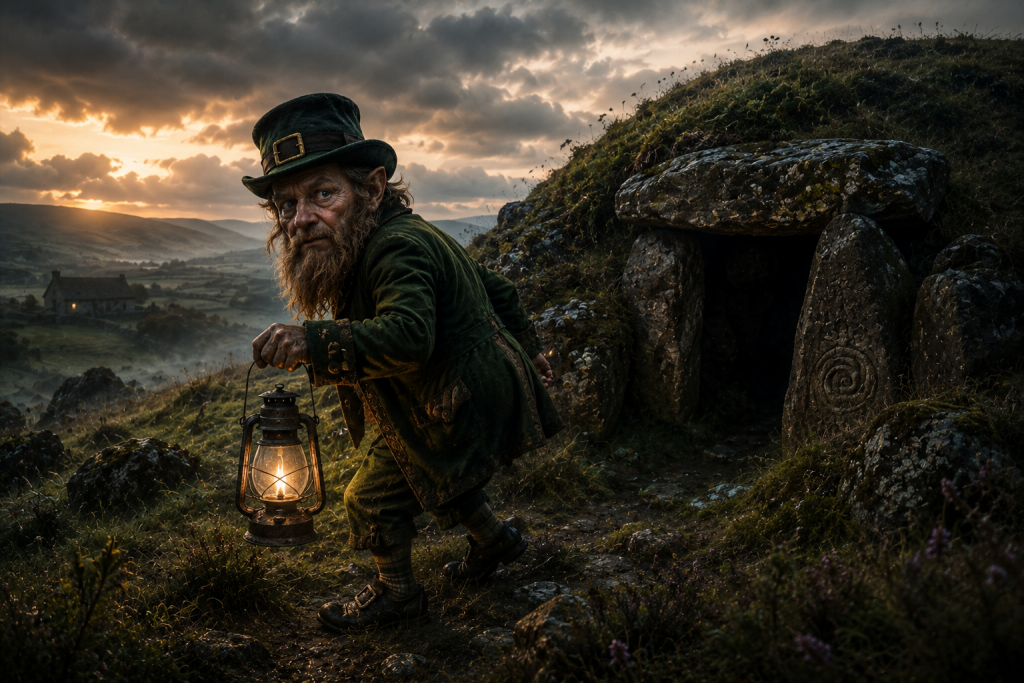
What unites these narratives is the understanding that Samhain was when the síde, the fairy mounds, stood open and the beings who inhabited them moved freely through the human world. The síde, also called the sídhe, were understood as both burial mounds — many of them were genuinely Neolithic passage tombs — and as entrances to the otherworld, the realm of the Tuatha Dé Danann and the dead. At Samhain the distinction between the two worlds dissolved temporarily, allowing passage in both directions. The dead could return. The supernatural could enter the human world. And humans who wandered too close to the mounds risked being taken.
The annals and chronicles add a different dimension. The Annals of the Four Masters and other historical texts describe Samhain as the occasion for the great assembly at Tara, the seat of the High King of Ireland. This assembly, the Feis Temro or Feast of Tara, was a political and legal event as much as a religious one: tribute was paid, laws were settled, disputes were resolved, and the political relationships that held the kingdom together were renewed and confirmed. The feast lasted three days before Samhain and three days after it, making the festival the centre of a week-long event of communal significance.
The Bonfire Tradition and the Sacred Flame
The bonfire is the most extensively documented practical element of Samhain celebration, and its significance goes considerably beyond simple festivity. The evidence comes from multiple independent sources across Ireland and Britain, and it describes a practice of coordinated fire-making that had genuine ritual and communal dimensions.
The key text here is the Dindshenchas, the medieval Irish lore of place-names, which describes the hill of Tlachtga in County Meath as the location where the central Samhain fire was kindled. Tlachtga was the daughter of the druid Mog Ruith, and the hill associated with her was understood as the origin point of the Samhain fire from which all of Ireland’s other Samhain fires were lit. The Primary History of Ireland, a section of the Book of Invasions, describes the High King’s fire at Tara being kindled only after the sacred fire at Tlachtga had been lit, and all the fires of Ireland following from that.
The ritual sequence as described in the sources involved the extinguishing of all domestic hearth fires before Samhain, followed by the lighting of the great bonfire at the sacred site, followed by the relighting of domestic fires from that central flame. This sequence is significant because it makes the domestic fire a participant in the sacred event: every home’s hearth fire at Samhain was a fragment of the sacred flame rather than simply a practical necessity, and the household that maintained that fire through the winter was maintaining a connection to the sacred centre of the community’s ritual life.
The bones of slaughtered animals were thrown into the bonfire — the word bonfire may itself derive from bone-fire — which was both practically sensible, since the bones could not be eaten, and ritually meaningful, since the destruction of the bones in fire was understood as a form of offering or transformation. Cattle that could not be kept through the winter were slaughtered at Samhain, their meat preserved for the cold months and their bones consigned to the fire. The festival was therefore directly associated with the smell of burning bone and roasting meat in a way that connected the practical reality of seasonal animal management with the supernatural character of the occasion.
People and livestock passed between two fires or through their smoke as a purificatory measure, the heat and smoke understood as cleansing agents against the supernatural dangers of the liminal period. This practice is documented across multiple independent accounts and appears in various forms in the folklore collected in the eighteenth and nineteenth centuries, suggesting genuine continuity from the medieval period.
The Supernatural Dangers of Samhain
The opening of the síde at Samhain was understood not as an invitation but as a hazard. The beings who emerged from the mounds were not generally benevolent, and the appropriate human response to their presence was caution, protective ritual, and where possible avoidance. The tradition of disguise that eventually became the Halloween costume tradition began, most scholars believe, as a practical response to this hazard: if supernatural beings were moving through the landscape, wearing a disguise made it more difficult for them to single out specific humans for attention.
The practice of going house to house that eventually became trick or treat has been connected by some scholars to the tradition of the dead returning at Samhain. Food left at the threshold or offered to those who came to the door on Samhain night might have been understood as offerings to the returning dead rather than simply as hospitality to human visitors. The medieval Christian practice of souling, in which poor people went door to door on All Souls’ Day offering prayers for the household’s dead in exchange for soul cakes, preserves this structure: going from house to house at the Halloween season, receiving food in exchange for a spiritual service.
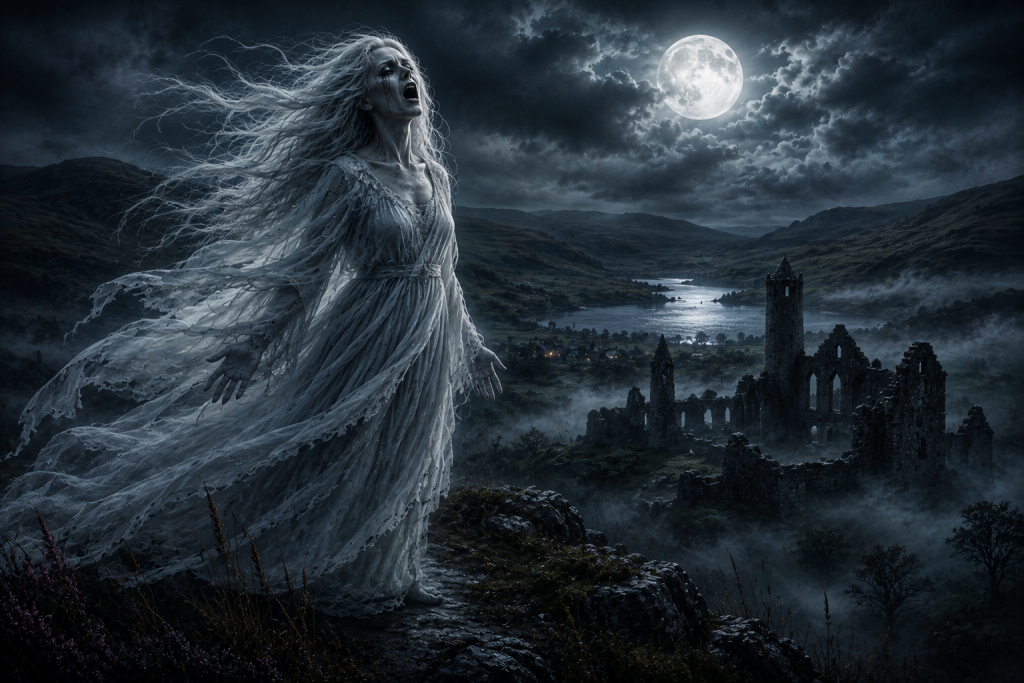
The Sluagh, the host of the unforgiven dead, was particularly active at Samhain in Irish and Scottish tradition. These were the souls of those who had died badly — violently, in sin, without the proper rites — and who were denied access to both heaven and the otherworld, condemned instead to roam the earth in a mass of tormented spirits that moved on the wind. They entered houses through the western window and were understood as capable of taking the dying before death had fully claimed them. The appropriate response to hearing them pass was to close the windows and stay indoors.
The fairy abduction tradition was at its most active at Samhain. The síde required human servants, human foster-children, and human musicians, and Samhain was the night when they were most likely to take them. Young people, nursing mothers, and skilled craftsmen were considered particularly at risk, and the protective measures used against fairy abduction — iron at the threshold, specific verbal formulas, the wearing of protective plants — were observed with special care at Samhain.
What the Church Did With Samhain
The relationship between Samhain and the Christian calendar is more complex than the simple narrative of suppression and replacement suggests. Pope Gregory IV moved the feast of All Saints to the 1st of November in 835 CE, placing it directly on the Samhain date, and Pope Gregory III had already established a chapel to All Saints in Saint Peter’s Basilica with its feast on the 1st of November in the 730s. All Souls’ Day followed on the 2nd of November, extending the commemoration of the dead into a two-day festival that occupied the same temporal space as Samhain’s central concern.
Whether the placement of All Saints on the 1st of November was a deliberate strategy to Christianise the existing festival is genuinely debated by historians. The counterargument is that All Saints Day had been celebrated on various dates across the Christian world before Gregory IV standardised it, and the choice of November may have been driven by factors internal to the Christian calendar rather than by a strategic decision to displace Samhain. The evidence does not conclusively settle the question either way.
What is clear is that the pre-Christian associations of the date persisted in folk tradition long after the official religious framework had changed. The thinning of the boundary between the living and the dead, the return of the ancestral dead, the protective fires, and the specific folk customs that surrounded the season all maintained continuity across the Christianisation in ways that made the Church’s occupation of the date incomplete. Samhain was not replaced by All Saints and All Souls. It was overlaid by them, and the pre-Christian content continued to operate beneath the Christian surface.
This is why the Eve of All Hallows — Hallowe’en — accumulated so much more supernatural content than All Saints Day itself. The eve inherited Samhain’s character while the feast day inherited its date. The night before All Saints was the dangerous night, the threshold night, the night when the dead returned and the supernatural was active, because it was the night that had always been those things.
The Invented God of the Dead
One of the most persistent falsehoods about Samhain is the claim that it was a festival honouring a Celtic god of the dead named Samhain. This claim appears regularly in popular accounts, in Halloween merchandise descriptions, and occasionally in sources that should know better. It is entirely without foundation in the historical or literary record.
There is no Celtic god named Samhain. The name refers to the festival and the month, not to a deity. The error appears to derive from an eighteenth century misreading of medieval Irish sources by the antiquarian Charles Vallancey, who in 1770 proposed that Samhain was a festival of the god of the dead called Sam-hiain. Vallancey was not a reliable scholar, and his interpretation was rejected by subsequent Celtic scholarship, but the invented god persisted in popular writing about Halloween and has been perpetuated to the present day through repetition rather than evidence.
The Celtic tradition does include figures associated with death and the otherworld — the Dagda governs life and death, the Morrigan is associated with death in battle, Donn is a figure associated with the dead in Irish tradition — but none of these is specifically a god named Samhain, and none of them has the specific character of a lord of the dead that the popular claim implies.
Samhain in Scotland and Wales
The Samhain tradition was not confined to Ireland but existed across the Celtic world in regional variants that share the core structure while differing in specific detail. In Scotland the festival was called Samhuinn in Gaelic and Hallowe’en in the Scots vernacular, and the folk traditions associated with it were extensively documented by collectors in the eighteenth and nineteenth centuries, particularly by Robert Burns, whose 1785 poem Halloween is one of the most important records of the Scottish Samhain tradition.
Burns’s poem describes the divination practices that were central to the Scottish Halloween: young people attempting to discover the identity of their future spouses through various ritual methods including pulling kale stalks, eating apples before a mirror at midnight, and throwing nuts into the fire to see whether they burned together or apart. These divination practices were understood as particularly powerful at Halloween because the thinning of the boundary between the worlds made supernatural knowledge more accessible than usual.
The Welsh tradition called the festival Calan Gaeaf, the first day of winter, and the night before it was Nos Galan Gaeaf, a night of supernatural danger. The Hwch Ddu Gwta, the tailless black sow, was a specifically Welsh Halloween creature who pursued people through the darkness, and the tradition of the last person to leave a communal bonfire being at risk of capture by supernatural forces was documented across Welsh-speaking communities into the nineteenth century.
From Samhain to Halloween: The American Transformation
The Halloween that most of the world now celebrates is an American creation built on Irish and Scottish immigrant traditions that arrived in North America in the nineteenth century, particularly during and after the Great Famine of 1845 to 1852 which drove approximately one million Irish people to emigrate. These immigrants brought their Halloween traditions with them: the lighting of fires, the practice of guising or dressing in costume to go from house to house, the carving of turnips into lanterns, the divination games, and the general understanding of the night as one of supernatural danger and excitement.
In America these traditions encountered each other and merged, were adopted by non-Irish communities attracted to the communal aspects of the celebration, and were gradually commercialised through the greeting card industry, the confectionery industry, and eventually the entertainment industry in ways that stripped out the supernatural content and replaced it with theatrical performance. The carved pumpkin replaced the carved turnip because pumpkins were easier to carve and native to America. The costume became an entertainment rather than a protective disguise. The divination games disappeared. The supernatural danger became theatrical horror.
What remained was the seasonal timing, the communal character, the association with the dead and with the supernatural, and the specific date of October 31st. The American Halloween exported back to Britain and Ireland through the twentieth century and globally through the twenty-first, arriving in cultures that had their own traditions of marking the thinning of the boundary at the year’s turning. In most cases it arrived as entertainment rather than as folk belief, which is the form in which it has spread most successfully.
Further Reading
If this article sparked your interest, these are the books worth reading next.
Halloween: From Pagan Ritual to Party Night
by Nicholas Rogers — the best single-volume history of Halloween, tracing it from its Celtic and medieval roots through to its commercialisation as a global holiday. Properly researched and clearly written.
Trick or Treat: A History of Halloween
by Lisa Morton — a thorough and highly readable history of Halloween’s customs and traditions, from souling and guising to the modern American commercial holiday.
The Halloween Encyclopedia
by Lisa Morton — the most comprehensive reference on Halloween in print, covering every aspect of the holiday’s history, folklore, customs, and cultural expressions in detail.
For more on the Halloween tradition, the Jack o’Lantern article covers the Irish folk legend of Stingy Jack and the turnip that became a pumpkin. The History of Trick or Treat article covers the medieval practice of souling and how it became the modern custom. The Wild Hunt at Halloween article covers the supernatural host that was most active at Samhain. The Halloween hub page has every article in the cluster.
Never miss a myth
Thank you for being here. The site is brand new and every subscriber genuinely means something to me. If you're here, you care about this stuff as much as I do - and that's all the reason I need to keep going. New stories, videos and dark folklore from around the world, straight to your inbox. No algorithm. Just the stories, when they're ready.