The Jack o’Lantern is one of the most recognisable symbols in the world for approximately six weeks every autumn, a grinning carved pumpkin with a candle inside it that appears on doorsteps, in shop windows, and across every piece of Halloween seasonal imagery from late September through the 31st of October. Its origin is an Irish folk legend about a man of such spectacular moral failure that he was refused entry to both heaven and hell when he died, condemned to wander the darkness of limbo forever with no light source except a lump of coal carried in a carved-out turnip. The pumpkin came later, when Irish emigrants arrived in America and discovered that the native crop was considerably easier to carve than the root vegetables they had brought their tradition with them to carve. The grinning face came with them too, though its meaning had shifted by then from something genuinely protective to something primarily decorative.
To understand the Jack o’Lantern properly you need to understand three things that are almost always treated separately: the Irish folk legend of Stingy Jack, which is the tradition’s narrative core; the practice of carving turnip lanterns at Halloween, which is the tradition’s practical expression; and the function those lanterns were understood to serve, which is considerably more interesting than simple decoration. The pumpkin is the end of the story. The beginning is considerably darker.
Who Stingy Jack Was
The folk legend of Stingy Jack exists in multiple versions across Ireland, each with variations in the specific details of the tricks Jack plays and the specific character of his eventual punishment, but the narrative core is consistent across all of them in ways that suggest a genuine folk tradition rather than a literary invention. Jack was a man — a blacksmith in some versions, a farmer in others, occasionally simply an unnamed man of the roads — distinguished by two qualities that the tradition consistently emphasises: his extraordinary miserliness and his equally extraordinary cunning. He was, by all accounts, an unpleasant person in the specifically Irish sense of someone who used intelligence primarily in service of avoiding any obligation to others.
The legend’s plot turns on two encounters between Jack and the devil, and the specific structure of these encounters tells you something important about the kind of story this is. This is not a story about a hero who outwits evil. It is a story about a man of no particular moral standing who outwits the devil through sheer low cunning, and who discovers that having outwitted the devil does not, in fact, constitute a moral achievement sufficient to get you into heaven. Jack is not a hero. He is barely a protagonist. He is a cautionary figure whose cautionary lesson is considerably subtler than the obvious one.
The First Trick
The first encounter between Jack and the devil varies in its specific mechanism across regional versions of the legend, but the most widely told version involves Jack drinking in a pub — an activity he engages in regularly despite his miserliness, which is itself a character detail worth noting — when the devil appears to collect his soul. Jack, rather than submitting to the inevitable, invites the devil to have a drink first. The devil accepts. When the bill arrives, Jack suggests that the devil transform himself into a coin to pay for the drinks, since this would be more convenient than the devil having to go through his pockets. The devil, apparently not paying close attention to the implications, transforms himself into a sixpence.
Jack puts the coin in his wallet, where he also happens to keep a silver crucifix. The devil, now in the form of a coin trapped next to a crucifix, cannot transform back. He is stuck. Jack has the devil at his mercy, which is a position that no previous human being has managed to achieve through such a casual and premeditated piece of trickery. He offers to release the devil on one condition: the devil must promise not to claim Jack’s soul for ten years. The devil agrees. Jack releases him. The devil departs, presumably reflecting that he has been outsmarted by a drunk Irishman using basic sleight of hand.
In an alternative version of the first trick, Jack persuades the devil to climb an apple tree to pick fruit, and while the devil is in the tree Jack carves crosses into the bark of the trunk at the base, trapping the devil in the tree because the devil cannot cross over the sign of the cross. The specific mechanism varies. The structure is identical: Jack uses the devil’s willingness to oblige a simple request against him, and extracts a binding supernatural promise as the price of release. The devil, for all his supernatural power, is consistently depicted as less quick-witted than a morally indifferent Irishman in need of a drink or a piece of fruit.
The Second Trick and Its Consequences
Ten years pass. Jack has not improved during them. He has continued to be miserly, dishonest, and generally unedifying as a human being, because the nature of his first trick was that it bought him time rather than salvation, and time spent not improving is simply time spent not improving. The devil returns at the end of the ten years to collect what was promised.
Jack is not ready to go quietly. He engages the devil in conversation and eventually persuades him that before they depart for hell Jack should be allowed to eat one last apple from a nearby apple tree. He asks the devil to climb up and get him one, which the devil — apparently not having learned anything from their previous encounter — does. Jack immediately carves crosses into the bark of the trunk and traps him again.
In another version, Jack asks the devil to transform himself into a coin one more time to pay for one last drink, and the devil — this is the version in which you begin to feel a degree of sympathy for the devil — does so, and is trapped again in the wallet with the crucifix. The mechanism is identical to the first trick, and the devil falls for it again, which is either a commentary on the nature of supernatural beings or a concession to the requirements of folk narrative structure.
From this second position of captivity, Jack extracts a second and final promise: the devil will never take his soul, under any circumstances, for as long as Jack lives. The devil, trapped and apparently without better options, agrees. Jack releases him. The devil departs. Jack has, by this point, secured what appears to be an extraordinarily advantageous supernatural arrangement: he cannot go to hell because the devil has sworn never to take him, and this promise, made under supernatural duress, is binding in ways that ordinary promises are not.
What Jack has not thought through — or what he has thought through and simply not cared about, which is consistent with his character — is that the promise not to take his soul does not say anything about heaven. The decision about heaven is not the devil’s to make.
The Refusal of Heaven and the Refusal of Hell
When Jack eventually dies — of causes the tradition does not specify, though the assumption is that a lifetime of drinking and miserliness eventually catches up with even the most supernaturally protected individuals — he presents himself at the gates of heaven and is refused. The grounds for refusal are not complicated. Jack has lived a life of miserliness, dishonesty, drunkenness, and general disregard for everyone around him. He has not repented of any of it. He has not made amends for any of it. He has, in fact, used the supernatural protection he extracted through trickery to extend his life without using that extended life for anything that might be considered morally improving. Heaven does not want him. The gates remain closed.
Jack proceeds to hell, which he presumably expects will be obliged to take him given that he has to go somewhere. He is wrong. The devil, who has spent the intervening decades nursing what must be a considerable grievance about the apple tree and the coin, is waiting for him. The devil reminds Jack of the binding promise: he will never take Jack’s soul. He cannot take him into hell. He will not. He is, by this point, not inclined to do Jack any favours, and the specific satisfaction he takes in refusing Jack is one of the more genuinely comic moments in Irish folk tradition.
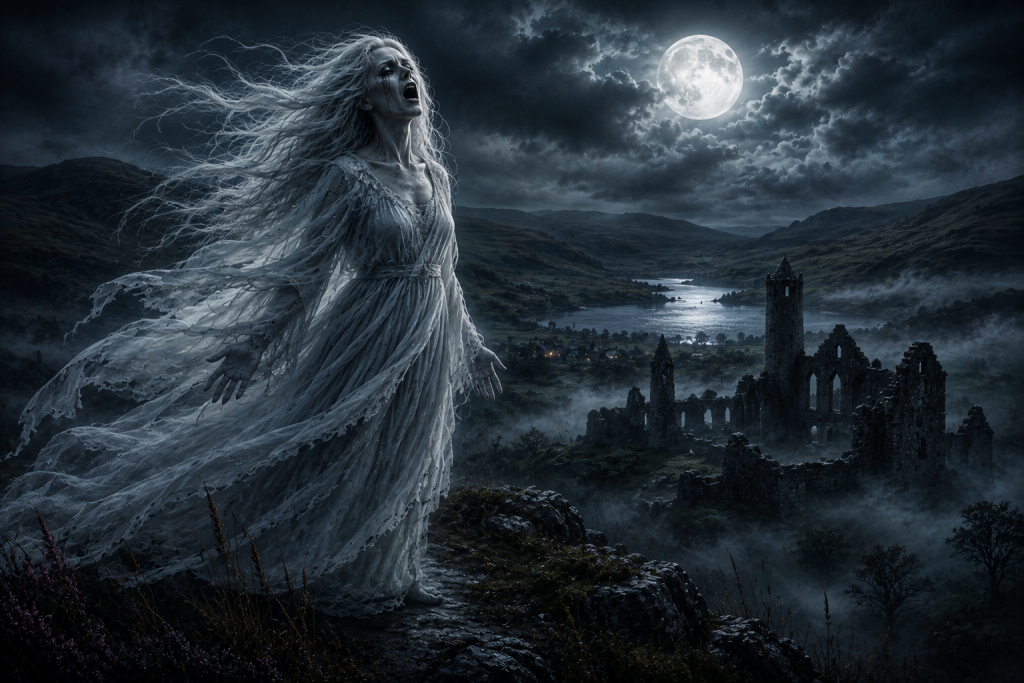
Jack is now in a position that the tradition presents with considerable precision: he is dead, refused by heaven, refused by hell, and has nowhere to go. The limbo he is consigned to is not simply metaphorical. It is a specific condition of supernatural displacement, neither living nor dead in any useful sense, present in the world but belonging to none of its proper categories. He will wander indefinitely, which in a tradition that places enormous value on belonging — to a family, a community, a place — is a specific kind of punishment rather than simply an inconvenient afterlife arrangement.
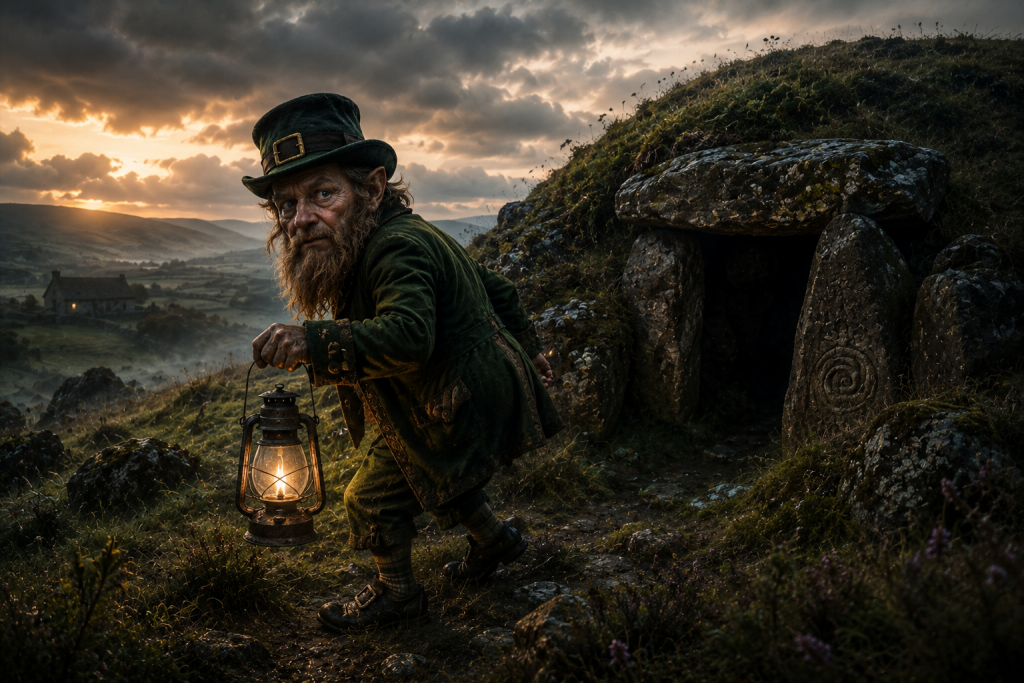
Jack asks the devil for at least something to light his way in the darkness. The devil, in what might be his only recorded act of something approaching generosity, throws Jack a coal from the fires of hell. The coal is burning. It will not go out. It is, in its small way, a piece of hell that Jack carries with him through the cold dark of limbo. He looks around for something to carry it in, finds a turnip he has in his pocket — the legend is not specific about why Jack happens to have a turnip on his person at the moment of his death, but the turnip is there and that is what matters — hollows it out, and puts the coal inside.
He is now Stingy Jack with his lantern, walking the dark roads of Ireland with his turnip-light, and he will do so forever, or until someone explains to the tradition how to end this particular story, which nobody has managed to do because the story does not have an ending. Jack cannot go anywhere that would resolve his situation. He can only walk.
Jack and the Will o’Wisp
The Jack o’Lantern legend serves a specific explanatory function in Irish and broader British folk tradition that is worth understanding because it illuminates why the carved lantern tradition developed the specific form that it did. Jack, wandering the dark roads and bogs with his turnip lantern, is the folk explanation for the will o’wisp, the strange lights seen moving over boggy ground at night that have been observed and puzzled over across the British Isles and continental Europe for as long as people have been walking near bogs at night.
The will o’wisp — called by various names including ignis fatuus, fool’s fire, corpse candle, and many regional variants — is a genuine atmospheric phenomenon. It is most likely produced by the spontaneous combustion of gases released by the decomposition of organic matter in boggy ground, though the specific chemistry of the phenomenon has been debated since at least the seventeenth century. The lights are real, they do appear over bogs and marshes at night, they do move in ways that appear purposeful though they are not, and they do have the specific quality of appearing to lead travellers astray, since someone following what appears to be a light in the distance and turning out to follow a will o’wisp will find themselves progressively further from their intended path.
The Jack o’Lantern legend provides a specific explanation for this phenomenon: the lights are Jack, walking his eternal road with his coal-in-turnip lantern, and the tendency of the lights to lead travellers astray is Jack’s characteristic mischievousness expressing itself in death as it did in life. This explanatory function is important because it means the carving of Halloween lanterns was not simply a decorative practice: it was the creation of objects that represented and in some traditions were understood to either ward against or impersonate the specific supernatural phenomenon that boggy lights represented.
The Turnip Lantern Tradition in Ireland
The carving of turnips at Halloween was a genuine and widely practised Irish folk custom, documented in multiple sources from the eighteenth century onward and maintained in rural Ireland into the twentieth century. The turnips used were large field turnips — swedes in British English, rutabagas in American English — which were hollowed out, carved with grotesque faces, and fitted with a candle or a lump of burning coal. The resulting lantern was hung at the door or window or carried during Halloween night activities.
The function of the carved turnip lantern was dual. It served as a practical light source for the Halloween night activities that required people to be outdoors in the dark: the guising processions, the visits between houses, the communal gatherings. And it served as a protective device, which is the more interesting function and the one that explains why the face carved into the turnip was typically grotesque rather than simply decorative.
The grotesque carved face was understood in the folk tradition as a means of frightening away the supernatural beings that were particularly active at Halloween. At Samhain the boundary between the living world and the otherworld was at its thinnest, and the creatures that could cross that boundary were numerous and not generally benevolent. A carved face fierce enough to frighten a person would, in the logic of sympathetic magic, be fierce enough to frighten a supernatural being, and placing such a face at the door or window of the house created a protective barrier against the night’s supernatural traffic.
This protective function means the turnip lantern was not simply a decoration or a representation of Jack’s light. It was a genuine folk magical object, an active participant in the Halloween protective practices that the community employed to keep itself safe during the most dangerous night of the year. The frightening face was the point. The fiercer the face, the better the protection. This is why carved turnip faces from the Irish tradition look nothing like the cheerful grinning pumpkins of modern American Halloween imagery: they were designed to terrify, not to amuse.
The carving of the turnip was itself a skilled task that required specific knowledge. The flesh of a large turnip is dense and fibrous, and carving a detailed face without tools designed for the purpose was labour intensive and required practice. The tools used were typically kitchen knives and metal skewers, and the process took considerably longer than carving a pumpkin. The skill required meant that turnip carving was typically done by the adults of the household rather than by children, which is the reverse of the modern pumpkin-carving tradition.
Scotland and Wales: Regional Variants
The turnip lantern tradition was not exclusively Irish. Scotland had its own version, called the tumshie lantern in Scots, made from a neep — the Scottish word for turnip or swede — and serving similar functions to the Irish version. The Scottish turnip lantern tradition was extensively documented in the late nineteenth century and was associated specifically with the guising custom: guisers carried their tumshie lanterns with them as they went from house to house, using them both for light and as props in the Halloween performance.
In Wales the tradition of the lantern at Halloween took a slightly different form. The Jack o’Lantern figure in Welsh folk tradition was associated not with a dead man’s coal but with a spirit called the corpse candle, the canwyll corff, a supernatural light that appeared near houses where death was imminent. The Welsh corpse candle tradition and the Irish Jack o’Lantern tradition share the same underlying folk belief about supernatural lights as omens of death, expressed in different narrative forms in different Celtic cultures.
The consistency of the carved lantern tradition across Ireland, Scotland, and Wales — three separate Celtic cultures with distinct languages and distinct folk traditions — suggests that the practice has roots deep enough in the shared Celtic substrate to predate the specific national traditions that preserved it. The carved lantern at the door on the night when the dead return is a concept old enough and widespread enough to have generated independent expressions in multiple Celtic cultures.
The Pumpkin: America and the Great Substitution
The Irish and Scottish emigrants who arrived in North America in their hundreds of thousands during the nineteenth century, particularly during and after the Great Famine, brought their Halloween traditions with them including the carved lantern practice. What they did not bring with them was a reliable supply of the large field turnips that the tradition required, since field turnips were not widely grown in North America in the areas of heaviest Irish settlement.
What North America did have, in enormous quantities and in exactly the right season, was pumpkins. The pumpkin, Cucurbita pepo, is native to North America and had been cultivated by Indigenous peoples for thousands of years before European settlement. By the nineteenth century it was widely grown across the eastern states, it ripened in October, and it was considerably larger and softer than a turnip, making it dramatically easier to carve. The substitution was practical, rapid, and permanent.
The carved pumpkin lantern appears in American sources from at least the 1830s, and by the latter half of the nineteenth century it was already becoming associated with Halloween in American popular culture. The Washington Irving story of the Headless Horseman of Sleepy Hollow, published in 1820, features a pumpkin as the missile that the Horseman throws at Ichabod Crane, associating the pumpkin with Halloween supernatural activity even before the carved lantern tradition had fully established itself. By the late nineteenth century the carved pumpkin Jack o’Lantern was a distinctive American Halloween symbol, and by the early twentieth century it had displaced the carved turnip in Irish-American communities as thoroughly as the American community itself had displaced the immigrant identity.
The pumpkin’s orange colour was an accidental gift to the Halloween aesthetic. The Irish turnip, which was typically yellow or white inside, did not have the vivid colour that made the pumpkin so visually striking when lit from inside. The combination of the orange exterior, the orange interior lit by a candle, and the carved face produced a visual effect that the turnip could not match, and the commercial imagery of Halloween that developed in the late nineteenth and early twentieth centuries built its colour scheme — orange and black — primarily around the carved pumpkin rather than any other element of the tradition.
The Modern Pumpkin Carving Tradition
The carved pumpkin Jack o’Lantern is now so dominant globally that the turnip original has become an obscurity in most places, known primarily as a historical curiosity rather than as a living tradition. In Ireland and Scotland there has been a modest revival of interest in the turnip lantern in recent decades, driven partly by academic interest in the genuine tradition and partly by a cultural assertion of the indigenous Halloween against the American commercial import. Irish supermarkets sell large turnips specifically for Halloween carving in the weeks before the 31st of October, marketed explicitly as the original Jack o’Lantern in a form of heritage consciousness that would have puzzled the communities that maintained the tradition without thinking of it as heritage.
The pumpkin carving industry that has grown up around the modern Halloween is substantial. Approximately one billion dollars worth of pumpkins are sold in the United States annually, the overwhelming majority of them in the weeks before Halloween and the overwhelming majority of those for carving rather than eating. Pumpkin carving has become a skill with its own competitive community, its own tools designed specifically for the purpose, and its own aesthetic conventions that have largely lost any connection to the protective function that motivated the original carved turnip faces.
The modern carved pumpkin face is typically grinning rather than grotesque, friendly rather than frightening, and designed to amuse rather than to ward off supernatural danger. This is the final step in a transformation that began with the substitution of pumpkin for turnip: the loss of the protective function turned the Jack o’Lantern from a folk magical object into a decoration, and the decoration evolved according to its own aesthetic logic rather than according to the folk magical principles that had originally determined what the face should look like.
Jack himself, wandering the dark with his coal in his turnip, is considerably less cheerful than the grinning pumpkins that bear his name. The tradition that produced the Jack o’Lantern was not primarily about festivity. It was about the specific danger of Halloween night, the need to protect the household against that danger, and the irony of using a condemned soul’s light source as the model for the protective device. The Jack o’Lantern wards away the supernatural because it represents someone already claimed by the supernatural — or rather, claimed by neither the supernatural nor the divine, which is a worse condition than either. The light in the window is the light of limbo, and it keeps the dark things away because even they would rather not look at what permanent displacement from every possible belonging actually looks like.
Further Reading
If this article sparked your interest, these are the books worth reading next.
Halloween: From Pagan Ritual to Party Night
by Nicholas Rogers — the best single-volume history of Halloween, tracing it from its Celtic and medieval roots through to its commercialisation as a global holiday. Properly researched and clearly written.
Trick or Treat: A History of Halloween
by Lisa Morton — a thorough and highly readable history of Halloween’s customs and traditions, from souling and guising to the modern American commercial holiday.
The Halloween Encyclopedia
by Lisa Morton — the most comprehensive reference on Halloween in print, covering every aspect of the holiday’s history, folklore, customs, and cultural expressions in detail.
For more on the Halloween tradition, the Origins of Samhain article covers the Celtic festival at the root of Halloween and the supernatural dangers that made the protective lantern necessary. The Witches and Halloween article covers the real history of witch belief and its connection to the season. The History of Trick or Treat article covers the medieval and folk roots of the other great Halloween custom. The Halloween hub page has every article in the cluster.
Never miss a myth
Thank you for being here. The site is brand new and every subscriber genuinely means something to me. If you're here, you care about this stuff as much as I do - and that's all the reason I need to keep going. New stories, videos and dark folklore from around the world, straight to your inbox. No algorithm. Just the stories, when they're ready.