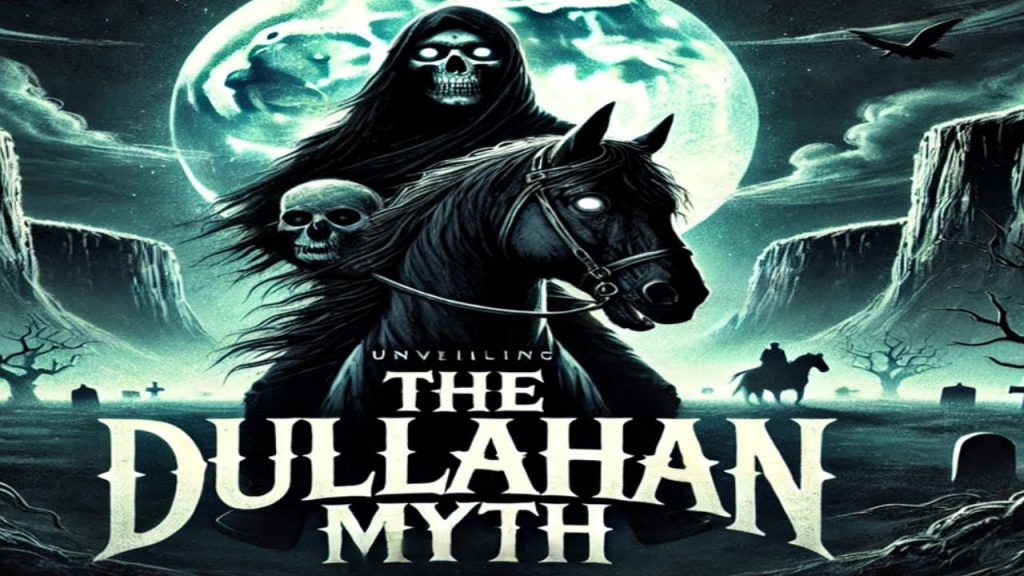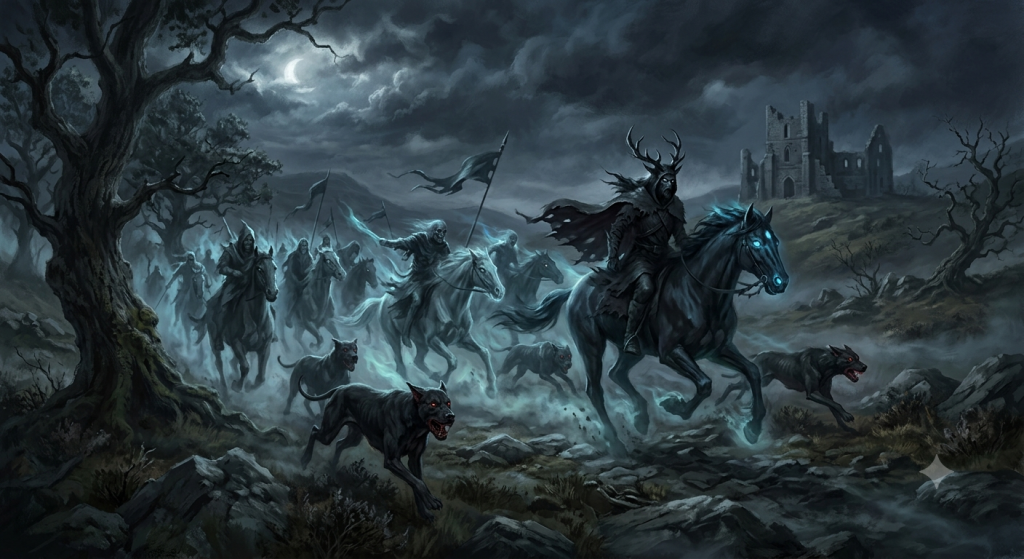
The Wild Hunt is one of the most widely distributed supernatural traditions in European folklore, a nocturnal procession of the dead led by a powerful supernatural figure that rides through the winter sky bringing storm, death, and the reminder that the boundary between the living and the dead is less solid than the living would like to believe. It appears in Norse, Germanic, English, Irish, Scottish, Welsh, and French traditions under different names and with different leaders, but its core character is consistent: a host of the dead riding through darkness, and the living advised to stay indoors and let them pass.
The Hunt’s connection to Halloween is both ancient and logical. Samhain was the night when the boundary between the living world and the dead world was understood to be at its thinnest, when the dead could return and the supernatural could move through the living landscape with unusual freedom. The Wild Hunt, which is precisely the supernatural moving through the landscape at night, naturally clusters around this thinning of the boundary. Halloween is the night when the Hunt is most likely to be abroad, and the Hunt is the most dramatically terrible form that the Halloween supernatural threat takes.
The Irish Tradition: The Sluagh
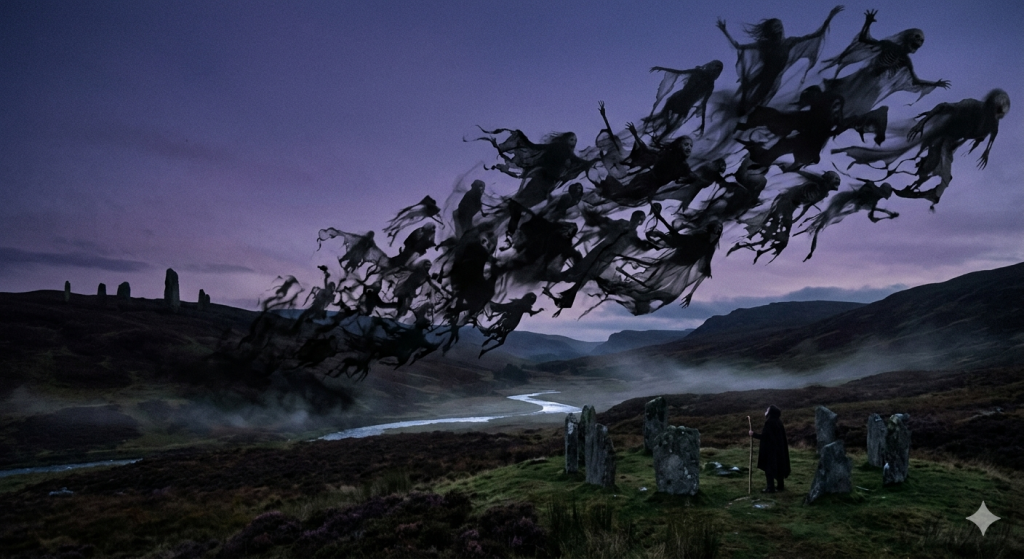
In Irish tradition the equivalent of the Wild Hunt is the Sluagh, the host of the unforgiven dead, souls of people who died in a state of sin and were refused by both heaven and hell, who ride through the night on the western wind seeking living souls to take with them. They fly in formation like starlings, darkening the sky, and they enter houses through the western window to take the dying before death has fully claimed them.
The Sluagh is specifically associated with Halloween in Irish tradition because Samhain was the night when the dead were most active and the barriers against them were weakest. Protective measures against the Sluagh included keeping the western windows of the house closed on Halloween night and avoiding going out alone after dark when the host was riding.
The Scottish Tradition: The Riding of the Fairy Host
In Scottish tradition the Halloween supernatural host takes the form of the fairy riding, the procession of the fairy folk who move from one hill to another on the great seasonal quarter days. Halloween was one of the four nights when the fairy mounds stood open and the fairy host rode between them, and humans who were caught outdoors during the riding could be taken away with the host, carried off to the fairy world and not returned, or returned changed in ways that made them no longer fully human.
Thomas the Rhymer, the Scottish prophet whose legend is tied to his encounter with the Queen of Elfhame, was taken by the fairy host on a day associated with one of these seasonal ridings. The fairy host as it appears in Scottish tradition shares the Wild Hunt’s quality of danger-by-proximity: you do not have to challenge it or engage with it to be harmed by it. Simply being in its path is sufficient.
Woden’s Hunt and the Halloween Connection
The Germanic Wild Hunt led by Woden or Wotan rides specifically through the twelve days of Christmas in the German tradition, but in English and Scandinavian traditions the Hunt is associated with a broader winter period that begins at Halloween and ends at Candlemas. The thinning of the boundary at Halloween that Samhain encoded in the Celtic tradition has an equivalent in the Germanic tradition in the understanding that winter generally, and its beginning specifically, is the time when the dead are most active and the Hunt most dangerous.
The conflation of Celtic Halloween and Germanic Wild Hunt traditions in the English folk tradition, where both streams of belief were present and interacting from the early medieval period, produced a Halloween characterised by both the Irish Sluagh tradition and the Woden’s Hunt tradition, giving English Halloween its particularly dense supernatural atmosphere.
Further Reading
If this article sparked your interest, these are the books worth reading next.
Halloween: From Pagan Ritual to Party Night
by Nicholas Rogers — the best single-volume history of Halloween, tracing it from its Celtic and medieval roots through to its commercialisation as a global holiday. Properly researched and clearly written.
Trick or Treat: A History of Halloween
by Lisa Morton — a thorough and highly readable history of Halloween’s customs and traditions, from souling and guising to the modern American commercial holiday.
The Halloween Encyclopedia
by Lisa Morton — the most comprehensive reference on Halloween in print, covering every aspect of the holiday’s history, folklore, customs, and cultural expressions in detail.
For more on the seasonal folklore tradition, the Origins of Samhain article covers the Celtic festival at the root of Halloween. The Wild Hunt Germany article covers the Germanic tradition in depth. The Sluagh article covers the Irish host of the dead. The Halloween hub page has every article in the cluster.
Never miss a myth
Thank you for being here. The site is brand new and every subscriber genuinely means something to me. If you're here, you care about this stuff as much as I do - and that's all the reason I need to keep going. New stories, videos and dark folklore from around the world, straight to your inbox. No algorithm. Just the stories, when they're ready.