In the spring of 1662, in the parish of Auldearn in the Scottish Highlands, a woman walked into a church and began to speak. Nobody had accused her. Nobody had arrested her. Nobody had applied the instruments of persuasion that extracted confessions from so many of her contemporaries. Isobel Gowdie simply began to talk, and what came out of her mouth over the course of four separate confessions was unlike anything recorded before or since in the long and brutal history of Scottish witch trials.
She described meetings with the Devil in vivid, specific detail. She named the members of her coven. She explained how to make a charm that would kill a man’s cattle, how to fly, how to transform into a hare, and how to steal the harvest from a neighbour’s field and transfer it to your own. She gave the names the fairies had told her to use. She described walking into the homes of sleeping families and shooting elf-bolts into their bodies.
She was articulate, detailed, and apparently entirely calm. And then, when she had finished, she was tried, convicted, and almost certainly executed, though the records of her death have not survived.
What Isobel Gowdie said in those four confessions has fascinated historians, folklorists, and scholars of witchcraft for centuries. Whether she believed every word of it, whether some of it was real within the folk belief of her time, and whether any of it points toward something older than Christianity itself, are questions that have never been fully resolved.
Who Was Isobel Gowdie?
Almost nothing is known about Isobel Gowdie before April 1662. She was a married woman living in Auldearn, a small settlement near Nairn in what is now the Highland region of Scotland. Her husband was a man named John Gilbert, described in the records as a husbandman, meaning a tenant farmer. Beyond this, the historical record is silent until the moment she began to confess.
The confession was recorded by the local minister and notary, and it survives in remarkable detail across four separate sessions given on 13 April, 3 May, 15 May, and 27 May 1662. The level of internal consistency across these sessions, the way details from one confession are elaborated in another, the names and places that remain stable, has led many scholars to conclude that Isobel was not simply making things up as she went. Whether she was recounting genuine experiences, shared folk beliefs, dreams, or something else entirely is another matter.
The Devil at Auldearn Church
Isobel’s account of her initiation into witchcraft is one of the most detailed in Scottish legal history. She described meeting the Devil in the church of Auldearn itself, which carried a specific blasphemous charge in a deeply Presbyterian culture. He appeared to her, she said, as a man in grey, and she renounced her baptism and gave herself to him, receiving a new name: Janet.
He marked her by sucking blood from her shoulder, leaving a mark that was both a seal of the pact and, in the legal framework of the time, potential evidence. Witch prickers, men employed to find the Devil’s mark on accused witches, operated on the principle that such a mark would be insensible to pain. The mark Isobel described was consistent with what courts expected to find.
She described the Devil as cold, and his seed as cold within her. This detail, the coldness of the Devil in physical contact, appears across multiple Scottish witch confessions of the period and has been interpreted in various ways, from evidence of shared cultural scripting to possible physiological explanations involving fear or cold environments in which encounters supposedly took place.
The Coven of Auldearn
Isobel named her coven with a specificity that caused immediate legal consequences for others. She described thirteen members, herself and twelve others, organised under the Devil’s direction into a functioning group with assigned roles and regular meetings.
The coven had an officer called the Maiden of the Coven, a position Isobel described in some detail. Members had spirit familiars assigned to them by the Devil, each with its own name. Isobel’s own familiar was called the Red Reiver. She described the familiars appearing as small animals or sprites, ready to do the bidding of their assigned witch.
The coven met regularly, she said, both for sabbath gatherings and for more specific operations. They met with the Devil in person. He preached to them. They danced, always turning against the direction of the sun, which was itself a marker of transgression in Scottish folk belief. They feasted.
The naming of coven members in such detail was legally devastating. Several of the people Isobel named were arrested and tried. Whether they were genuine associates in folk magic practice, neighbours she had reason to distrust, or simply people whose names came to her in the confessional moment, cannot now be determined.
Flying, Hares, and the Shape of Folk Magic
The sections of Isobel’s confession dealing with transformation and flight are among the most vivid and folklorically rich in the entire document. They read less like legal testimony and more like an account drawn from a living tradition of folk belief.
To fly, Isobel said, the witches used besoms, straws, bean stalks, or rushes, calling out specific words as they mounted them. The incantation she provided was recorded phonetically by the notary:
“Horse and Hattock, Horse and go, Horse and Pellatis, Ho Ho”
These words, or variations of them, appear in other Scottish witchcraft accounts, suggesting they were part of a shared oral tradition rather than individual invention.
Transformation was equally specific. To become a hare, Isobel gave an incantation and described the physical sensation of the change. To return to human form, she gave a different set of words. The hare transformation in particular connects to a deep stratum of Scottish and Irish folk belief in which witches and supernatural women took hare form. Stories of milk-stealing hares, shot by suspicious farmers who later find a wounded woman in the village, span centuries and geography. Isobel’s account places her inside this tradition with apparent familiarity.
She also described taking the form of a crow and a cat. The specificity of the words used for each transformation, the different incantations, the different return phrases, suggests either a genuine mnemonic tradition being reported or an extraordinarily detailed act of composition.
The Fairy Hills of Auldearn
One of the most remarkable and debated sections of Isobel’s confession concerns the fairies. She described entering the fairy hills, the sithean, and meeting with the Queen of Fairy, who gave her more elf-bolts to use against the living.
This connection between witchcraft and fairy belief is not unique to Isobel, but she elaborates it with unusual clarity. The elf-bolts, small flint arrowheads understood in folk tradition as fairy weapons, were used to shoot people and cattle. Victims struck by them would sicken and die. Isobel described the Devil trimming the bolts and the witches shaping them, the Devil teaching them to shoot.
The intersection here between diabolical witchcraft as the Church understood it and the older, pre-Christian fairy tradition of the Scottish Highlands is exactly the kind of detail that has made Isobel’s confession so important to scholars. The scholar Emma Wilby, in her extensive analysis of the confessions, argues that Isobel’s accounts of fairy contacts and spirit familiars may reflect genuine shamanistic practices surviving within Scottish folk culture, a tradition far older than Christianity in which certain individuals acted as intermediaries between the human world and the spirit world.
This does not mean the events happened as described. It means the framework Isobel was using to describe her experiences may have been drawn from a real and functioning belief system rather than invented from scratch or extracted by coercion.
If you want more like this, the Tales of Myth and Magic newsletter delivers new creatures, legends, and forgotten folklore straight to your inbox.
No fixed schedule. No noise. Just the stories, when they are ready.
Sign up here →Charms, Curses, and the Elf-Arrow
Beyond the dramatic elements of sabbath and transformation, Isobel’s confessions contain a wealth of practical folk magic that reads like a genuinely observed tradition.
She described how to take the profit of a neighbour’s land and transfer it to your own, a concern that speaks directly to the anxieties of tenant farming communities where a good harvest meant survival and a bad one meant ruin. She gave the words of charms for different purposes. She described the making of a clay image, a corp creadha, which would be passed between coven members and used to harm an enemy by progressive destruction of the clay figure.
The corp creadha described by Isobel was being used against the family of the local laird, the Hay family of Park. This gave the confession a specific, local political dimension. Whether it reflected a genuine grievance, a real practice, or simply a detail the interrogators were interested in is impossible to say.
The elf-bolt tradition Isobel described connects to genuine archaeological objects. Neolithic flint arrowheads were found regularly in Scottish fields, left by peoples millennia dead, and in folk belief they were understood as fairy weapons. Cunning folk and witches were said to collect and use them. Isobel’s detailed account of their preparation and use places her within a tradition that had a real material component.
Why Did She Confess?
This is the question that has occupied everyone who has encountered Isobel Gowdie’s confessions. She was not, as far as the records show, tortured before she began to speak. She was not accused by a neighbour and forced to defend herself. She initiated the confession herself, apparently voluntarily, and returned four times to elaborate and extend it.
Explanations have ranged across a wide spectrum. Some historians have suggested that Isobel was mentally ill and that the confessions reflect a delusional belief system. Others have argued that she was a genuine practitioner of folk magic who chose to speak openly about practices she had long kept private, perhaps driven by a desire for notoriety, or by a genuine belief that what she was describing was true and important.
The scholar Julian Goodare has noted that the confessions are structurally consistent with what courts of the period expected to hear, suggesting that Isobel may have been drawing on a shared cultural script for what a witch was and did, filling in the expected categories with local detail. Others, including Wilby, argue that the confessions contain too much genuinely unusual material to be explained purely as performance for an audience.
There is also the possibility, which should not be dismissed, that Isobel was simply tired. Tired of her life, tired of her marriage, tired of the grinding existence of a tenant farmer’s wife in seventeenth century Scotland, and that the confessions were a way out. A terrible way out, ending almost certainly in execution, but a way out nonetheless. A moment of being heard, of being the most important person in the room, of having every word written down.
A Voice That Would Not Be Silenced
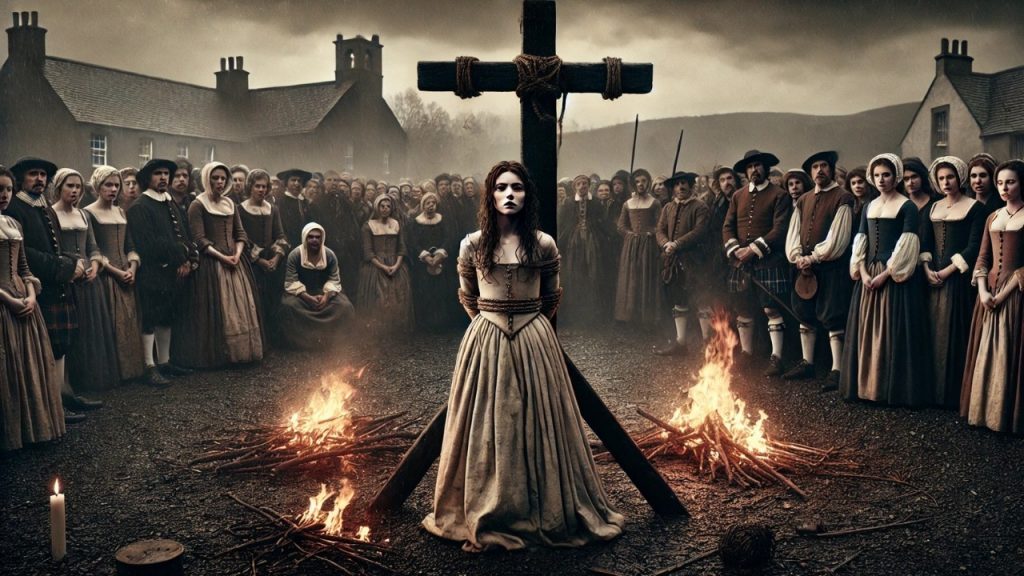
Isobel Gowdie was tried and convicted. The records of her execution do not survive, but given the legal outcome and the practices of the period, it is almost certain that she was strangled and burned at the stake, the standard method of execution for convicted witches in Scotland.
Her confessions survived in the legal records and were rediscovered and published in the nineteenth century, when they attracted immediate attention from folklorists and scholars of witchcraft. They have not stopped attracting attention since.
The composer James MacMillan wrote a major orchestral work inspired by her, The Confession of Isobel Gowdie, premiered in 1990 and now considered one of the significant Scottish classical works of the twentieth century. Folklorists have cited her in studies of fairy belief, shamanism, and the cunning folk tradition. Historians of witchcraft return to her again and again as a document unlike any other in the Scottish record.
What Isobel Gowdie said in that church in Auldearn in the spring of 1662 has outlasted everything else about her life. It has outlasted the people she named, the laird whose family she cursed, the minister who wrote her words down. It has outlasted the very building in which she first spoke.
She walked into a church and began to talk, and more than three and a half centuries later, people are still listening.
Further Reading
If this article sparked your interest, these are the books worth reading next.
Scottish Urban Legends: 50 Myths and True Stories
by Aaron Mullins — fifty Scottish urban legends including stories from Glasgow, Edinburgh, and the Highlands. The kind of tradition that Maggie Murphy belongs to, collected properly in one volume.
Scottish Urban Myths and Ancient Legends
by Grace Banks and Sheena Blackhall — vampires, werewolves, devil encounters, and the school playground legends of Scotland. A genuinely good collection of the stories Scots have been telling each other for generations.
The Lore of Scotland: A Guide to Scottish Legends
by Jennifer Westwood and Sophia Kingshill — the most comprehensive collection of Scottish legend in print, covering Glasgow to Shetland, exploring origins and historical basis. Endorsed by Terry Pratchett as the real macabre.
Never miss a myth
Thank you for being here. The site is brand new and every subscriber genuinely means something to me. If you're here, you care about this stuff as much as I do - and that's all the reason I need to keep going. New stories, videos and dark folklore from around the world, straight to your inbox. No algorithm. Just the stories, when they're ready.