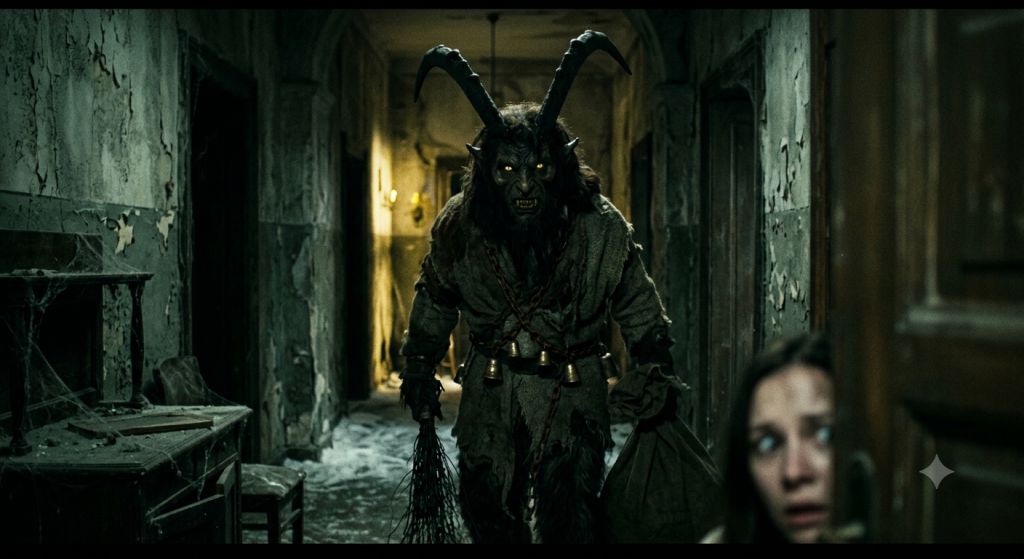
The Tomte is the household and farm spirit of Scandinavian tradition, a small supernatural being who has inhabited the farmstead since its founding and whose wellbeing is directly connected to the wellbeing of the farm and the family. He protects the animals, watches over the buildings, warns of approaching danger, and ensures the general prosperity of the household — as long as the household maintains its obligations to him. The obligations are specific: a bowl of porridge with butter on Christmas Eve, respectful acknowledgement, and the maintenance of the farm’s routines and traditions. Fail in these, and the Tomte’s protection becomes something else entirely.
The Tomte is known under different names across the Scandinavian countries: Nisse in Denmark and Norway, Tomte or Tomtenisse in Sweden, Tonttu in Finland. The regional variants share the same basic character — small, elderly in appearance, wearing a grey or red pointed cap, fiercely protective of the farm and the family, and capable of extraordinary violence when disrespected. He is one of the most deeply embedded supernatural figures in Scandinavian folk tradition, present in the culture for centuries before the Christmas gift-giving tradition attached itself to him.
The Christmas Connection
The Tomte’s connection to Christmas is ancient in Scandinavian tradition. The Christmas porridge left for him on Christmas Eve is one of the most widely documented folk customs in Scandinavia, a ritual obligation that frames the entire Christmas celebration as partly a matter of maintaining the relationship with the farm’s supernatural guardian. The family cannot simply celebrate Christmas for themselves. They must first take care of the Tomte.
The bowl of porridge must have butter in the centre. In the folk tradition, a Tomte who received his porridge without the butter — because someone had eaten it as a prank, or forgotten, or been stingy — would exact revenge on the farm’s animals, sometimes killing the best cow before realising what he had done, then repenting and replacing it. The story of the Tomte who killed the cow for the missing butter and then replaced it is one of the most widely told in the Scandinavian tradition, and it encodes the precise and somewhat terrifying reciprocity of the relationship: the Tomte gives everything, and he requires everything that is owed to him.
The Tomte as Santa’s Ancestor
The modern Scandinavian version of Santa Claus is called Julenisse in Denmark and Norway and Jultomte in Sweden, and the figure is explicitly the farm’s Tomte expanded into a Christmas gift-giver. The pointed red cap that is the Tomte’s most distinctive visual feature became the cap of the Scandinavian Christmas figure and eventually, through the complex cultural exchange that produced the modern Santa Claus, contributed to the image of Santa’s helpers and elves in the Anglo-American tradition.
The Tomte-as-gift-giver is a nineteenth century development, driven partly by the influence of the broader European Christmas gift-giving tradition and partly by the commercial Christmas card and illustration culture that standardised Christmas imagery across Europe. The original Tomte was not a gift-giver but a guardian and a judge, and his transformation into a benevolent figure who distributes presents represents the same softening of a genuinely fierce folk figure that the Yule Lads, Krampus, and Perchta have all undergone in their modern versions.
The Tomte’s Character
Beyond the Christmas porridge obligation, the Tomte’s character in the tradition is that of an absolute loyalist who identifies completely with the farm and the family he protects. He has been there since the farm was founded, sometimes understood as the spirit of the founding ancestor who built the first buildings on the land. He will fight any supernatural threat to the farm. He will work through the night completing tasks that the family has left unfinished. He will warn the family of approaching danger.
But he has no patience for disrespect, no tolerance for changes to the farm’s routines that he has not approved, and no forgiveness for failures of the ritual obligations that maintain the relationship. The Tomte who is treated well is the farm’s greatest asset. The Tomte who is treated badly is the farm’s most dangerous enemy, and the Tomte cannot be expelled — he leaves when he chooses to and the farm declines when he goes.
Further Reading
If this article sparked your interest, these are the books worth reading next.
The Dark Side of Christmas
The dark figures, the threatening traditions, and the midwinter beliefs that the commercial Christmas has largely erased. Essential reading for anyone who wants to understand what the season actually was before it became what it is now.
Krampus: The Devil of Christmas
by Monte Beauchamp — a visually extraordinary collection of vintage Krampus greeting cards with historical context. The best introduction to the Krampus tradition’s visual culture.
The Battle for Christmas
by Stephen Nissenbaum — a genuinely excellent history of how Christmas became what it is, from its contested early modern origins through the Victorian reinvention that produced the holiday we now celebrate.
For more on the Christmas folklore tradition, the Grýla article covers the Icelandic giantess whose family represents the threatening dimension of the Scandinavian Christmas tradition. The Real Saint Nicholas article covers the historical figure whose legend the Tomte became attached to. The Christmas hub page has every article in the cluster.
Never miss a myth
Thank you for being here. The site is brand new and every subscriber genuinely means something to me. If you're here, you care about this stuff as much as I do - and that's all the reason I need to keep going. New stories, videos and dark folklore from around the world, straight to your inbox. No algorithm. Just the stories, when they're ready.